## Line Charts: Success Rate vs. Number of Actions
### Overview
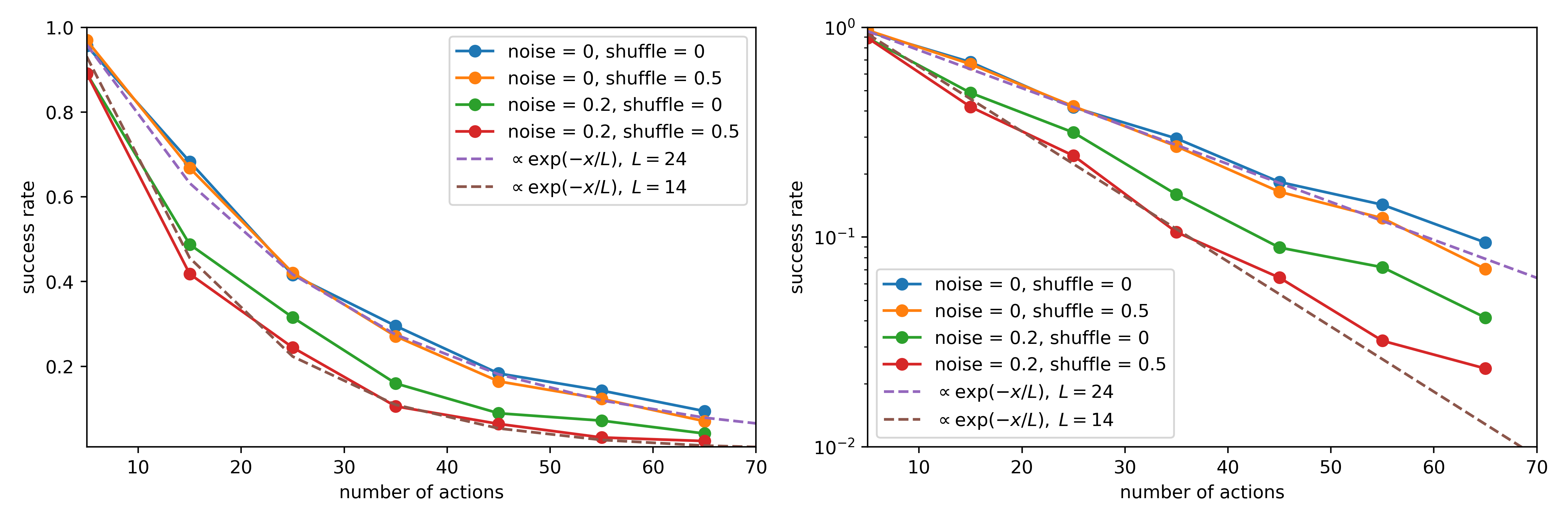
The image contains two line charts comparing the success rate against the number of actions under different noise and shuffle conditions. The left chart uses a linear scale for the y-axis (success rate), while the right chart uses a logarithmic scale. Both charts share the same x-axis (number of actions). The charts show how success rate decreases as the number of actions increases, with variations based on noise levels and shuffling.
### Components/Axes
**Left Chart:**
* **Title:** Implicitly, "Success Rate vs. Number of Actions (Linear Scale)"
* **X-axis:** "number of actions", ranging from 0 to 70 in increments of 10.
* **Y-axis:** "success rate", ranging from 0.0 to 1.0 in increments of 0.2.
* **Legend:** Located in the top-right corner.
* Blue line: "noise = 0, shuffle = 0"
* Orange line: "noise = 0, shuffle = 0.5"
* Green line: "noise = 0.2, shuffle = 0"
* Red line: "noise = 0.2, shuffle = 0.5"
* Dashed purple line: "∝ exp(-x/L), L = 24"
* Dashed brown line: "∝ exp(-x/L), L = 14"
**Right Chart:**
* **Title:** Implicitly, "Success Rate vs. Number of Actions (Logarithmic Scale)"
* **X-axis:** "number of actions", ranging from 0 to 70 in increments of 10.
* **Y-axis:** "success rate", logarithmic scale ranging from 10^-2 to 10^0 (0.01 to 1.0).
* **Legend:** Located in the bottom-right corner, identical to the left chart.
* Blue line: "noise = 0, shuffle = 0"
* Orange line: "noise = 0, shuffle = 0.5"
* Green line: "noise = 0.2, shuffle = 0"
* Red line: "noise = 0.2, shuffle = 0.5"
* Dashed purple line: "∝ exp(-x/L), L = 24"
* Dashed brown line: "∝ exp(-x/L), L = 14"
### Detailed Analysis
**Left Chart (Linear Scale):**
* **noise = 0, shuffle = 0 (Blue):** Starts at approximately 0.98 and decreases to about 0.18.
* **noise = 0, shuffle = 0.5 (Orange):** Starts at approximately 0.95 and decreases to about 0.15.
* **noise = 0.2, shuffle = 0 (Green):** Starts at approximately 0.88 and decreases to about 0.08.
* **noise = 0.2, shuffle = 0.5 (Red):** Starts at approximately 0.42 and decreases to about 0.03.
* **∝ exp(-x/L), L = 24 (Purple Dashed):** Starts at approximately 0.95 and decreases to about 0.10.
* **∝ exp(-x/L), L = 14 (Brown Dashed):** Starts at approximately 0.88 and decreases to about 0.01.
**Right Chart (Logarithmic Scale):**
* **noise = 0, shuffle = 0 (Blue):** Starts at approximately 0.98 and decreases to about 0.10.
* **noise = 0, shuffle = 0.5 (Orange):** Starts at approximately 0.95 and decreases to about 0.08.
* **noise = 0.2, shuffle = 0 (Green):** Starts at approximately 0.88 and decreases to about 0.04.
* **noise = 0.2, shuffle = 0.5 (Red):** Starts at approximately 0.42 and decreases to about 0.02.
* **∝ exp(-x/L), L = 24 (Purple Dashed):** Starts at approximately 0.95 and decreases to about 0.04.
* **∝ exp(-x/L), L = 14 (Brown Dashed):** Starts at approximately 0.88 and decreases to about 0.01.
### Key Observations
* All success rates decrease as the number of actions increases.
* Higher noise levels (0.2 vs. 0) generally lead to lower success rates.
* Shuffling (0.5 vs. 0) also tends to decrease success rates, but the effect is less pronounced than the noise level.
* The exponential decay curves (∝ exp(-x/L)) provide a baseline for comparison. The curve with L=14 decays faster than the curve with L=24.
* The logarithmic scale in the right chart emphasizes the differences in success rates at lower values.
### Interpretation
The charts illustrate the impact of noise and shuffling on the success rate of a process as the number of actions increases. The data suggests that both noise and shuffling negatively affect performance, with noise having a more significant impact. The exponential decay curves provide a theoretical model for the decrease in success rate, and the empirical data appears to follow this trend. The logarithmic scale highlights the differences in performance at lower success rates, which may be important in certain applications. The charts demonstrate that controlling noise and minimizing shuffling are crucial for maintaining high success rates in systems with a large number of actions.