## Workflow Diagram: Lean 4 Formalization Process
### Overview
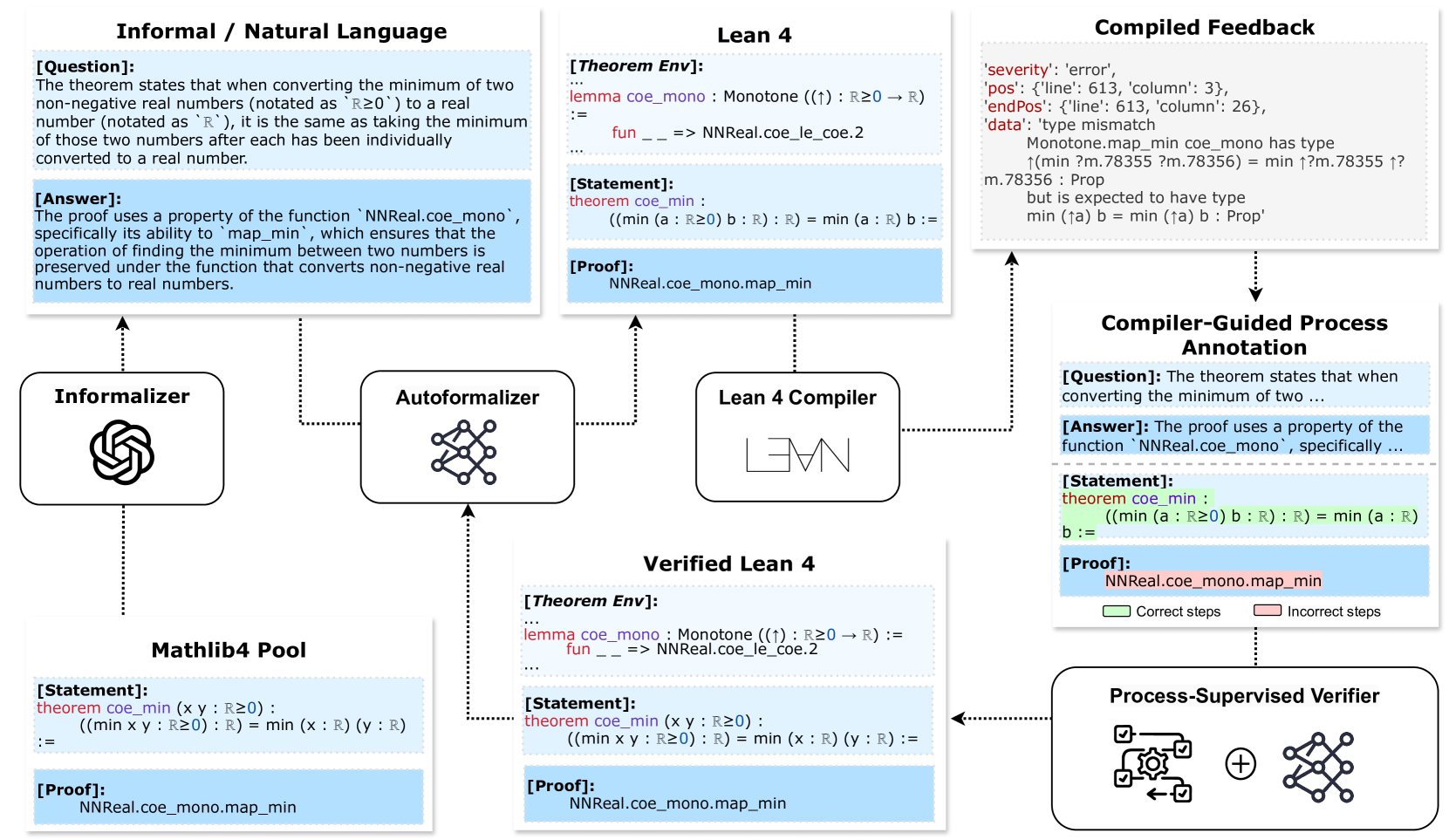
The image presents a workflow diagram illustrating the process of formalizing mathematical statements using Lean 4, a theorem prover. The diagram outlines the steps from informal language input to verified Lean 4 code, incorporating compiler feedback and process supervision.
### Components/Axes
The diagram consists of several key components:
1. **Informal / Natural Language**: Represents the initial input, a mathematical statement expressed in natural language.
2. **Informalizer**: A component that processes the informal language input.
3. **Autoformalizer**: A component that automatically formalizes the input.
4. **Mathlib4 Pool**: A repository of mathematical definitions and theorems.
5. **Lean 4**: The Lean 4 theorem prover environment.
6. **Lean 4 Compiler**: The compiler for the Lean 4 language.
7. **Compiled Feedback**: Feedback generated by the Lean 4 compiler.
8. **Compiler-Guided Process Annotation**: Annotations provided to guide the formalization process.
9. **Verified Lean 4**: The final output, a verified Lean 4 code.
10. **Process-Supervised Verifier**: A component that supervises the formalization process.
11. **Legend**: Located in the bottom-right, indicating "Correct steps" (green) and "Incorrect steps" (red).
### Detailed Analysis or ### Content Details
**1. Informal / Natural Language (Top-Left)**
* **[Question]:** The theorem states that when converting the minimum of two non-negative real numbers (notated as 'R≥0') to a real number (notated as 'R'), it is the same as taking the minimum of those two numbers after each has been individually converted to a real number.
* **[Answer]:** The proof uses a property of the function 'NNReal.coe\_mono', specifically its ability to `map_min`, which ensures that the operation of finding the minimum between two numbers is preserved under the function that converts non-negative real numbers to real numbers.
**2. Informalizer (Bottom-Left)**
* An icon representing the Informalizer.
**3. Autoformalizer (Bottom-Center)**
* An icon representing the Autoformalizer.
**4. Mathlib4 Pool (Bottom-Left)**
* **[Statement]:** theorem coe\_min (x y: R≥0) : ((min x y: R≥0): R) = min (x: R) (y: R) :=
* **[Proof]:** NNReal.coe\_mono.map\_min
**5. Lean 4 (Top-Center)**
* **[Theorem Env]:** lemma coe\_mono : Monotone ((↑): R≥0 → R) := fun \_ => NNReal.coe\_le\_coe.2
* **[Statement]:** theorem coe\_min : ((min (a: R≥0) b: R): R) = min (a: R) b:=
* **[Proof]:** NNReal.coe\_mono.map\_min
**6. Lean 4 Compiler (Center)**
* The Lean 4 logo.
**7. Compiled Feedback (Top-Right)**
* 'severity': 'error',
* 'pos': {'line': 613, 'column': 3},
* 'endPos': {'line': 613, 'column': 26},
* 'data': 'type mismatch Monotone.map\_min coe\_mono has type ↑(min ?m.78355 ?m.78356) = min ↑?m.78355 ↑?m.78356 : Prop but is expected to have type min (↑a) b = min (↑a) b : Prop'
**8. Compiler-Guided Process Annotation (Center-Right)**
* **[Question]:** The theorem states that when converting the minimum of two ...
* **[Answer]:** The proof uses a property of the function `NNReal.coe_mono`, specifically ...
* **[Statement]:** theorem coe\_min : ((min (a: R≥0) b: R): R) = min (a: R) b :=
* **[Proof]:** NNReal.coe\_mono.map\_min
* Legend: Correct steps (green), Incorrect steps (red)
**9. Verified Lean 4 (Bottom-Center)**
* **[Theorem Env]:** lemma coe\_mono : Monotone ((↑): R≥0 → R) := fun \_ => NNReal.coe\_le\_coe.2
* **[Statement]:** theorem coe\_min (x y: R≥0) : ((min x y: R≥0): R) = min (x: R) (y: R) :=
* **[Proof]:** NNReal.coe\_mono.map\_min
**10. Process-Supervised Verifier (Bottom-Right)**
* An icon representing the Process-Supervised Verifier, containing a gear and a neural network symbol connected by a plus sign.
### Key Observations
* The diagram illustrates a cyclical process where informal language is formalized, compiled, and verified.
* Compiler feedback and process annotations are used to guide the formalization process.
* The Mathlib4 Pool serves as a resource for mathematical definitions and theorems.
### Interpretation
The diagram depicts an automated or semi-automated workflow for formalizing mathematical statements using Lean 4. The process starts with an informal statement, which is then processed by the Informalizer and Autoformalizer. The Lean 4 compiler checks the formalized code, providing feedback that guides the process. The Compiler-Guided Process Annotation component uses this feedback to refine the formalization. The Process-Supervised Verifier oversees the entire process, ensuring that the final verified Lean 4 code is correct. The Mathlib4 Pool provides necessary mathematical background. This workflow aims to bridge the gap between informal mathematical reasoning and formal, machine-verifiable proofs.