\n
## Diagram: Compiler-Guided Theorem Proving Process
### Overview
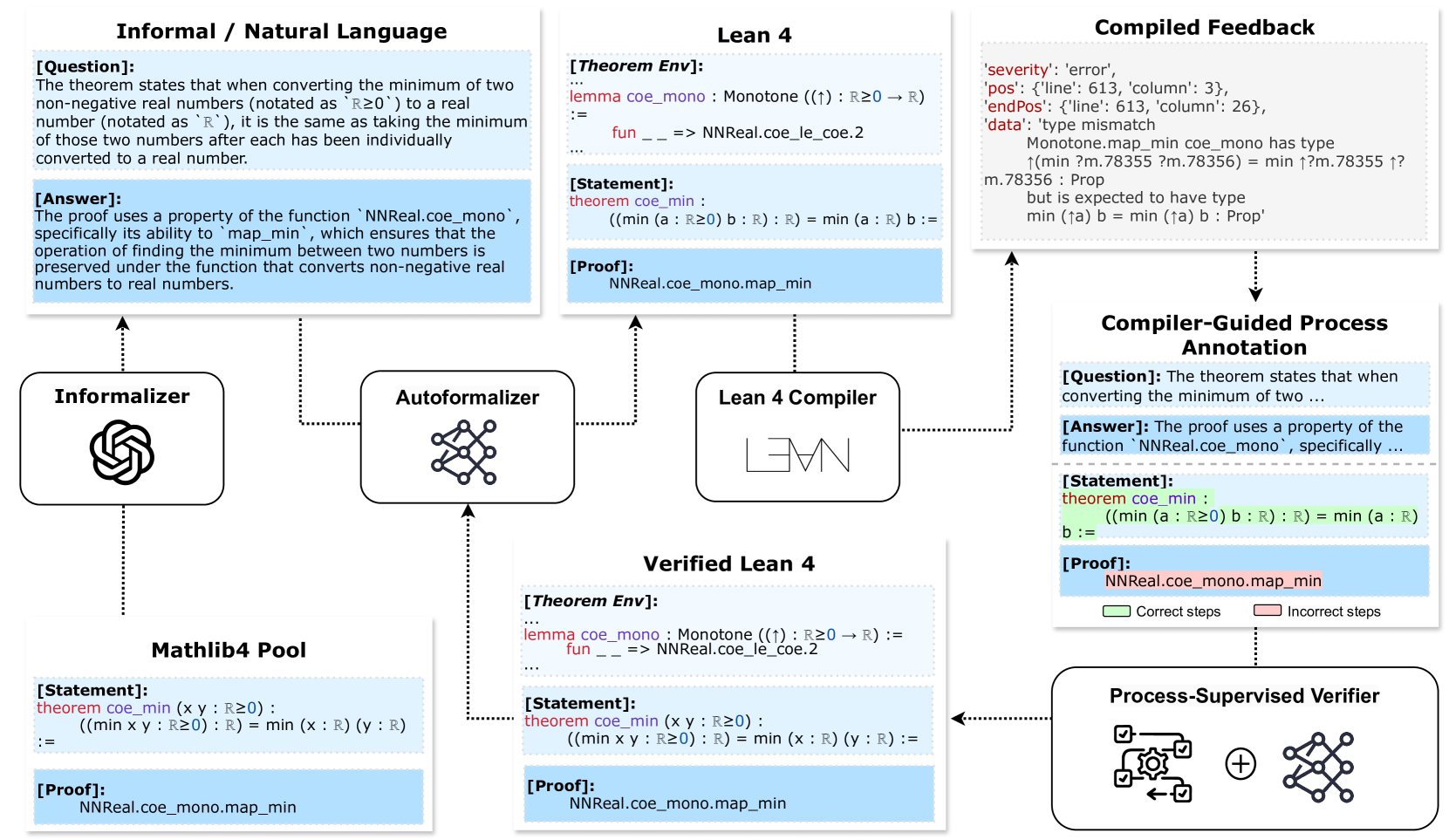
This diagram illustrates a compiler-guided theorem proving process, showcasing the interaction between informal/natural language, formal theorem environments (Lean 4), and compiled feedback. It depicts a workflow involving informalization, autoformalization, compilation, verification, and a process-supervised verifier. The diagram is segmented into several blocks representing different stages and components of this process.
### Components/Axes
The diagram is structured around several key blocks:
* **Informal / Natural Language:** Contains a "[Question:]" and "[Answer:]" section.
* **Lean 4:** Contains "[Theorem Env:]" and "[Statement:]" sections. Two instances of Lean 4 are present: one labeled "Lean 4" and another labeled "Verified Lean 4".
* **Compiled Feedback:** Displays error information with fields like 'severity', 'pos', 'endPos', and 'data'.
* **Compiler-Guided Process Annotation:** Contains "[Question:]" and "[Answer:]" sections.
* **Mathlib4 Pool:** Contains "[Statement:]" and "[Proof:]" sections.
* **Process-Supervised Verifier:** Uses color-coded indicators ("Correct steps" in green, "Incorrect steps" in red).
* **Visual Representations:** Includes diagrams representing "Informalizer", "Autoformalizer", "Lean 4 Compiler", and a visual representation of the Lean logo.
### Detailed Analysis or Content Details
**1. Informal / Natural Language (Top-Left):**
* **[Question:]** "The theorem states that when converting the minimum of two non-negative real numbers (notated as ℝ≥0) to a real number (notated as ℝ), it is the same as taking the minimum of those two numbers after each has been individually converted to a real number."
* **[Answer:]** "The proof uses a property of the function `NNReal.coe_mono`, specifically its ability to `map_min`, which ensures that the operation of finding the minimum between two numbers is preserved under the function that converts non-negative real numbers to real numbers."
**2. Lean 4 (Top-Center-Left):**
* **[Theorem Env:]** `lemma coe_mono : Monotone (f : ℝ≥0 → ℝ) := fun _ => NNReal.coe_le_coe_2`
* **[Statement:]** `theorem coe_min : (min (a : ℝ≥0) b : ℝ) = min (a : ℝ) b :=`
* **[Proof:]** `NNReal.coe_mono_map_min`
**3. Compiled Feedback (Top-Right):**
* **'severity':** 'error'
* **'pos':** {'line': 613, 'column': 3}
* **'endPos':** {'line': 613, 'column': 26}
* **'data':** 'type mismatch Monotone.map_min coe_mono has type min ?m.78355 ?m.78356 = min ?m.78355 1?' but is expected to have type min (a b) = min (1a b) : Prop'
**4. Compiler-Guided Process Annotation (Bottom-Right):**
* **[Question:]** "The theorem states that when converting the minimum of two ..." (truncated)
* **[Answer:]** "The proof uses a property of the function `NNReal.coe_mono`, specifically ..." (truncated)
* **[Statement:]** `theorem coe_min : (min (a : ℝ≥0) b : ℝ) = min (a : ℝ) b :=`
* **[Proof:]** `NNReal.coe_mono_map_min`
**5. Mathlib4 Pool (Bottom-Center-Left):**
* **[Statement:]** `theorem coe_min (x y : ℝ≥0) : (min x y : ℝ) = min (coe x) (coe y) :=`
* **[Proof:]** `NNReal.coe_map_min`
**6. Verified Lean 4 (Bottom-Center):**
* **[Theorem Env:]** `lemma coe_mono : Monotone (f : ℝ≥0 → ℝ) := fun _ => NNReal.coe_le_coe_2`
* **[Statement:]** `theorem coe_min (x y : ℝ≥0) : (min x y : ℝ) = min (coe x) (coe y) :=`
* **[Proof:]** `NNReal.coe_mono_map_min`
**7. Process-Supervised Verifier (Bottom-Right):**
* Displays a series of steps, some marked in green ("Correct steps") and some in red ("Incorrect steps"). The exact steps are not legible.
**8. Visual Representations:**
* **Informalizer:** A spiral diagram.
* **Autoformalizer:** A diagram resembling a network.
* **Lean 4 Compiler:** The Lean 4 logo.
### Key Observations
* The diagram highlights a process of formalizing mathematical statements from natural language.
* The "Compiled Feedback" block indicates a type mismatch error during the compilation process.
* The "Process-Supervised Verifier" suggests an iterative refinement of the proof, with steps being verified for correctness.
* The presence of both "Lean 4" and "Verified Lean 4" suggests a workflow where a theorem is initially stated and then verified.
* The Mathlib4 Pool seems to contain a related theorem statement.
### Interpretation
The diagram illustrates a sophisticated workflow for formalizing and verifying mathematical theorems. It demonstrates how natural language statements are translated into a formal language (Lean 4), compiled, and then verified using a process-supervised approach. The error message in the "Compiled Feedback" block suggests that the initial formalization may have contained a type error, which was subsequently identified and corrected. The use of a "Process-Supervised Verifier" indicates a focus on ensuring the correctness of each step in the proof. The diagram suggests a tight integration between a compiler, a theorem prover (Lean 4), and a verification process, enabling a robust and reliable approach to mathematical reasoning. The inclusion of the Mathlib4 Pool suggests leveraging existing mathematical libraries to aid in the formalization and verification process. The visual representations of the informalizer and autoformalizer suggest automated tools are used to assist in the initial stages of formalization.