\n
## Data Transformation: Matrix Representation
### Overview
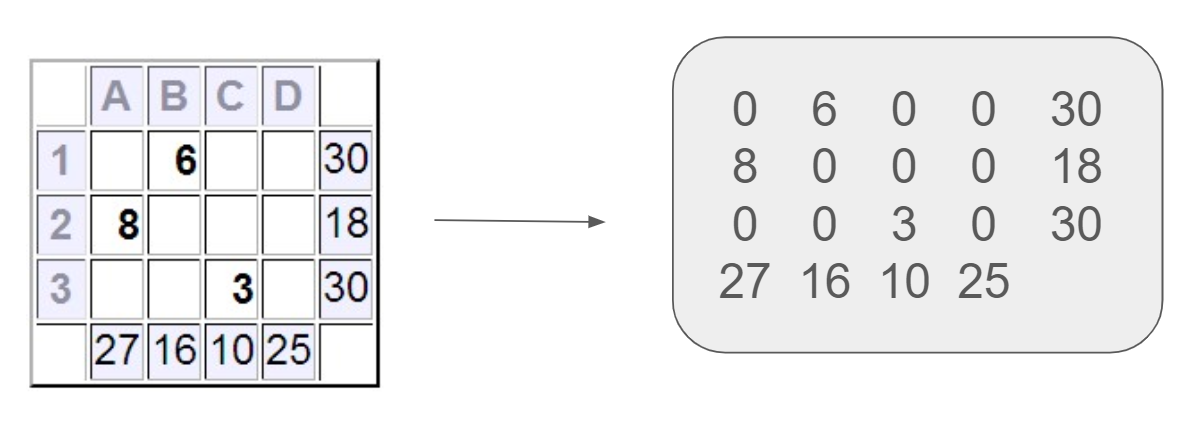
The image depicts a transformation of a partially filled 4x4 matrix into a 4x5 matrix. The left matrix appears to represent sparse data, while the right matrix represents the same data in a more complete, rectangular format. An arrow indicates the transformation process.
### Components/Axes
The left matrix has row labels 1, 2, 3, and a fourth row with no explicit label. Column labels are A, B, C, and D. The right matrix has row labels 1, 2, 3, and 4. Column labels are not explicitly provided, but can be inferred as 1, 2, 3, 4, and 5.
### Detailed Analysis or Content Details
**Left Matrix (Sparse Representation):**
* Row 1: A = 6, D = 30
* Row 2: B = 8, D = 18
* Row 3: B = 3, D = 30
* Row 4: A = 27, B = 16, C = 10, D = 25
**Right Matrix (Complete Representation):**
* Row 1: 0, 6, 0, 0, 30
* Row 2: 8, 0, 0, 0, 18
* Row 3: 0, 0, 3, 0, 30
* Row 4: 27, 16, 10, 25, 0
**Transformation Logic:**
The transformation appears to map the values from the sparse matrix into the corresponding positions in the complete matrix. Missing values in the sparse matrix are represented as 0 in the complete matrix. The column order is maintained.
### Key Observations
The transformation effectively converts a sparse matrix into a dense matrix by filling in missing values with zeros. This is a common operation in data processing and machine learning. The original matrix contains only 7 non-zero values, while the transformed matrix contains 20 values.
### Interpretation
This image demonstrates a method for representing sparse data in a complete matrix format. This is useful for algorithms that require a fixed-size input or for performing matrix operations that are not well-defined for sparse matrices. The transformation preserves the original data while adding zero-valued entries to fill the matrix. The transformation is a simple padding operation, and the choice of zero as the padding value is arbitrary; other values could be used depending on the application. The transformation is likely used to prepare the data for a matrix operation or a machine learning algorithm that requires a complete matrix.