\n
## Formal System Definitions: Type Theory Rules
### Overview
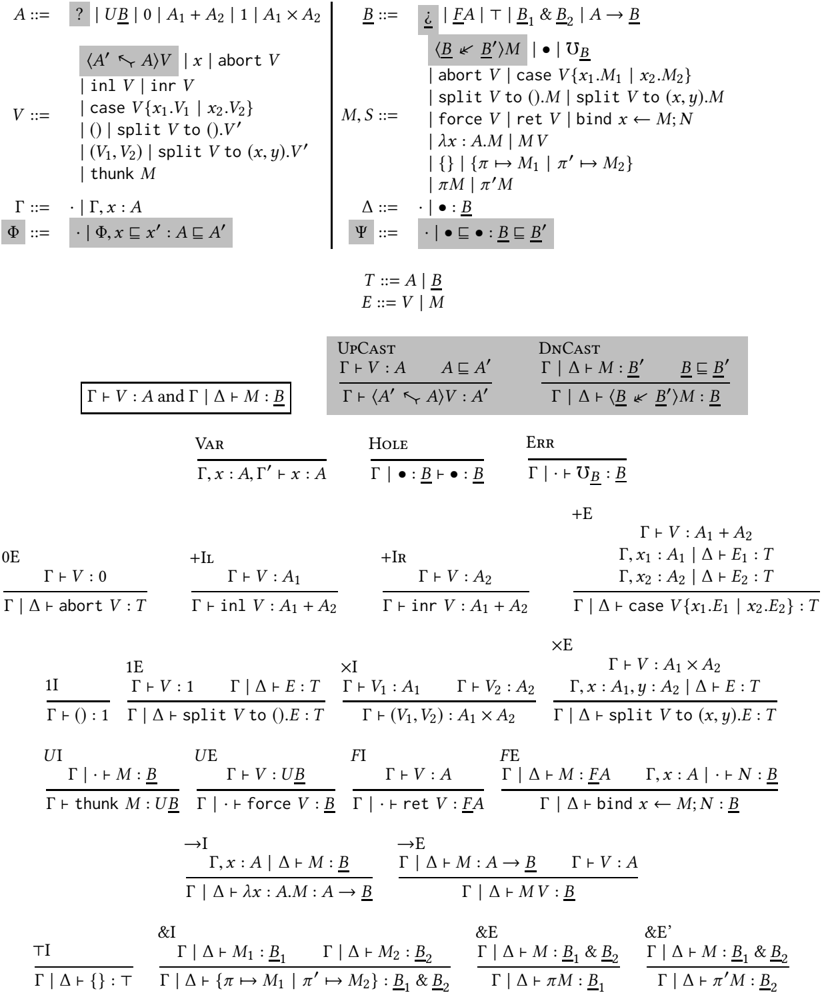
The image presents a collection of formal definitions and inference rules, likely related to a type theory system. It appears to be a visual representation of the syntax and semantics of a programming language or a logical framework. The image is densely packed with symbols and notations, suggesting a high level of technical detail. The layout is organized into sections defining various components (A, B, V, M, S, T, Δ, Ψ) and rules (UpCast, DnCast, VAR, HOLE, ERR, OE, +IL, +IR, 1E, XI, UI, UE, FI, FE, +E, +EE).
### Components/Axes
The image does not contain traditional axes or charts. Instead, it consists of symbolic definitions and rules. The key components are:
* **A, B:** Represent types.
* **V:** Represents values.
* **M:** Represents environments (mappings from names to values).
* **S:** Represents substitution.
* **T:** Represents contexts.
* **Δ:** Represents type environments.
* **Ψ:** Represents value environments.
* **Γ:** Represents a context (a set of assumptions).
* **Rules:** UpCast, DnCast, VAR, HOLE, ERR, OE, +IL, +IR, 1E, XI, UI, UE, FI, FE, +E, +EE. Each rule has a specific format: `Γ ⊢ expression : type`.
### Detailed Analysis or Content Details
Here's a transcription of the definitions and rules, grouped by component:
**Definitions:**
* **A ::= ? | UB | O | A₁ + A₂ | A₁ × A₂ | A₂**
* **B ::= | A | T | B & B | B₂ | A → B**
* **V ::= (A ∧ V) | x | abort V**
* **M, S ::= split V to (M | split V to (x,y,M)**
* **T ::= .Γ, x:A**
* **Φ ::= | Φ x ∈ C A'**
* **Δ ::= :: B**
* **Ψ ::= :: B ⊆ B'**
**Rules:**
* **UpCast:** `Γ ⊢ V : A A ⊆ A' => Γ ⊢ V : A'`
* **DnCast:** `Γ ⊢ A ⊆ M' B ⊆ B' => Γ ⊢ B : M'`
* **VAR:** `Γ ⊢ x : A, x:A' Γ ⊢ x : A`
* **HOLE:** `Γ ⊢ :: B => Γ ⊢ : B`
* **ERR:** `Γ ⊢ : UB => B`
* **OE:** `Γ ⊢ V : O => Γ ⊢ Δ + abort V : T`
* **+IL:** `Γ ⊢ V : A₁ Γ ⊢ V : A₂ => Γ ⊢ V : A₁ + A₂`
* **+IR:** `Γ ⊢ V : A₁ + A₂ => Γ ⊢ case V(x₁,x₂) : A₁ → E₁ T A₂ → E₂ T`
* **1E:** `Γ ⊢ V : 1 => Γ ⊢ V : E : T`
* **XI:** `Γ ⊢ V₁ : V₂ A₁ × A₂ => Γ ⊢ Δ + split V to (x,y) : E : T`
* **UI:** `Γ ⊢ V : UB => Γ ⊢ M : M : B`
* **UE:** `Γ ⊢ V : UB Γ ⊢ force V : B => Γ ⊢ ret V : FA`
* **FI:** `Γ ⊢ M : M : FA => Γ ⊢ Δ + bind x = M : N : B`
* **FE:** `Γ ⊢ Δ + M : A → B => Γ ⊢ Δ + M V : B`
* **+E:** `Γ ⊢ Δ + M V : B => Γ ⊢ Δ + M : B : B`
* **+EE:** `Γ ⊢ Δ + M₁ : B₁ Γ ⊢ Δ + M₂ : B₂ => Γ ⊢ Δ + M : B₁ & B₂`
**Additional Notation:**
* `A ∧ V`
* `x abort V`
* `split V to (x,y,M)`
* `case V(x₁,x₂) : A₁ → E₁ T A₂ → E₂ T`
* `force V`
* `ret V`
* `bind x = M`
### Key Observations
The rules are presented in a standard logical notation, with the turnstile symbol (`⊢`) indicating a derivation or judgment. The rules define how to manipulate types, values, and environments within the system. The presence of rules like `UpCast` and `DnCast` suggests a type system with subtyping. The rules involving `split` and `bind` indicate mechanisms for handling data structures and variable bindings. The notation is very compact and relies heavily on symbolic representation.
### Interpretation
This image represents a formal specification of a type system, likely for a functional programming language. The rules define the valid operations and derivations within the system, ensuring type safety and correctness. The system appears to support subtyping, product types (A × A₂), sum types (A₁ + A₂), and potentially dependent types (indicated by the use of contexts and environments). The rules are designed to ensure that type checking and evaluation are sound and consistent. The presence of `abort V` suggests a mechanism for handling errors or exceptional conditions. The overall structure suggests a sophisticated type system capable of expressing complex data structures and computations. The notation is highly abstract and requires a strong background in type theory and formal methods to fully understand. The image is a concise and precise representation of a complex system, intended for experts in the field.