## Logical Type Theory System: Core Inference Rules and Type Definitions
### Overview
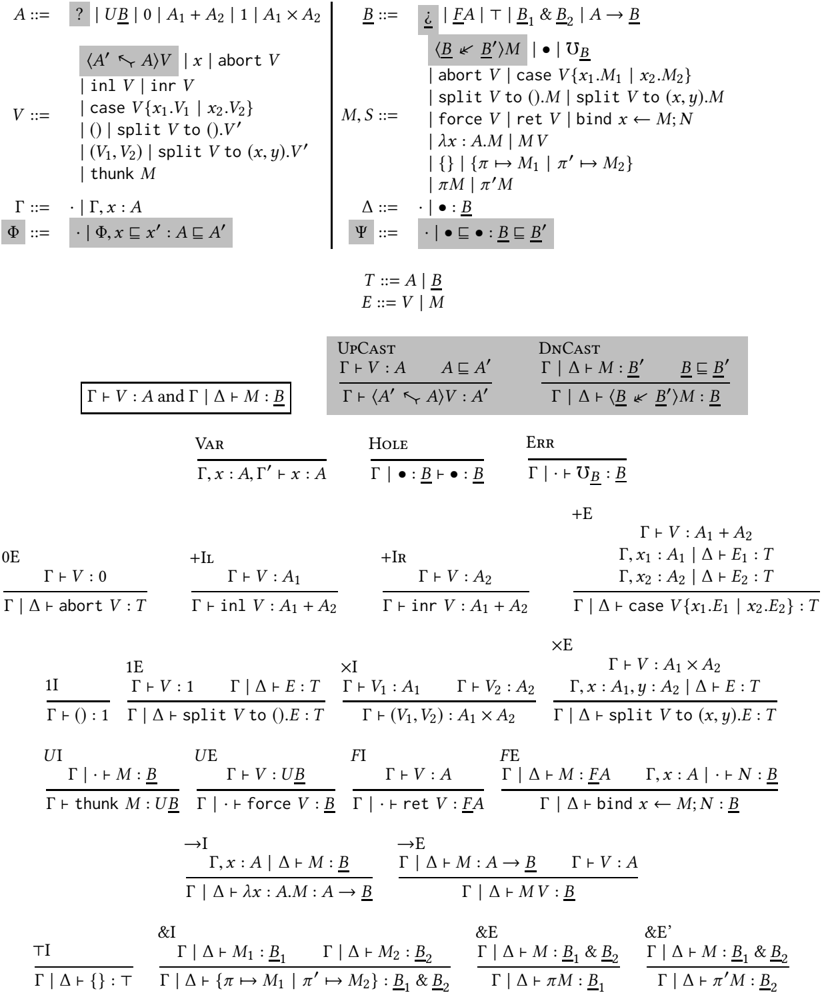
The image presents a formal type theory system with definitions for types (`A`, `B`), variables (`V`), contexts (`Γ`), and inference rules. It includes type judgments (`⊢`), term constructors (`case`, `split`), and operational semantics (`think`, `force`, `bind`). The system emphasizes type safety through strict type checking and pattern matching.
### Components/Axes
#### Type Definitions
- **`A`**: A type defined as `? | U_B | 0 | A₁ + A₂ | 1 | A₁ × A₂`
- **`B`**: A type defined as `? | F_A | ⊤ | B₁ & B₂ | A → B`
- **`V`**: A variable type with case analysis:
`case V {x₁.V₁ | x₂.V₂} | () | split V to ().V' | (V₁, V₂) split V to (x, y).V'`
- **`Γ`**: Type context: `· | Γ, x : A`
- **`Φ`**: Type context with subtyping: `· | Φ, x ⊆ x' : A ⊆ A'`
#### Inference Rules
1. **Var** (Variable Introduction):
`Γ ⊢ V : A` and `Γ ⊢ Δ ⊢ M : B`
`Γ ⊢ V : A`
2. **Hole** (Type Hole):
`Γ ⊢ ? : B`
3. **Err** (Error Type):
`Γ ⊢ U_B : B`
4. **UpCast/DownCast**:
- **UpCast**: `Γ ⊢ V : A` and `A ⊆ A'`
`Γ ⊢ ⟨A' ⇸ A⟩V : A'`
- **DownCast**: `Γ ⊢ Δ ⊢ M : B'` and `B ⊆ B'`
`Γ ⊢ Δ ⊢ ⟨B ⇸ B'⟩M : B`
5. **Operational Semantics**:
- **`think`**: `Γ ⊢ ? ⊢ M : U_B`
- **`force`**: `Γ ⊢ V : U_B`
- **`bind`**: `Γ ⊢ x : A` and `Γ ⊢ N : B`
`Γ ⊢ bind x ← M; N : B`
6. **Type Constructors**:
- **Sum Type (`+`)**:
`Γ ⊢ V : A₁ + A₂`
`Γ, x₁ : A₁ ⊢ E₁ : T` and `Γ, x₂ : A₂ ⊢ E₂ : T`
`Γ ⊢ case V {x₁.E₁ | x₂.E₂} : T`
- **Product Type (`×`)**:
`Γ ⊢ V : A₁ × A₂`
`Γ, x : A₁, y : A₂ ⊢ E : T`
`Γ ⊢ split V to (x, y).E : T`
#### Type Judgments
- **`⊢`**: Type derivation (e.g., `Γ ⊢ V : A`)
- **`⊨`**: Semantic entailment (e.g., `A ⊆ A'`)
### Detailed Analysis
- **Type Hierarchy**:
- `A` includes base types (`0`, `1`), sums (`A₁ + A₂`), and products (`A₁ × A₂`).
- `B` includes base types (`⊤`), products (`B₁ & B₂`), and function types (`A → B`).
- **Pattern Matching**:
- `case V` deconstructs sum types, while `split V` deconstructs product types.
- **Context Extensions**:
- `Γ, x : A` adds a variable `x` of type `A` to the context `Γ`.
- **Subtyping**:
- `A ⊆ A'` allows upcasting (widening) and downcasting (narrowing) with checks.
### Key Observations
1. **Strict Type Safety**:
- All operations (e.g., `case`, `split`) are type-checked to ensure no runtime errors.
2. **Recursive Definitions**:
- `V` and `M` are recursively defined with case analysis and splitting.
3. **Operational Semantics**:
- `think` and `force` handle undefined and error types, respectively.
4. **Subtyping Rules**:
- Upcasting (`A ⊆ A'`) and downcasting (`B ⊆ B'`) enforce type compatibility.
### Interpretation
This system formalizes a dependently typed lambda calculus with:
- **Algebraic Data Types**: Sums (`+`) and products (`×`) for data structures.
- **Pattern Matching**: Ensures exhaustive and correct deconstruction of types.
- **Type Safety**: Inference rules prevent ill-typed programs from compiling.
- **Operational Semantics**: Defines evaluation rules for terms (e.g., `bind` for monadic operations).
The system resembles a core calculus for functional programming languages, emphasizing correctness through type theory. The absence of numerical data suggests it is a theoretical framework rather than empirical analysis.