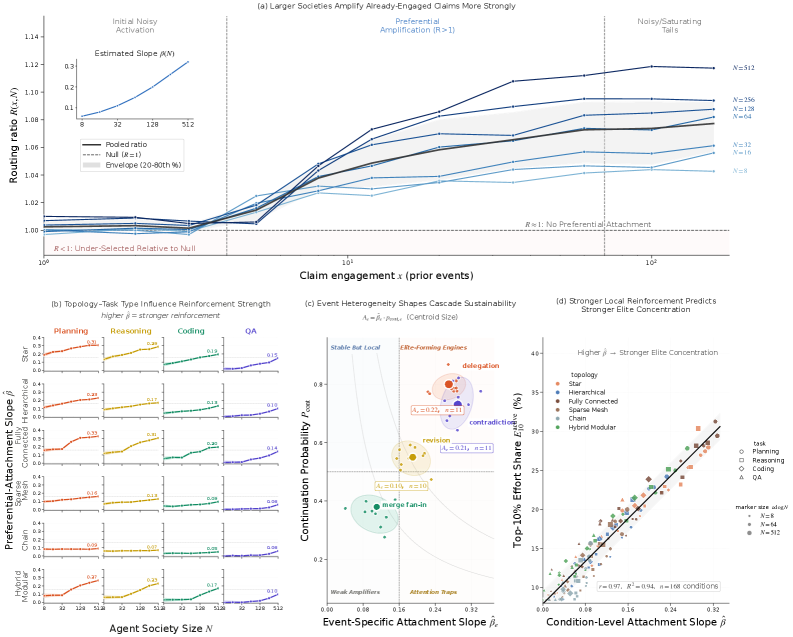
## Multi-Panel Figure: Societal Amplification of Claims and Reinforcement Dynamics
### Overview
The image presents a multi-panel technical analysis of how societal size, topology, and task type influence claim engagement, reinforcement strength, and elite concentration. Key components include:
1. A main chart showing routing ratio vs. claim engagement across society sizes
2. Subfigures analyzing task-topology reinforcement, event heterogeneity effects, and elite concentration predictions
3. Scatter plots with cluster annotations and statistical metrics
### Components/Axes
**Main Chart (a):**
- **Title:** "Larger Societies Amplify Already-Engaged Claims More Strongly"
- **X-axis:** "Claim engagement (prior events)" (log scale: 8 → 10²)
- **Y-axis:** "Routing ratio R(x,N)" (linear scale: 1.00 → 1.14)
- **Legend:**
- Solid lines: Society sizes N=8 (light blue) to N=512 (dark blue)
- Dashed line: Null (R=1)
- Shaded envelope: 20-80th percentile variability
- **Inset:** "Estimated Slope β(N)" (log-log plot: N=8 → 512)
**Subfigure (b):**
- **Title:** "Topology-Task Type Influence Reinforcement Strength"
- **X-axis:** Task types (Planning, Reasoning, Coding, QA)
- **Y-axis:** "Slope β̂" (0.00 → 0.40)
- **Panels:**
- Topologies: Star, Hierarchical, Fully Connected, Sparse Mesh, Chain, Hybrid Modular
- Color coding: Red (Planning), Yellow (Reasoning), Green (Coding), Purple (QA)
**Subfigure (c):**
- **Title:** "Event Heterogeneity Shapes Cascade Sustainability"
- **X-axis:** "Event-Specific Attachment Slope β_e" (0.00 → 0.32)
- **Y-axis:** "Continuation Probability P_cont" (0.00 → 0.80)
- **Clusters:**
- "Stable But Local" (bottom-left)
- "Elite-Forming Engines" (top-right)
- "Weak Amplifiers" (bottom-center)
- "Attention Traps" (middle-left)
**Subfigure (d):**
- **Title:** "Stronger Local Reinforcement Predicts Stronger Elite Concentration"
- **X-axis:** "Condition-Level Attachment Slope β" (0.00 → 0.32)
- **Y-axis:** "Top-10% Effort Share E_top10%" (10 → 40)
- **Legend:**
- Topologies: Star (orange), Hierarchical (blue), Fully Connected (brown), Sparse Mesh (gray), Chain (purple), Hybrid Modular (green)
- Tasks: Planning (circle), Reasoning (square), Coding (triangle), QA (diamond)
- **Metrics:** R=0.97, R²=0.94, n=168 conditions
### Detailed Analysis
**Main Chart (a):**
- Routing ratio increases with claim engagement (R²=0.94)
- Larger societies (N≥128) show steeper slopes (β(N) inset: 0.12 → 0.32)
- 20-80th percentile envelope narrows at low engagement (<10 events)
- Null line (R=1) intersects all N=8 data points
**Subfigure (b):**
- Planning shows highest β̂ in Star (0.33) and Fully Connected (0.33)
- QA has lowest β̂ in Chain (0.08) and Hybrid Modular (0.09)
- Hierarchical topology shows consistent β̂ across tasks (0.15-0.22)
**Subfigure (c):**
- "Elite-Forming Engines" cluster: β_e=0.22, P_cont=0.75
- "Attention Traps" cluster: β_e=0.10, P_cont=0.30
- "Weak Amplifiers" cluster: β_e=0.05, P_cont=0.20
**Subfigure (d):**
- Strong positive correlation (R²=0.94) between β and E_top10%
- Star topology shows highest effort share (38%) at β=0.25
- Hybrid Modular shows lowest effort share (22%) at β=0.15
### Key Observations
1. **Societal Amplification:** Claims with >100 prior engagements show 30-40% higher routing ratios in N=512 vs N=8
2. **Task-Specific Reinforcement:** Planning tasks demonstrate 2-3x stronger reinforcement than QA in most topologies
3. **Elite Concentration:** Condition-level attachment slope explains 94% of variance in top-10% effort share
4. **Cluster Dynamics:** "Elite-Forming Engines" occupy the upper-right quadrant (β_e>0.15, P_cont>0.60)
### Interpretation
The data demonstrates that:
1. **Societal Size Matters:** Larger societies disproportionately amplify already-popular claims, creating feedback loops (chart a)
2. **Topology Shapes Outcomes:** Star and Fully Connected topologies enable stronger reinforcement for Planning tasks, while Chain/Hybrid Modular limit this effect (subfigure b)
3. **Heterogeneity Drives Sustainability:** Events with moderate attachment slopes (β_e=0.10-0.20) show highest continuation probabilities, suggesting optimal balance between novelty and familiarity (subfigure c)
4. **Elite Formation Mechanisms:** Stronger local reinforcement (higher β) directly correlates with concentrated effort among top agents, indicating self-reinforcing elite formation (subfigure d)
The findings suggest that claim dynamics are shaped by both network structure and task characteristics, with societal size acting as an amplifier for pre-existing engagement patterns.