## Diagram: Two-Stage Signal Processing System
### Overview
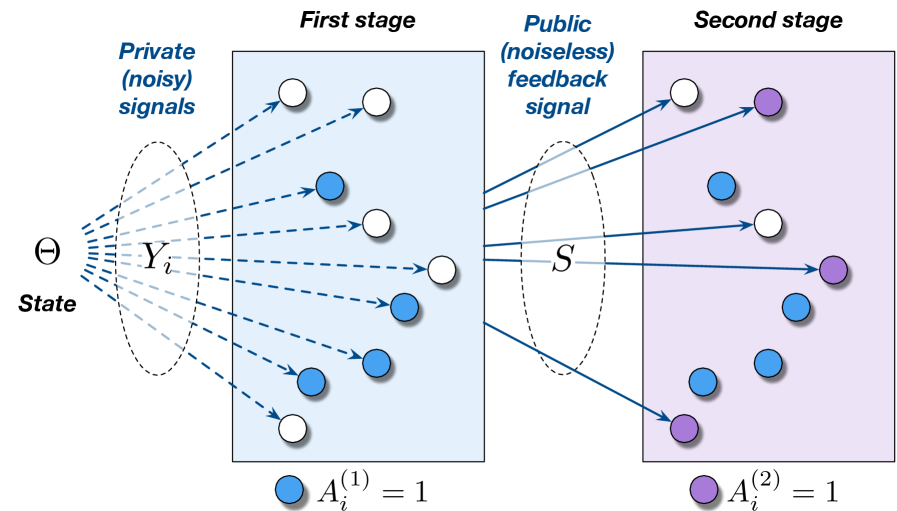
The diagram illustrates a two-stage signal processing system involving a central "State" entity that emits signals through two distinct phases. The first stage involves noisy private signals, while the second stage processes these into a noiseless public feedback signal. Arrows indicate directional flow, and colored circles represent discrete actions or events tied to each stage.
---
### Components/Axes
1. **Central Nodes**:
- **State (Θ)**: A central node emitting signals, positioned at the far left.
- **Yᵢ (First Stage)**: A cluster of nodes representing "Private (noisy) signals" in the first stage.
- **S (Second Stage)**: A cluster of nodes representing "Public (noiseless) feedback signal" in the second stage.
2. **Arrows**:
- **Dashed Arrows**: Connect the State to Yᵢ (first stage), indicating noisy signal emission.
- **Solid Arrows**: Connect Yᵢ to S (second stage), showing signal refinement into a noiseless feedback.
3. **Legend**:
- **Blue Circles**: Labeled *Aᵢ⁽¹⁾ = 1*, associated with the first stage (noisy signals).
- **Purple Circles**: Labeled *Aᵢ⁽²⁾ = 1*, associated with the second stage (noiseless feedback).
4. **Text Labels**:
- **First Stage**: "Private (noisy) signals" and "State" (Θ).
- **Second Stage**: "Public (noiseless) feedback signal" and "S".
---
### Detailed Analysis
- **First Stage**:
- The State emits **noisy signals** (Yᵢ) via dashed arrows. These signals are represented by **blue circles** (Aᵢ⁽¹⁾ = 1), indicating discrete events or actions tied to the noisy phase.
- The legend confirms blue corresponds to the first stage, with all blue circles positioned within the light blue region.
- **Second Stage**:
- Noisy signals (Yᵢ) are processed into a **noiseless feedback signal** (S) via solid arrows. This stage is represented by **purple circles** (Aᵢ⁽²⁾ = 1), positioned within the light purple region.
- The legend confirms purple corresponds to the second stage, with all purple circles aligned to the solid arrows.
- **Flow Direction**:
- Signals flow **left to right**: State → Yᵢ (noisy) → S (noiseless).
- The transition from dashed to solid arrows visually emphasizes the refinement of signals from noisy to noiseless.
---
### Key Observations
1. **Signal Transformation**: The system explicitly separates noisy and noiseless processing stages, with the second stage acting as a refinement mechanism.
2. **Action Differentiation**: Blue (Aᵢ⁽¹⁾) and purple (Aᵢ⁽²⁾) circles are spatially isolated, reinforcing the distinction between stages.
3. **Noisy vs. Noiseless**: The absence of noise in the second stage (solid arrows, purple circles) suggests a critical filtering or consensus mechanism.
---
### Interpretation
This diagram models a system where raw, noisy signals (first stage) are transformed into a refined, noiseless output (second stage). The use of distinct colors and arrow styles highlights the progression from uncertainty (noise) to clarity (noiseless feedback). The central "State" acts as the source, while Yᵢ and S represent intermediate and final outputs, respectively. The legend’s spatial placement (top-right) ensures clarity in distinguishing action types. This structure could represent communication protocols, decision-making frameworks, or error-correction systems where noise reduction is critical.