## Diagram: Hierarchical Transformer Architecture for Audio/Music Generation
### Overview
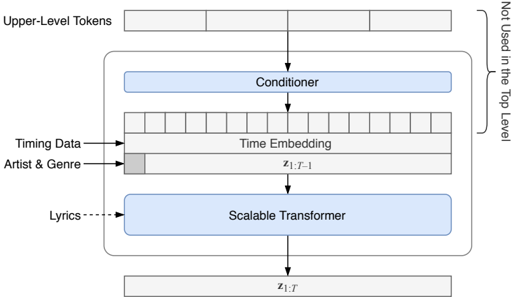
This diagram illustrates the architecture of a neural network, likely a hierarchical transformer model designed for music or audio generation. The flow is top-down, showing how upper-level tokens and various conditioning inputs (Artist, Genre, Lyrics, Timing) are processed through a "Scalable Transformer" to produce a final sequence of tokens ($z_{1:T}$).
### Components/Axes
The diagram is organized into a vertical stack enclosed within a main rounded rectangular container, with additional annotations on the periphery.
**Main Components (Top to Bottom):**
* **Upper-Level Tokens:** A row of four empty rectangular boxes at the very top.
* **Conditioner:** A blue rectangular block located below the Upper-Level Tokens.
* **Time Embedding:** A row of 12 small, light-grey boxes positioned above a horizontal bar.
* **$z_{1:T-1}$:** A horizontal bar representing the input sequence. On the far left of this bar is a small, shaded grey box.
* **Scalable Transformer:** A large blue rectangular block located below the $z_{1:T-1}$ bar.
* **$z_{1:T}$:** A horizontal bar at the bottom of the diagram, representing the final output sequence.
**Annotations and Labels:**
* **Right Side:** A large curly bracket spans the "Conditioner," "Time Embedding," and "$z_{1:T-1}$" blocks, labeled "Not Used in the Top Level."
* **Left Side (Arrows):**
* **Timing Data:** A solid arrow pointing to the "Time Embedding" row.
* **Artist & Genre:** A solid arrow pointing to the small grey box on the left side of the $z_{1:T-1}$ bar.
* **Lyrics:** A dashed arrow pointing directly into the "Scalable Transformer" block.
### Detailed Analysis
The diagram depicts a sequential data processing pipeline:
1. **Input Flow:** The process begins with "Upper-Level Tokens," which pass through a "Conditioner."
2. **Conditioning:** The output of the Conditioner influences the "Time Embedding" and the sequence $z_{1:T-1}$.
3. **Sequence Integration:**
* The "Time Embedding" provides temporal context.
* The $z_{1:T-1}$ bar represents the autoregressive input (the sequence generated so far).
* The small grey box within $z_{1:T-1}$ explicitly injects "Artist & Genre" information into the sequence.
4. **Transformation:** The "Scalable Transformer" acts as the primary processing engine. It takes the conditioned sequence ($z_{1:T-1}$) and integrates "Lyrics" (via the dashed arrow) to perform the computation.
5. **Output:** The transformer outputs the final sequence $z_{1:T}$.
### Key Observations
* **Hierarchical Nature:** The bracket on the right labeled "Not Used in the Top Level" strongly implies this is a sub-module of a larger, hierarchical system. The "Top Level" likely operates on a coarser resolution, while this module operates on a finer resolution.
* **Multi-Modal Conditioning:** The model is highly conditioned. It integrates global context (Upper-Level Tokens), temporal context (Time Embedding), metadata (Artist & Genre), and semantic content (Lyrics).
* **Autoregressive Structure:** The notation $z_{1:T-1}$ as input and $z_{1:T}$ as output is characteristic of autoregressive models, where the model predicts the next token in a sequence based on all previous tokens.
### Interpretation
This architecture represents a sophisticated generative model, likely used for tasks such as singing voice synthesis or music generation with lyrics.
* **The Role of the Conditioner:** The Conditioner serves as a bridge, translating the abstract, high-level representations ("Upper-Level Tokens") into a format that the lower-level Transformer can utilize.
* **The Role of the Transformer:** By receiving both the previous sequence ($z_{1:T-1}$) and the lyrics, the "Scalable Transformer" is tasked with aligning the semantic content (lyrics) with the temporal and stylistic constraints (Artist, Genre, Timing) to generate the next segment of audio/music.
* **Peircean Investigative Note:** The dashed arrow for "Lyrics" versus the solid arrows for other inputs suggests that the lyrics might be injected as a cross-attention mechanism or a separate conditioning input, rather than being part of the primary sequence embedding, distinguishing semantic content from the structural/temporal sequence.