## Diagram: Music Generation Model Architecture
### Overview
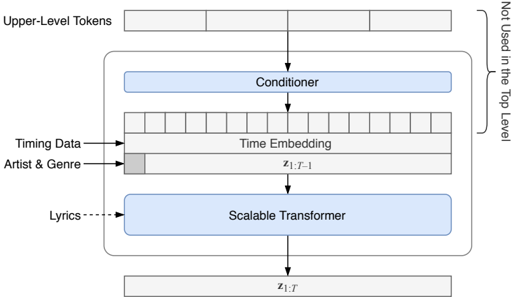
The diagram illustrates a hierarchical music generation system with multiple processing stages. It shows data flow from input features (timing, artist/genre, lyrics) through a scalable transformer architecture to produce time-embedded outputs. Key components include conditional processing, time embedding, and artist/genre integration.
### Components/Axes
1. **Upper-Level Tokens**: Topmost horizontal bar (gray), feeds into the Conditioner.
2. **Conditioner**: Blue horizontal bar below Upper-Level Tokens, processes input tokens.
3. **Timing Data**: Labeled arrow pointing to a segmented bar (12 gray squares) below the Conditioner.
4. **Artist & Genre**: Labeled arrow pointing to a single gray square (smaller than Timing Data) adjacent to Timing Data.
5. **Lyrics**: Dashed arrow pointing to a blue box (Scalable Transformer) below Artist & Genre.
6. **Scalable Transformer**: Large blue box spanning the width of the diagram, receives inputs from Timing Data, Artist & Genre, and Lyrics.
7. **Time Embedding**: Labeled segmented bar (12 gray squares) above the Scalable Transformer.
8. **z₁:ₜ₋₁ and z₁:ₜ**: Output bars at the bottom, representing sequential states.
9. **Note**: Right-side annotation stating "Not Used in the Top Level" with a brace connecting to Upper-Level Tokens.
### Detailed Analysis
- **Flow Direction**:
- Upper-Level Tokens → Conditioner → Time Embedding → Scalable Transformer → z₁:ₜ₋₁/z₁:ₜ.
- Artist & Genre and Lyrics bypass the Conditioner, feeding directly into the Scalable Transformer.
- **Component Sizes**:
- Timing Data (12 squares) is twice the width of Artist & Genre (1 square).
- Scalable Transformer is the widest component, spanning the full diagram width.
- **Color Coding**:
- Gray: Input/output bars (Upper-Level Tokens, Timing Data, Artist & Genre, z₁:ₜ₋₁/z₁:ₜ).
- Blue: Processing components (Conditioner, Scalable Transformer).
- Dashed lines: Optional/alternative pathways (Lyrics).
### Key Observations
1. **Hierarchical Processing**:
- Upper-Level Tokens are processed first, then conditioned before time embedding.
- Artist/Genre and Lyrics are integrated later, suggesting modular feature handling.
2. **Output Structure**:
- z₁:ₜ₋₁ and z₁:ₜ represent sequential states, likely for autoregressive generation.
3. **Unused Elements**:
- Upper-Level Tokens are explicitly marked as "Not Used in the Top Level," implying they may serve a different purpose (e.g., higher-level conditioning).
### Interpretation
This architecture combines **temporal alignment** (Timing Data), **stylistic context** (Artist & Genre), and **textual content** (Lyrics) within a scalable transformer framework. The Conditioner likely refines input tokens before temporal embedding, while the Scalable Transformer handles multi-modal integration. The exclusion of Upper-Level Tokens from the top-level processing suggests they might be used for global context or meta-information. The dashed Lyrics connection implies optional or auxiliary input, possibly for lyrics-to-music alignment tasks. The sequential outputs (z₁:ₜ₋₁/z₁:ₜ) indicate a time-step-dependent generation process, typical in music synthesis models.