## Diagram: Question Answering System Workflow
### Overview
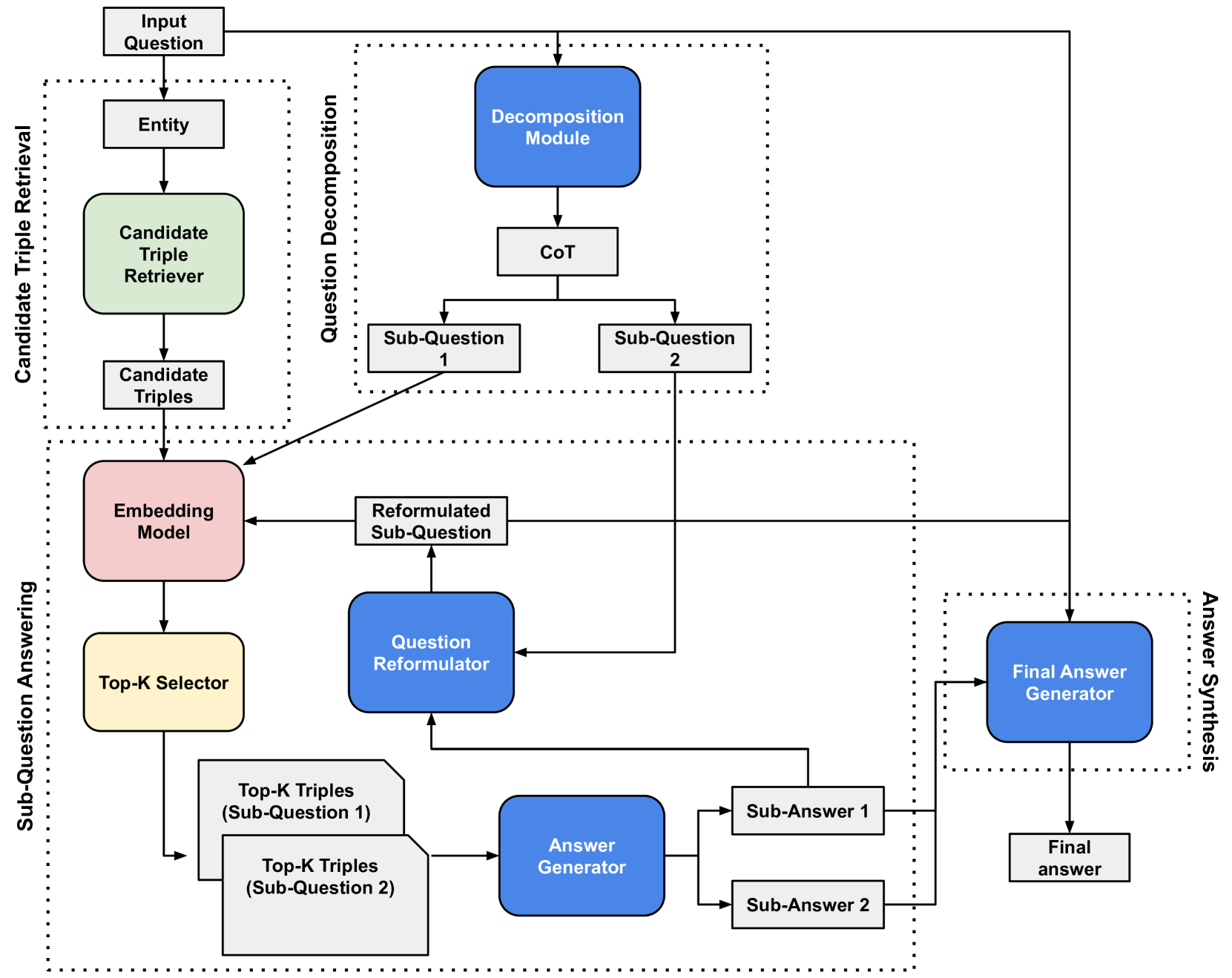
This diagram illustrates a workflow for a question answering system. It outlines the process from receiving an input question, through decomposition, sub-question answering, and finally to answer synthesis. The system appears to handle complex questions by breaking them down into smaller, manageable sub-questions.
### Components/Axes
The diagram consists of several interconnected rectangular and rounded rectangular boxes, representing modules or data. Arrows indicate the flow of information between these components. The main functional areas are delineated by dotted lines and labeled: "Candidate Triple Retrieval", "Question Decomposition", "Sub-Question Answering", and "Answer Synthesis".
**Key Components and their Labels:**
* **Input Question**: A rectangular box at the top, serving as the initial input.
* **Entity**: A rectangular box, receiving input from "Input Question".
* **Candidate Triple Retriever**: A rounded green rectangular box, receiving input from "Entity".
* **Candidate Triples**: A rectangular box, receiving output from "Candidate Triple Retriever".
* **Decomposition Module**: A rounded blue rectangular box within the "Question Decomposition" area.
* **CoT**: A rectangular box, receiving output from "Decomposition Module". "CoT" likely stands for "Chain of Thought".
* **Sub-Question 1**: A rectangular box, receiving output from "CoT".
* **Sub-Question 2**: A rectangular box, receiving output from "CoT".
* **Embedding Model**: A rounded red rectangular box, receiving input from "Candidate Triples" and "Sub-Question 1".
* **Top-K Selector**: A rounded yellow rectangular box, receiving output from "Embedding Model".
* **Reformulated Sub-Question**: A rectangular box, receiving output from "Top-K Selector" and feeding into "Question Reformulator".
* **Question Reformulator**: A rounded blue rectangular box, receiving input from "Reformulated Sub-Question".
* **Top-K Triples (Sub-Question 1)**: A grey parallelogram-shaped box, receiving output from "Top-K Selector".
* **Top-K Triples (Sub-Question 2)**: A grey parallelogram-shaped box, receiving output from "Top-K Selector".
* **Answer Generator**: A rounded blue rectangular box, receiving input from "Top-K Triples (Sub-Question 1)" and "Top-K Triples (Sub-Question 2)".
* **Sub-Answer 1**: A rectangular box, receiving output from "Answer Generator".
* **Sub-Answer 2**: A rectangular box, receiving output from "Answer Generator".
* **Final Answer Generator**: A rounded blue rectangular box within the "Answer Synthesis" area.
* **Final answer**: A rectangular box at the bottom, representing the final output.
**Flow of Information (Arrows):**
1. **Input Question** -> **Entity**
2. **Entity** -> **Candidate Triple Retriever**
3. **Candidate Triple Retriever** -> **Candidate Triples**
4. **Candidate Triples** -> **Embedding Model**
5. **Input Question** -> **Decomposition Module** (This arrow is implied by the dotted box encompassing "Decomposition Module" and "Input Question" being at the top, but not explicitly drawn as a direct arrow from "Input Question" to "Decomposition Module". However, the "Decomposition Module" is within the "Question Decomposition" area which is initiated by the "Input Question".)
6. **Decomposition Module** -> **CoT**
7. **CoT** -> **Sub-Question 1**
8. **CoT** -> **Sub-Question 2**
9. **Sub-Question 1** -> **Embedding Model**
10. **Sub-Question 1** -> **Top-K Triples (Sub-Question 1)** (This arrow originates from "Sub-Question 1" and points to the parallelogram, but the "Top-K Triples" are generated by the "Top-K Selector". This suggests "Sub-Question 1" might be used to filter or select relevant triples.)
11. **Sub-Question 2** -> **Top-K Triples (Sub-Question 2)** (Similar to the above, suggesting "Sub-Question 2" is used for selection.)
12. **Embedding Model** -> **Top-K Selector**
13. **Top-K Selector** -> **Reformulated Sub-Question**
14. **Top-K Selector** -> **Top-K Triples (Sub-Question 1)**
15. **Top-K Selector** -> **Top-K Triples (Sub-Question 2)**
16. **Reformulated Sub-Question** -> **Question Reformulator**
17. **Question Reformulator** -> **Embedding Model** (This creates a feedback loop for refining sub-questions.)
18. **Top-K Triples (Sub-Question 1)** -> **Answer Generator**
19. **Top-K Triples (Sub-Question 2)** -> **Answer Generator**
20. **Answer Generator** -> **Sub-Answer 1**
21. **Answer Generator** -> **Sub-Answer 2**
22. **Sub-Answer 1** -> **Final Answer Generator**
23. **Sub-Answer 2** -> **Final Answer Generator**
24. **Final Answer Generator** -> **Final answer**
### Detailed Analysis or Content Details
The diagram outlines a multi-stage process for answering questions.
1. **Candidate Triple Retrieval**: An "Input Question" is processed to identify an "Entity". This entity is then used by the "Candidate Triple Retriever" to fetch "Candidate Triples".
2. **Question Decomposition**: The "Input Question" is fed into a "Decomposition Module" which generates a "Chain of Thought" (CoT). This CoT is then used to break down the original question into two "Sub-Question 1" and "Sub-Question 2".
3. **Sub-Question Answering**:
* The "Candidate Triples" are passed to an "Embedding Model".
* "Sub-Question 1" also feeds into the "Embedding Model". This suggests the model embeds both the retrieved triples and the sub-question to find relevant information.
* The output of the "Embedding Model" goes to a "Top-K Selector", which likely selects the most relevant embeddings or triples based on the sub-question.
* The "Top-K Selector" outputs a "Reformulated Sub-Question" and "Top-K Triples" for both "Sub-Question 1" and "Sub-Question 2".
* The "Reformulated Sub-Question" is processed by a "Question Reformulator", which then feeds back into the "Embedding Model", indicating an iterative refinement process for sub-questions.
* The "Top-K Triples" for each sub-question are sent to an "Answer Generator".
* The "Answer Generator" produces "Sub-Answer 1" and "Sub-Answer 2".
4. **Answer Synthesis**: The "Sub-Answer 1" and "Sub-Answer 2" are combined by the "Final Answer Generator" to produce the "Final answer".
### Key Observations
* The system employs a decomposition strategy to handle complex questions by breaking them into sub-questions.
* There is an iterative refinement loop involving the "Question Reformulator" and "Embedding Model" for sub-questions.
* The "Embedding Model" plays a central role in relating candidate triples to sub-questions.
* The "Top-K Selector" is crucial for filtering relevant information.
* The process culminates in synthesizing individual sub-answers into a final, coherent answer.
### Interpretation
This diagram depicts a sophisticated question-answering system that leverages a modular approach. The "Candidate Triple Retrieval" phase suggests the system operates on a knowledge base represented as triples (subject-predicate-object). The "Question Decomposition" phase highlights the system's ability to understand and break down complex queries, likely using a "Chain of Thought" mechanism to guide the decomposition.
The "Sub-Question Answering" phase is particularly intricate, involving an "Embedding Model" that likely uses vector representations to match sub-questions with relevant knowledge triples. The "Top-K Selector" and "Question Reformulator" indicate a process of selecting and refining information and queries to improve accuracy. The feedback loop from the "Question Reformulator" to the "Embedding Model" suggests an adaptive learning or iterative improvement mechanism within the sub-question answering process.
Finally, "Answer Synthesis" consolidates the answers derived from individual sub-questions, implying that the system can construct a comprehensive answer by combining partial solutions. This workflow is characteristic of advanced question-answering systems designed to tackle complex, multi-hop reasoning questions that cannot be answered by a single knowledge retrieval step. The system aims to provide a more robust and accurate response by systematically addressing different facets of a complex question.