## Flowchart: Question-Answering System Architecture
### Overview
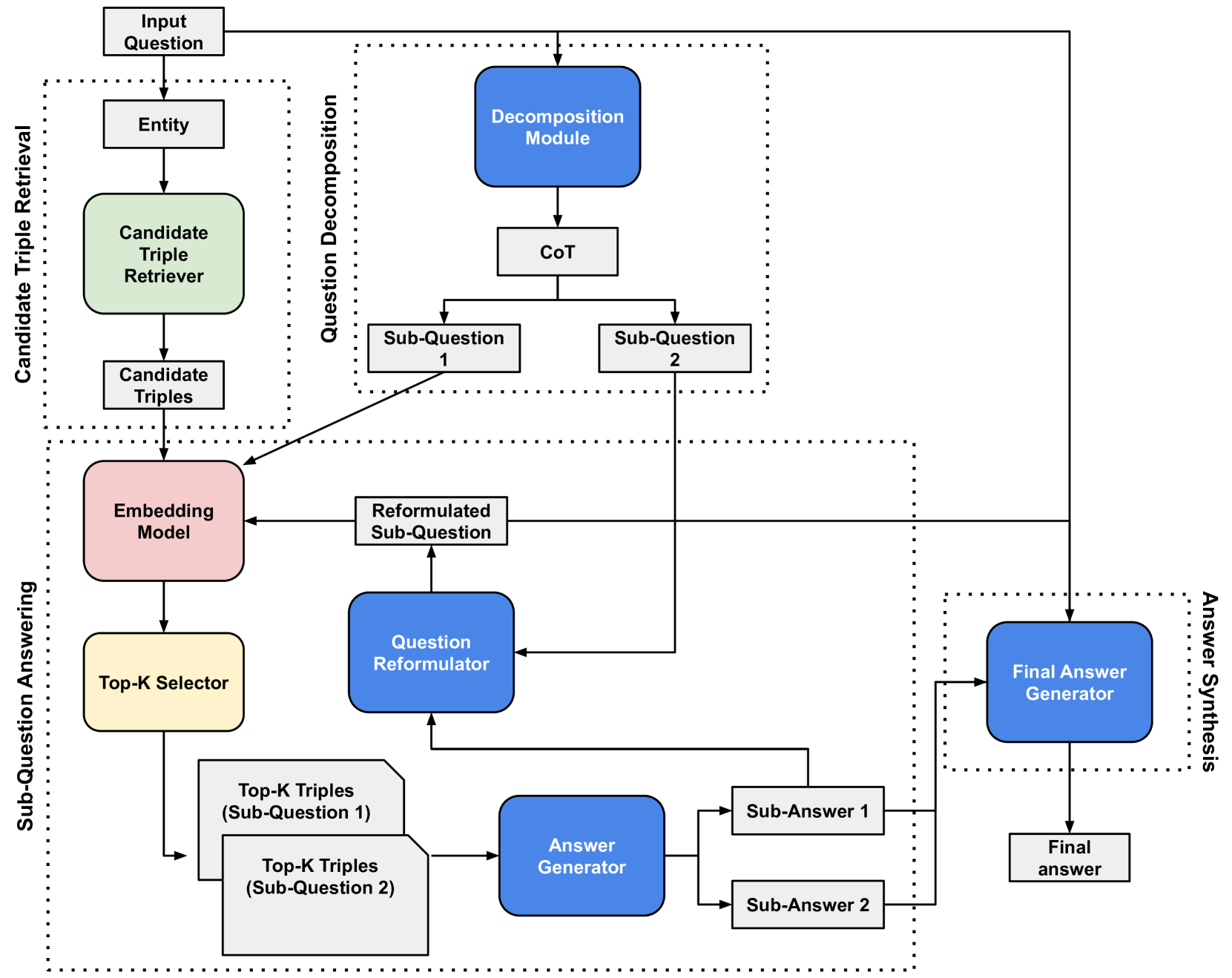
The diagram illustrates a multi-stage pipeline for processing an input question into a final answer. It involves decomposition, candidate retrieval, embedding, answer generation, and synthesis. Key components include modules for sub-question reformulation, triple retrieval, and answer synthesis.
### Components/Axes
- **Input**: "Input Question" (top-left).
- **Decomposition**: "Decomposition Module" (blue box) splits the input into two sub-questions ("Sub-Question 1" and "Sub-Question 2").
- **Candidate Retrieval**: "Candidate Triple Retriever" (green box) generates candidate triples from entities.
- **Embedding**: "Embedding Model" (pink box) processes triples into vectors.
- **Answer Generation**: "Answer Generator" (blue box) produces sub-answers for each sub-question.
- **Final Synthesis**: "Final Answer Generator" (blue box) combines sub-answers into a coherent final answer.
### Detailed Analysis
1. **Decomposition Module**:
- Splits the input question into two sub-questions (labeled "Sub-Question 1" and "Sub-Question 2").
- Uses a "CoT" (Chain of Thought) mechanism to guide decomposition.
2. **Candidate Triple Retriever**:
- Retrieves candidate triples (e.g., "Candidate Triples") from entities.
- Outputs to the "Embedding Model" for vectorization.
3. **Embedding Model**:
- Converts candidate triples into embeddings.
- Feeds into the "Top-K Selector" to prioritize relevant triples.
4. **Top-K Selector**:
- Selects top-K triples for each sub-question (e.g., "Top-K Triples (Sub-Question 1)" and "Top-K Triples (Sub-Question 2)").
5. **Question Reformulator**:
- Reforms sub-questions into "Reformulated Sub-Question" for improved clarity.
6. **Answer Generator**:
- Generates sub-answers ("Sub-Answer 1" and "Sub-Answer 2") for each sub-question.
7. **Final Answer Generator**:
- Synthesizes sub-answers into a "Final Answer" (bottom-right).
### Key Observations
- **Modular Design**: Each stage (decomposition, retrieval, embedding, generation) operates independently but sequentially.
- **Color Coding**:
- Blue boxes: Decomposition and answer generation modules.
- Green box: Candidate retrieval.
- Pink box: Embedding model.
- Yellow box: Top-K selector.
- **Flow Direction**: Arrows indicate a left-to-right, top-to-bottom progression from input to final answer.
### Interpretation
The system employs a hierarchical approach to handle complex questions:
1. **Decomposition** breaks down the input into manageable sub-questions, enabling focused retrieval.
2. **Candidate Retrieval** and **Embedding** ensure relevant information is prioritized via vector similarity.
3. **Answer Generation** and **Synthesis** combine sub-answers into a cohesive response, emphasizing coherence.
The use of "CoT" in decomposition suggests an emphasis on logical reasoning, while the "Top-K Selector" optimizes efficiency by filtering irrelevant data. The final answer generator’s role highlights the importance of integrating partial answers for accuracy.
**Note**: No numerical data or trends are present; the diagram focuses on structural relationships and process flow.