## Flowchart: Grammatical and Semantic Relationships with Embeddings
### Overview
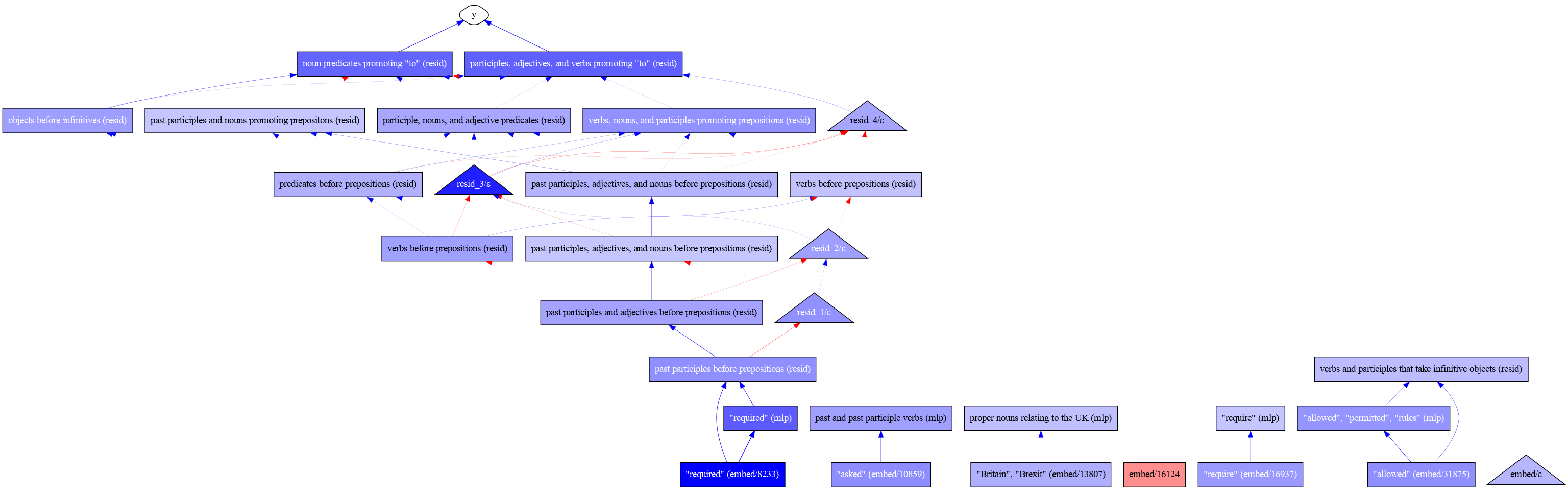
The image is a complex flowchart depicting hierarchical relationships between grammatical structures (e.g., nouns, verbs, participles) and their semantic embeddings. It includes nodes labeled with linguistic terms, prepositions, and embedding codes, connected by directional arrows. Triangles labeled with "resid_3/ε", "resid_4/ε", etc., appear to represent categorical or hierarchical groupings.
### Components/Axes
- **Nodes**:
- "noun predicates promoting 'to' (resid)"
- "participles, adjectives, and verbs promoting 'to' (resid)"
- "objects before infinitives (resid)"
- "past participles and nouns promoting prepositions (resid)"
- "participle, nouns, and adjective predicates (resid)"
- "verbs, nouns, and participles promoting prepositions (resid)"
- "predicates before prepositions (resid)"
- "verbs before prepositions (resid)"
- "past participles, adjectives, and nouns before prepositions (resid)"
- "past participles and adjectives before prepositions (resid)"
- "past participles before prepositions (resid)"
- "required" (embed/8233)
- "asked" (embed/10859)
- "Britain", "Brexit" (embed/13807)
- "require" (embed/16937)
- "allowed", "permitted", "rules" (mlp)
- "verbs and participles that take infinitive objects (resid)"
- "allowed" (embed/31875)
- "embed/ε" (triangle)
- **Triangles**:
- "resid_3/ε"
- "resid_4/ε"
- "resid_2/ε"
- "resid_1/ε"
- "embed/ε"
- **Arrows**:
- Blue arrows indicate hierarchical or causal relationships (e.g., "noun predicates promoting 'to' (resid)" → "objects before infinitives (resid)").
- Red arrows highlight specific dependencies (e.g., "resid_3/ε" → "resid_4/ε").
### Detailed Analysis
- **Grammatical Structures**:
- Nodes like "noun predicates promoting 'to' (resid)" and "participles, adjectives, and verbs promoting 'to' (resid)" suggest a focus on verbs and their modifiers that govern infinitives.
- "Objects before infinitives (resid)" and "past participles before prepositions (resid)" indicate positional relationships in sentence structure.
- **Embeddings**:
- Words like "required" (embed/8233), "asked" (embed/10859), and "Britain", "Brexit" (embed/13807) are linked to specific embedding codes, implying a computational model (e.g., word embeddings or machine learning parameters).
- "require" (embed/16937) and "allowed" (embed/31875) suggest semantic or syntactic roles in the model.
- **Hierarchical Groupings**:
- Triangles labeled "resid_3/ε", "resid_4/ε", etc., may represent tiers of grammatical categories or residual components in a parsing model.
- "embed/ε" (triangle) could denote a base or undefined embedding category.
### Key Observations
- **Red Arrows**: Highlight critical dependencies, such as "resid_3/ε" → "resid_4/ε" and "resid_2/ε" → "resid_1/ε", suggesting a stepwise refinement or categorization process.
- **Embedding Codes**: Numerical values (e.g., 8233, 10859) likely correspond to pre-trained embeddings or model parameters.
- **Semantic Roles**: Terms like "allowed", "permitted", and "rules" (mlp) imply a focus on permission or constraint-based grammar.
### Interpretation
The flowchart appears to model a **grammatical parsing or semantic analysis system**, where:
1. **Grammatical Relationships**: Nodes represent syntactic structures (e.g., prepositions, participles) and their roles in sentence formation.
2. **Embedding Integration**: Words and phrases are mapped to numerical embeddings, suggesting a machine learning or NLP framework.
3. **Hierarchical Categorization**: Triangles ("resid_3/ε", etc.) may denote layers of abstraction or residual components in a parsing algorithm.
**Notable Patterns**:
- The emphasis on "prepositions" and "infinitives" suggests a focus on complex syntactic structures.
- The inclusion of "Britain" and "Brexit" (embed/13807) implies domain-specific or contextual embeddings.
- The "required" (embed/8233) and "asked" (embed/10859) nodes might represent high-frequency or contextually significant terms.
**Anomalies**:
- The "embed/ε" triangle lacks a clear label, possibly indicating an undefined or placeholder category.
- The "mlp" (multi-layer perceptron) label on "allowed", "permitted", and "rules" suggests a neural network component, but its exact role is unclear without additional context.
This diagram likely serves as a visual representation of a computational model for analyzing or generating grammatical structures, with embeddings capturing semantic and syntactic relationships.