## Formal Inference Rules: Type System Subtyping Relations
### Overview
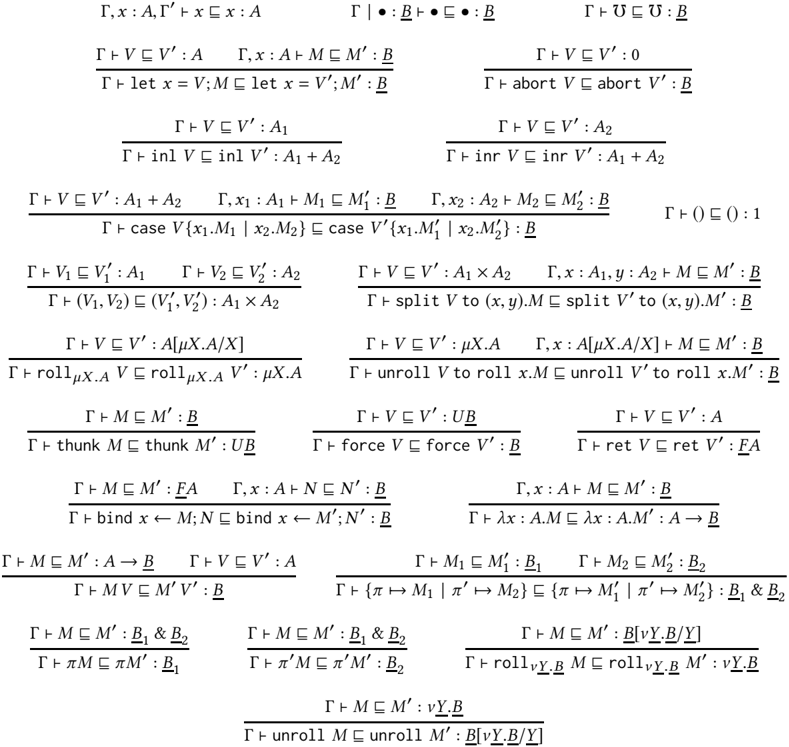
The image displays a collection of formal inference rules, likely from a type system or programming language theory paper. These rules define a subtyping or ordering relation (denoted by `⊑`) between terms (`V`, `M`) and types (`A`, `B`). The rules are presented in a standard natural deduction style, with premises above a horizontal line and the conclusion below. The notation uses a typing context `Γ`.
### Components/Axes
* **Primary Symbols:**
* `Γ`: Typing context.
* `⊢`: Turnstile, denoting "entails" or "proves".
* `⊑`: Subtyping or ordering relation.
* `: A`, `: B`: Type annotations.
* `⊆`: Appears to be a variant or specific form of the subtyping relation, often used with variables (`x ⊆ x`).
* **Type Constructors:**
* `A1 + A2`: Sum type (disjoint union).
* `A1 × A2`: Product type (tuple/record).
* `A[μX.A/X]`: Recursive type unfolding.
* `μX.A`: Recursive type.
* `U B`: Likely a "thunk" or suspended computation type.
* `F A`: Likely a "future" or monadic type.
* `A → B`: Function type.
* `B1 & B2`: Intersection type.
* `vY.B`: Appears to be a form of recursive type or binder (possibly "v" for "recursive variable").
* **Term Formers/Constructors:**
* `let x = V; M`: Let binding.
* `abort V`: Abort operation.
* `inl V`, `inr V`: Injections into sum types.
* `case V{x1.M1 | x2.M2}`: Case analysis on sum types.
* `(V1, V2)`: Tuple construction.
* `split V to (x,y).M`: Destructuring a product.
* `roll_μX.A V`, `unroll V to roll x.M`: Rolling/unrolling recursive types.
* `thunk M`, `force V`: Thunking and forcing delayed computations.
* `ret V`: Returning a value in a monadic context.
* `bind x ← M; N`: Monadic bind.
* `λx:A.M`: Lambda abstraction (function definition).
* `M V`: Function application.
* `{π ↦ M1 | π' ↦ M2}`: Record construction with labels `π`, `π'`.
* `πM`, `π'M`: Projection from a record.
* `roll_vY.B M`, `unroll M`: Another form of rolling/unrolling, possibly for a different recursive type construct.
### Detailed Analysis / Content Details
The image contains 24 distinct inference rules. Below is a transcription of each rule's conclusion (below the line), grouped by the type constructor they primarily involve. The premises are omitted for brevity but follow the standard pattern of requiring subtyping relations for the components.
**1. Base & Variable Rules:**
* `Γ ⊢ x ⊆ x : A` (Variable reflexivity)
* `Γ ⊢ • : B ⊢ • ⊆ • : B` (Empty context/base case)
* `Γ ⊢ U ⊆ U : B` (Thunk type subtyping)
**2. Let Binding & Abort:**
* `Γ ⊢ let x = V; M ⊆ let x = V'; M' : B`
* `Γ ⊢ abort V ⊆ abort V' : 0`
**3. Sum Types (+):**
* `Γ ⊢ inl V ⊆ inl V' : A1 + A2`
* `Γ ⊢ inr V ⊆ inr V' : A1 + A2`
* `Γ ⊢ case V{x1.M1 | x2.M2} ⊆ case V'{x1.M1' | x2.M2'} : B`
**4. Product Types (×):**
* `Γ ⊢ (V1, V2) ⊆ (V1', V2') : A1 × A2`
* `Γ ⊢ split V to (x,y).M ⊆ split V' to (x,y).M' : B`
**5. Recursive Types (μ):**
* `Γ ⊢ roll_μX.A V ⊆ roll_μX.A V' : μX.A`
* `Γ ⊢ unroll V to roll x.M ⊆ unroll V' to roll x.M' : B`
**6. Computational/Effect Types (U, F):**
* `Γ ⊢ thunk M ⊆ thunk M' : U B`
* `Γ ⊢ force V ⊆ force V' : B`
* `Γ ⊢ ret V ⊆ ret V' : F A`
* `Γ ⊢ bind x ← M; N ⊆ bind x ← M'; N' : B`
**7. Function Types (→):**
* `Γ ⊢ λx:A.M ⊆ λx:A.M' : A → B`
* `Γ ⊢ M V ⊆ M' V' : B`
**8. Intersection Types (&):**
* `Γ ⊢ {π ↦ M1 | π' ↦ M2} ⊆ {π ↦ M1' | π' ↦ M2'} : B1 & B2`
* `Γ ⊢ πM ⊆ πM' : B1`
* `Γ ⊢ π'M ⊆ π'M' : B2`
**9. Advanced Recursive/Unrolling (vY.B):**
* `Γ ⊢ roll_vY.B M ⊆ roll_vY.B M' : vY.B`
* `Γ ⊢ unroll M ⊆ unroll M' : B[vY.B/Y]`
### Key Observations
1. **Systematic Structure:** Every rule follows the same pattern: if the subtyping relation `⊑` holds for all components in the premises, then it holds for the constructed term in the conclusion. This is characteristic of a **coinductive** or **equational** definition of a relation.
2. **Underlined `B`:** The type `B` in the conclusion of many rules is underlined. This is a non-standard notation and may indicate that `B` is a specific, fixed type (like a "answer type" or "result type") in this system, or it could be a typographical emphasis from the source document.
3. **Two Flavors of Recursion:** The rules distinguish between `μX.A` (a standard recursive type) and `vY.B` (a less common construct, possibly a "recursive type in negative position" or a "recursive computation type"). The unrolling rule for `vY.B` involves a substitution `B[vY.B/Y]`.
4. **Effect System:** The presence of `U` (thunk), `F` (future/monad), `ret`, and `bind` strongly suggests this is a **type system for a language with computational effects** (like state, exceptions, or I/O), managed via monads or similar constructs.
5. **No Axiom for `⊑` Itself:** The image does not show a reflexivity or transitivity rule for `⊑` as a standalone relation. Its properties are entirely defined by its interaction with the term and type formers.
### Interpretation
This image presents the **core equational theory or subtyping rules for a sophisticated type system**. The system appears designed for a functional programming language with:
* **Algebraic Data Types:** Sum (`+`) and Product (`×`) types.
* **Recursive Types:** At least two distinct forms (`μ` and `v`).
* **Effect Handling:** Via thunks (`U`), monads (`F`, `ret`, `bind`), and explicit `abort`.
* **Intersection Types:** (`&`), allowing terms to have multiple types simultaneously.
The relation `⊑` likely represents **contextual equivalence**, **bisimulation**, or a **preorder on terms** that is sound with respect to some notion of program behavior. The rules are **compositional**: the relation on complex terms is defined purely from the relation on their immediate subterms. This is a foundational piece for proving properties like type safety, compiler optimizations (e.g., inlining, dead code elimination), or program equivalence in a language with effects and recursion. The underlined `B` might be a key technical device, perhaps representing the "type of observations" or "return type" in a coinductive definition of behavioral equivalence.