## Logical Rules Diagram: Type System Inference Rules
### Overview
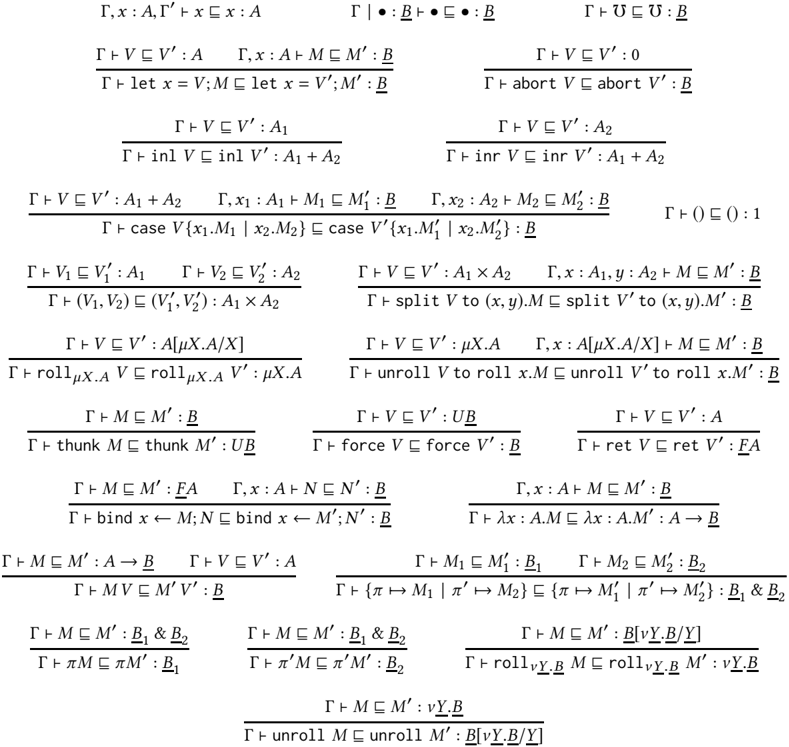
The image depicts a formal system of logical inference rules, likely from a type theory or programming language semantics context. It consists of 25+ rules organized in a grid-like structure, each representing a type-preserving transformation or operational behavior. Rules involve variables (`x`, `M`, `V`), types (`A`, `B`), and operations (`let`, `case`, `split`, `roll`, `unroll`, etc.).
### Components/Axes
- **Structure**: Rules are presented as horizontal lines with premises (above the line) and conclusions (below the line).
- **Symbols**:
- `Γ ⊢ ...` : Type context entailment
- `⊆` : Subtyping or inclusion
- `→` : Function type
- `∧` : Logical conjunction (and)
- `∨` : Logical disjunction (or)
- `μ` : Type constructor (e.g., for recursive types)
- `λ` : Lambda abstraction
- `∀` : Universal quantification
- **Operations**:
- `let`, `case`, `split`, `roll`, `unroll`, `thunk`, `force`, `bind`, `ret`, `abort`, `inl`, `inr`
### Detailed Analysis
1. **Substitution Rule**:
```
Γ ⊢ V ⊆ V' : A
Γ, x : A, M ⊆ M' : B
------------------------
Γ ⊢ let x = V; M ⊆ let x = V'; M' : B
```
Preserves subtyping under variable binding.
2. **Case Analysis**:
```
Γ ⊢ V ⊆ V' : A₁ + A₂
Γ, x₁ : A₁, M₁ ⊆ M'₁ : B
Γ, x₂ : A₂, M₂ ⊆ M'₂ : B
-----------------------------------------
Γ ⊢ case V{x₁.M₁ | x₂.M₂} ⊆ case V'{x₁.M'₁ | x₂.M'₂} : B
```
Handles sum types (`A₁ + A₂`) with pattern matching.
3. **Pair Splitting**:
```
Γ ⊢ V ⊆ V' : A₁ × A₂
Γ, x : A₁, y : A₂, M ⊆ M' : B
----------------------------------------
Γ ⊢ split V to (x,y).M ⊆ split V' to (x,y).M' : B
```
Deconstructs pairs into components.
4. **Monadic Operations**:
- **Roll/Unroll**:
```
Γ ⊢ V ⊆ V' : μX.A
Γ ⊢ roll V ⊆ roll V' : μX.A
```
Encapsulates values in a monad (`μX.A`).
- **Thunk/Force**:
```
Γ ⊢ M ⊆ M' : U B
Γ ⊢ thunk M ⊆ thunk M' : U B
Γ ⊢ force V ⊆ force V' : B
```
Manages lazy evaluation.
5. **Error Handling**:
```
Γ ⊢ () ⊆ () : 1
Γ ⊢ abort V ⊆ abort V' : B
```
Represents unit type and error propagation.
6. **Binding/Return**:
```
Γ ⊢ M ⊆ M' : F A
Γ, x : A, N ⊆ N' : B
----------------------------------------
Γ ⊢ bind x ← M; N ⊆ bind x ← M'; N' : B
```
Chains monadic actions.
### Key Observations
- **Type Preservation**: All rules ensure that operations preserve subtyping (`⊆`).
- **Monadic Structure**: Rules for `roll`, `unroll`, `bind`, and `force` suggest a monadic type system (e.g., for IO or state).
- **Sum/Prod Types**: Explicit handling of `A₁ + A₂` (sum) and `A₁ × A₂` (product) types.
- **Error Propagation**: `abort` and `ret` rules indicate explicit error handling.
### Interpretation
This system formalizes a **strongly typed, effectful programming language** with:
1. **Type Safety**: Subtyping ensures operations respect type constraints.
2. **Computational Effects**: Monadic operations (`roll`, `bind`) manage side effects (e.g., IO, state).
3. **Pattern Matching**: `case` and `split` rules enable algebraic data type deconstruction.
4. **Lazy Evaluation**: `thunk`/`force` rules support non-strict semantics.
The rules collectively define a **calculus of constructions** or **dependent type system**, where types can depend on terms (e.g., `μX.A`). The presence of `abort` and `ret` suggests a **sum type for errors** (`A + B`), common in total functional languages.
No numerical data or trends are present; the focus is on syntactic and semantic rules for type checking and program behavior.