\n
## Diagram: Visual Preference Task Choices
### Overview
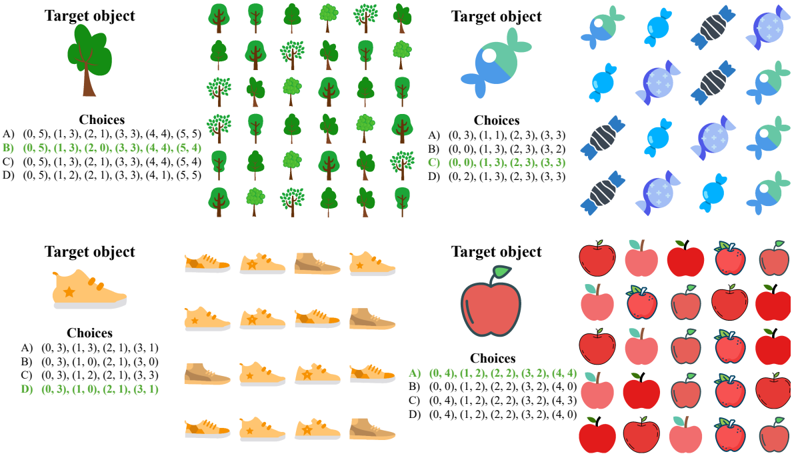
The image presents four separate visual preference tasks. Each task displays a "Target object" alongside four "Choices" represented by sets of objects with associated numerical tuples. The tasks involve different object categories: trees, fish, shoes, and apples. The numerical tuples likely represent some feature vector or attribute associated with each choice.
### Components/Axes
Each task is structured as follows:
* **Target object:** A single, larger image of the object being compared.
* **Choices:** Four sets of smaller images, each with a corresponding numerical tuple.
* **Labels:** Each choice is labeled A, B, C, and D.
* **Numerical Tuples:** Each choice has a tuple of five numbers in parentheses, e.g., (0, 5), (1, 3), etc.
### Detailed Analysis or Content Details
**Task 1: Trees**
* Target object: A green tree with red apples.
* Choice A: Five green trees with tuple (0, 5), (1, 3), (2, 1), (3, 3), (4, 5).
* Choice B: Four green trees with tuple (0, 5), (1, 3), (2, 0), (3, 3), (4, 4).
* Choice C: Five green trees with tuple (0, 5), (1, 3), (2, 1), (3, 3), (4, 5).
* Choice D: Five green trees with tuple (0, 5), (1, 2), (2, 1), (3, 3), (4, 1), (5, 5).
**Task 2: Fish**
* Target object: A blue fish.
* Choice A: Three blue fish with tuple (0, 3), (1, 1), (2, 3), (3, 3).
* Choice B: Three blue fish with tuple (0, 0), (1, 3), (2, 3), (3, 2).
* Choice C: Three blue fish with tuple (0, 0), (1, 3), (2, 3), (3, 3).
* Choice D: Three blue fish with tuple (0, 2), (1, 3), (2, 3), (3, 3).
**Task 3: Shoes**
* Target object: A yellow sneaker.
* Choice A: Three yellow sneakers with tuple (0, 0), (1, 3), (2, 1), (3, 1).
* Choice B: Two yellow sneakers and one brown shoe with tuple (0, 0), (1, 0), (2, 1), (3, 0).
* Choice C: Three yellow sneakers with tuple (0, 3), (1, 2), (2, 1), (3, 1).
* Choice D: Three yellow sneakers with tuple (0, 3), (1, 0), (2, 1), (3, 1).
**Task 4: Apples**
* Target object: A red apple.
* Choice A: Four red apples with tuple (0, 4), (1, 2), (2, 2), (3, 2), (4, 4).
* Choice B: Two red apples and two purple apples with tuple (0, 0), (1, 2), (2, 2), (3, 2), (4, 0).
* Choice C: Four red apples with tuple (0, 4), (1, 2), (2, 2), (3, 2), (4, 4).
* Choice D: Four red apples with tuple (0, 4), (1, 2), (2, 3), (3, 2), (4, 0).
### Key Observations
* The numerical tuples appear to be consistent within each choice set, but vary across choices.
* The tuples likely represent features of the objects, such as color, size, shape, or texture.
* The tasks are designed to assess visual preferences based on these features.
* Some choices include objects that differ from the target object (e.g., brown shoe in the sneaker task, purple apples in the apple task).
### Interpretation
This diagram illustrates a visual preference task, likely used in a study of perception, cognition, or machine learning. The goal is to understand how individuals (or algorithms) choose between different visual stimuli based on their features. The numerical tuples represent a quantifiable description of these features. The tasks are designed to test how sensitive subjects are to variations in these features. The inclusion of slightly different objects within the choices (e.g., the brown shoe) suggests that the study is also investigating how subjects handle variations in object category. The data collected from these tasks could be used to train a model to predict human visual preferences or to understand the underlying neural mechanisms of visual perception. The tuples could represent a feature vector, and the task is to determine which feature vector is most similar to the target object.