## Tree Diagram: Hierarchical Node Network with Weighted Edges
### Overview
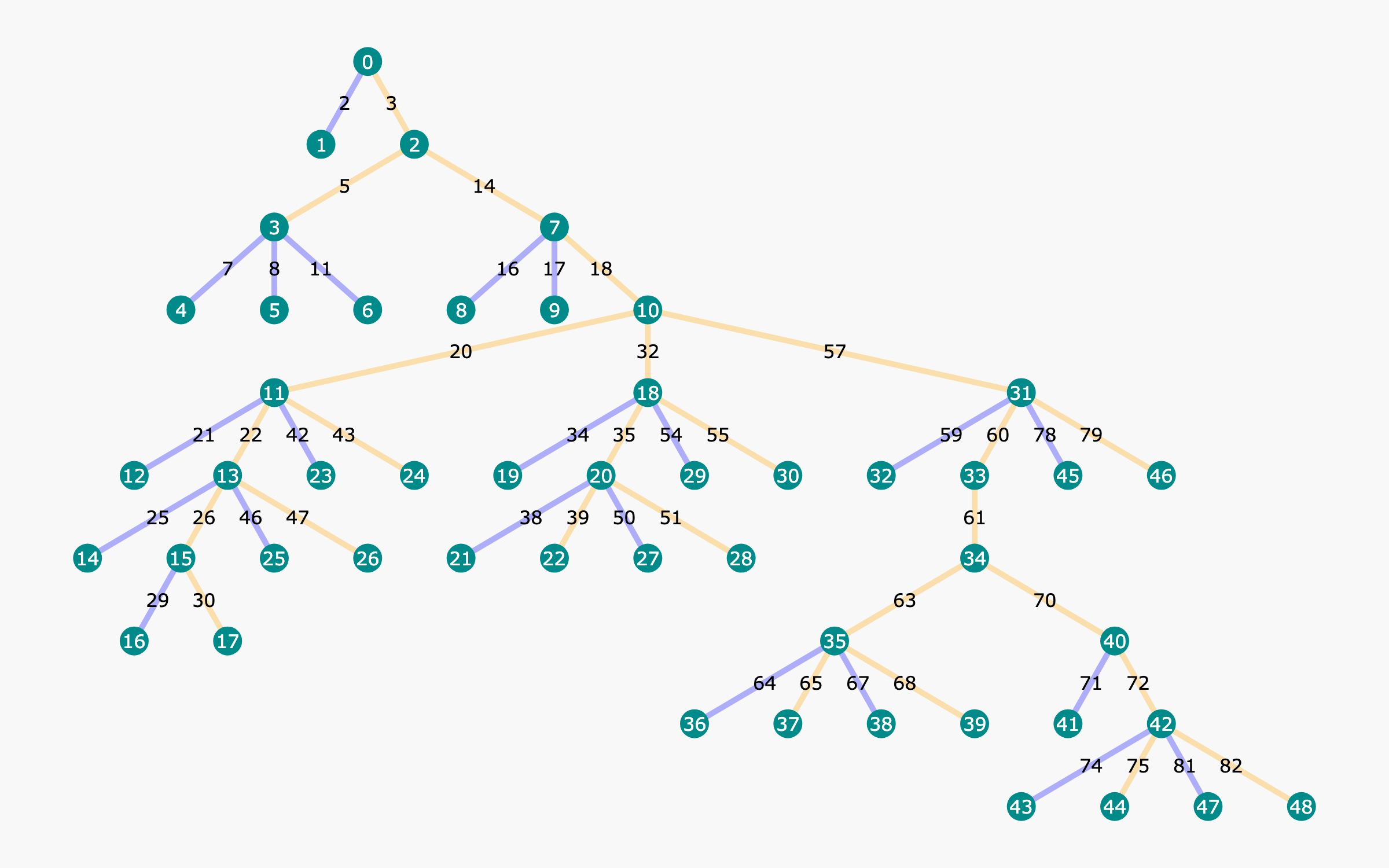
The image displays a hierarchical tree diagram (or directed graph) with a root node at the top, branching downward into multiple levels. The diagram consists of numbered circular nodes connected by lines (edges). Each edge is labeled with a numerical value and is colored either purple or beige. The structure is complex, with varying branching factors at different nodes.
### Components/Axes
* **Nodes:** Represented as teal circles with white numbers inside. The root node is labeled **0**.
* **Edges:** Lines connecting nodes. Each edge has a numerical label placed near its midpoint.
* **Edge Color Coding:**
* **Purple Edges:** Connect certain parent-child node pairs.
* **Beige (Light Orange) Edges:** Connect other parent-child node pairs.
* *Note: There is no explicit legend provided in the image. The color distinction is visually clear but its semantic meaning (e.g., edge type, weight category) is not defined.*
* **Spatial Layout:** The tree is laid out top-down. The root (0) is at the top center. The tree expands significantly in width and depth towards the bottom, with the deepest nodes (e.g., 43, 44, 47, 48) located at the bottom-right.
### Detailed Analysis
**Node and Edge Inventory (Traced from Root):**
The following is a systematic trace of the tree structure. For each parent node, its children and the connecting edge's label and color are listed.
* **Node 0 (Root):**
* → Node 1 (Edge: 2, Purple)
* → Node 2 (Edge: 3, Beige)
* **Node 1:** Leaf node (no children).
* **Node 2:**
* → Node 3 (Edge: 5, Beige)
* → Node 7 (Edge: 14, Beige)
* **Node 3:**
* → Node 4 (Edge: 7, Purple)
* → Node 5 (Edge: 8, Purple)
* → Node 6 (Edge: 11, Purple)
* **Node 4, 5, 6:** Leaf nodes.
* **Node 7:**
* → Node 8 (Edge: 16, Purple)
* → Node 9 (Edge: 17, Purple)
* → Node 10 (Edge: 18, Beige)
* **Node 8, 9:** Leaf nodes.
* **Node 10:**
* → Node 11 (Edge: 20, Beige)
* → Node 18 (Edge: 32, Beige)
* → Node 31 (Edge: 57, Beige)
* **Node 11:**
* → Node 12 (Edge: 21, Purple)
* → Node 13 (Edge: 22, Purple)
* → Node 23 (Edge: 42, Purple)
* → Node 24 (Edge: 43, Beige)
* **Node 12:** Leaf node.
* **Node 13:**
* → Node 14 (Edge: 25, Purple)
* → Node 15 (Edge: 26, Purple)
* → Node 25 (Edge: 46, Purple)
* → Node 26 (Edge: 47, Beige)
* **Node 14:** Leaf node.
* **Node 15:**
* → Node 16 (Edge: 29, Purple)
* → Node 17 (Edge: 30, Beige)
* **Node 16, 17, 23, 24, 25, 26:** Leaf nodes.
* **Node 18:**
* → Node 19 (Edge: 34, Purple)
* → Node 20 (Edge: 35, Purple)
* → Node 29 (Edge: 54, Purple)
* → Node 30 (Edge: 55, Beige)
* **Node 19:** Leaf node.
* **Node 20:**
* → Node 21 (Edge: 38, Purple)
* → Node 22 (Edge: 39, Purple)
* → Node 27 (Edge: 50, Purple)
* → Node 28 (Edge: 51, Beige)
* **Node 21, 22, 27, 28, 29, 30:** Leaf nodes.
* **Node 31:**
* → Node 32 (Edge: 59, Purple)
* → Node 33 (Edge: 60, Purple)
* → Node 45 (Edge: 78, Purple)
* → Node 46 (Edge: 79, Beige)
* **Node 32, 45, 46:** Leaf nodes.
* **Node 33:**
* → Node 34 (Edge: 61, Beige)
* **Node 34:**
* → Node 35 (Edge: 63, Beige)
* → Node 40 (Edge: 70, Beige)
* **Node 35:**
* → Node 36 (Edge: 64, Purple)
* → Node 37 (Edge: 65, Purple)
* → Node 38 (Edge: 67, Purple)
* → Node 39 (Edge: 68, Beige)
* **Node 36, 37, 38, 39:** Leaf nodes.
* **Node 40:**
* → Node 41 (Edge: 71, Purple)
* → Node 42 (Edge: 72, Beige)
* **Node 41:** Leaf node.
* **Node 42:**
* → Node 43 (Edge: 74, Purple)
* → Node 44 (Edge: 75, Purple)
* → Node 47 (Edge: 81, Purple)
* → Node 48 (Edge: 82, Beige)
* **Node 43, 44, 47, 48:** Leaf nodes.
### Key Observations
1. **Asymmetric Growth:** The tree is not balanced. The rightmost branch (from node 10 → 31 → 33 → 34...) is the deepest and most complex, containing the highest-numbered nodes (up to 48).
2. **Edge Label Pattern:** The numerical labels on edges generally increase as one moves from the root down and from left to right across the tree. The smallest label is **2** (edge 0→1) and the largest is **82** (edge 42→48).
3. **Branching Factor:** Nodes have varying numbers of children (from 1 to 4). Nodes 10, 11, 13, 18, 20, 31, 35, and 42 are significant branching points with 3 or 4 children.
4. **Color Distribution:** Purple edges are more frequent in the left and central sub-trees and on the final branches leading to leaf nodes. Beige edges are prominent on the main "spine" connecting major sub-roots (e.g., 0→2, 2→7, 7→10, 10→18, 10→31, 31→33, 33→34, 34→40, 40→42).
### Interpretation
This diagram represents a **weighted, directed tree structure**. The nodes likely represent states, entities, or data points, while the edges represent relationships, transitions, or connections between them. The numerical edge labels are most probably **weights, costs, distances, or capacities** associated with each connection.
The color coding (purple vs. beige) suggests a categorical distinction between types of relationships or edges. Without a legend, plausible hypotheses include:
* **Primary vs. Secondary Paths:** Beige edges may form the core backbone or primary pathways, while purple edges represent secondary or alternative branches.
* **Edge Type or Property:** The colors could denote different protocols, data types, or confidence levels in a network.
* **Algorithmic Output:** The diagram could visualize the output of a graph algorithm (like a shortest-path tree or a clustering result), where color indicates the algorithm's decision or the edge's inclusion in a specific set.
The increasing numerical labels suggest an ordering, possibly a traversal order (like a breadth-first or depth-first search indexing) or a cumulative weight metric. The structure's asymmetry indicates that the underlying system it models is not uniform; some nodes (like 10, 31, 34, 42) are critical hubs with high connectivity, while others are terminal points. This is characteristic of many real-world networks, such as organizational charts, decision trees, computer network topologies, or phylogenetic trees.