## Binary Tree Diagram: Hierarchical Structure with Node Numbering
### Overview
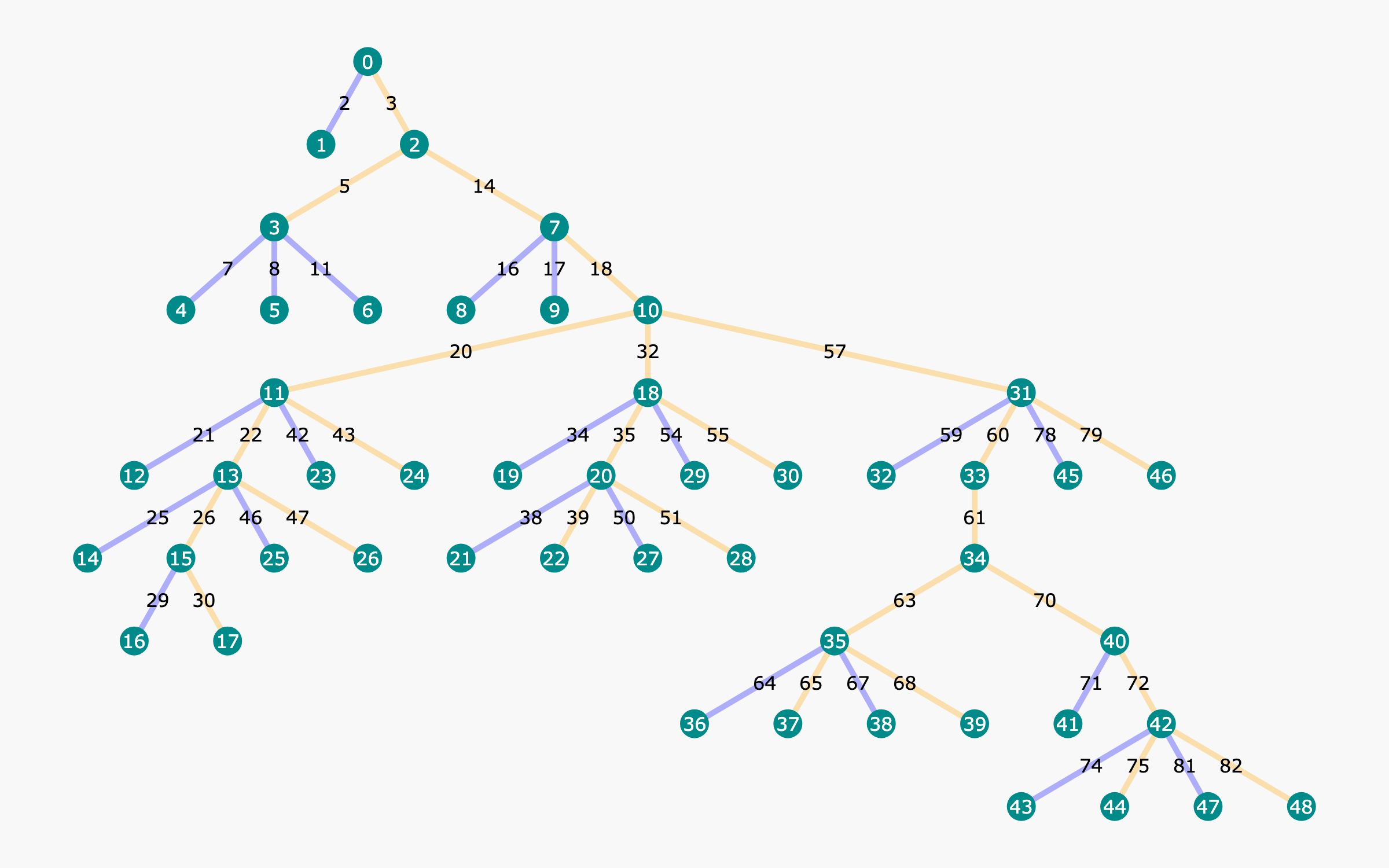
The image depicts a binary tree diagram with nodes numbered from 0 to 82. The tree is structured hierarchically, with each node having two children. The left child of a node `n` is calculated as `2n + 1`, and the right child as `2n + 2`. Nodes are color-coded: **teal** nodes contain their own numbers, while **orange** nodes display the numbers of their children. The tree is truncated at the 82nd node, indicating an incomplete final level.
---
### Components/Axes
- **Nodes**:
- **Teal Nodes**: Contain their own numerical labels (e.g., 0, 1, 2, 3, ..., 82).
- **Orange Nodes**: Display the numbers of their children (e.g., node 0 shows "1" and "2", node 2 shows "5" and "6").
- **Edges**: Connect parent nodes to their children, following the binary tree structure.
- **Legend**:
- **Teal**: Represents nodes with their own numbers.
- **Orange**: Represents nodes displaying their children's numbers.
- **Positioning**:
- **Root Node (0)**: Top-center of the diagram.
- **Legend**: Located on the right side of the diagram.
- **Nodes**: Arranged in levels, with each level branching left and right.
---
### Detailed Analysis
#### Node Numbering and Structure
- **Level 0**: Root node `0` (teal).
- **Level 1**: Children of `0` are `1` (orange) and `2` (orange). These nodes display their children's numbers: `1` shows "3" and "5", `2` shows "5" and "6".
- **Level 2**:
- Node `1` (orange) has children `3` (teal) and `5` (teal).
- Node `2` (orange) has children `5` (teal) and `6` (teal).
- **Level 3**:
- Node `3` (teal) has children `7` (orange) and `8` (orange).
- Node `5` (teal) has children `11` (orange) and `12` (orange).
- Node `6` (teal) has children `13` (orange) and `14` (orange).
- **Subsequent Levels**: Continue recursively, with each node's children calculated as `2n + 1` (left) and `2n + 2` (right). The tree is truncated at node `82`, which is the rightmost node on the final visible level.
#### Color Coding
- **Teal Nodes**: Always contain their own numerical labels (e.g., `0`, `1`, `3`, `5`, `7`, etc.).
- **Orange Nodes**: Display the numbers of their children (e.g., node `0` shows "1" and "2", node `2` shows "5" and "6").
#### Truncation
- The tree is incomplete at the final level. The last visible node is `82`, which is the right child of node `40` (orange). The full level would include nodes up to `126` (for level 6), but the diagram stops at `82`.
---
### Key Observations
1. **Perfect Binary Tree Structure**: The tree follows a strict hierarchical pattern where each node has exactly two children, except for the truncated final level.
2. **Color-Coded Hierarchy**: Teal nodes represent parent nodes with their own numbers, while orange nodes act as "child indicators" showing the numbers of their children.
3. **Truncation at Node 82**: The diagram is cut off before completing the final level, leaving the tree incomplete.
4. **Consistency in Numbering**: The left child of a node `n` is always `2n + 1`, and the right child is `2n + 2`, ensuring no conflicts in numbering.
---
### Interpretation
- **Hierarchical Relationships**: The tree visually represents a binary tree structure, with each level doubling the number of nodes. This is critical for understanding data structures like heaps or priority queues.
- **Color Coding Purpose**: The teal/orange distinction helps differentiate between parent nodes (teal) and their child references (orange), aiding in visual parsing of the tree's structure.
- **Truncation Implications**: The incomplete final level suggests the diagram is a simplified representation, possibly for illustrative purposes. A full binary tree would require 127 nodes (levels 0–6), but the diagram stops at 82, indicating a partial or truncated view.
- **Mathematical Foundation**: The formulas `2n + 1` (left) and `2n + 2` (right) ensure a deterministic and non-overlapping numbering system, which is essential for algorithms like heap operations or tree traversal.
---
### Final Notes
The diagram effectively illustrates the principles of binary tree construction, emphasizing hierarchical relationships and numerical patterns. The color coding and truncation highlight both the structure's logic and its practical limitations in visualization.