## Bar Chart: Solve Rate Comparison Across Prompting Techniques
### Overview
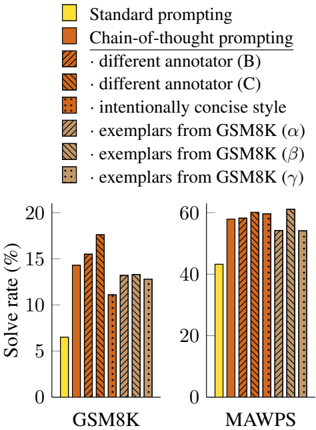
The image is a grouped bar chart comparing solve rates (%) for two models (GSM8K and MAWPS) across six prompting techniques. The chart uses color-coded bars with distinct patterns to differentiate methods, with a legend on the right. Solve rates range from 0% to 60% on the y-axis, and models are labeled on the x-axis.
### Components/Axes
- **X-axis**: Model names ("GSM8K" and "MAWPS"), positioned at the bottom.
- **Y-axis**: "Solve rate (%)", scaled from 0 to 60 in increments of 20.
- **Legend**: Located on the right, with six entries:
1. **Standard prompting** (solid yellow)
2. **Chain-of-thought prompting** (solid orange)
3. **Different annotator (B)** (orange with diagonal stripes)
4. **Different annotator (C)** (orange with dots)
5. **Intentionally concise style** (beige with diagonal stripes)
6. **Exemplars from GSM8K (α/β/γ)** (beige with dots, grouped under one legend entry).
### Detailed Analysis
#### GSM8K Bars (Left Group)
- **Standard prompting** (yellow): ~6% solve rate.
- **Chain-of-thought prompting** (orange): ~15%.
- **Different annotator (B)** (striped orange): ~18%.
- **Different annotator (C)** (dotted orange): ~12%.
- **Intentionally concise style** (striped beige): ~13%.
- **Exemplars from GSM8K (α/β/γ)** (dotted beige): ~14%.
#### MAWPS Bars (Right Group)
- **Standard prompting** (yellow): ~42%.
- **Chain-of-thought prompting** (orange): ~58%.
- **Different annotator (B)** (striped orange): ~59%.
- **Different annotator (C)** (dotted orange): ~57%.
- **Intentionally concise style** (striped beige): ~55%.
- **Exemplars from GSM8K (α/β/γ)** (dotted beige): ~56%.
### Key Observations
1. **Model Performance**: MAWPS consistently outperforms GSM8K across all prompting techniques (e.g., MAWPS's "Chain-of-thought" at 58% vs. GSM8K's 15%).
2. **Prompting Technique Impact**:
- **Chain-of-thought prompting** and **exemplars from GSM8K** yield the highest solve rates for both models.
- **Different annotators (B/C)** show mixed results, with B slightly outperforming C in GSM8K but underperforming in MAWPS.
- **Intentionally concise style** performs poorly in GSM8K (~13%) but moderately in MAWPS (~55%).
3. **Data Trends**:
- GSM8K bars are shorter and more variable (6–18%).
- MAWPS bars are taller and more consistent (42–59%).
### Interpretation
The data suggests that **MAWPS is inherently more capable** than GSM8K, as evidenced by its higher baseline solve rates. Prompting techniques like **Chain-of-thought** and **GSM8K exemplars** significantly enhance performance for both models, with MAWPS benefiting more from these methods. The use of **different annotators** introduces variability, with annotator B generally performing better than C. The **intentionally concise style** underperforms in GSM8K but remains viable for MAWPS, indicating that model architecture may mitigate the drawbacks of overly simplified prompts. The legend's grouping of α/β/γ exemplars under one category implies they are treated as a unified approach, despite potential differences in their individual contributions.