## Task Suite: Reasoning with Visual World Modeling
### Overview
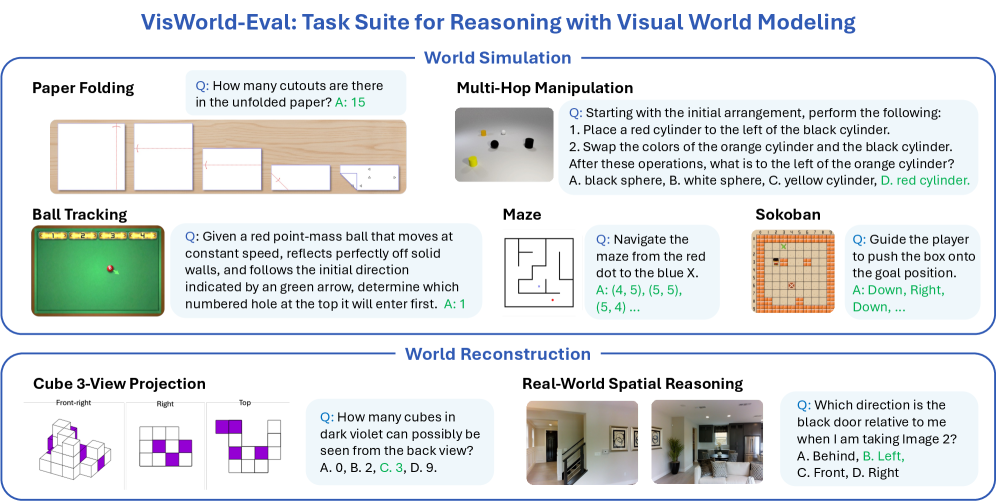
The image presents a suite of visual reasoning tasks, categorized into "World Simulation" and "World Reconstruction." Each task involves a visual scenario, a question, and a set of possible answers. The tasks range from paper folding and ball tracking to maze navigation, cube projection, and real-world spatial reasoning.
### Components/Axes
**Header:**
* Title: "VisWorld-Eval: Task Suite for Reasoning with Visual World Modeling"
**Categories:**
* World Simulation: Contains Paper Folding, Multi-Hop Manipulation, Ball Tracking, Maze, and Sokoban tasks.
* World Reconstruction: Contains Cube 3-View Projection and Real-World Spatial Reasoning tasks.
**Task Components (General Structure):**
* Visual Scenario: An image or diagram depicting the task.
* Question (Q): A textual question related to the visual scenario.
* Answer Options (A): A set of possible answers, labeled A, B, C, D.
### Detailed Analysis or ### Content Details
**World Simulation Tasks:**
* **Paper Folding:**
* Visual: A sequence of images showing a paper being folded and cut.
* Question: "How many cutouts are there in the unfolded paper?"
* Answer: "A: 15"
* **Multi-Hop Manipulation:**
* Visual: An image showing colored cylinders and spheres.
* Question: "Starting with the initial arrangement, perform the following: 1. Place a red cylinder to the left of the black cylinder. 2. Swap the colors of the orange cylinder and the black cylinder. After these operations, what is to the left of the orange cylinder?"
* Answer: "A. black sphere, B. white sphere, C. yellow cylinder, D. red cylinder."
* **Ball Tracking:**
* Visual: A top-down view of a rectangular area with numbered holes along the top edge and a red ball inside. A green arrow indicates the initial direction.
* Question: "Given a red point-mass ball that moves at constant speed, reflects perfectly off solid walls, and follows the initial direction indicated by an green arrow, determine which numbered hole at the top it will enter first."
* Answer: "A: 1"
* **Maze:**
* Visual: A simple maze with a red dot at the start and a blue X at the end.
* Question: "Navigate the maze from the red dot to the blue X."
* Answer: "A: (4, 5), (5, 5), (5, 4) ..."
* **Sokoban:**
* Visual: A Sokoban puzzle with a grid, a box, and a goal position marked with an "X".
* Question: "Guide the player to push the box onto the goal position."
* Answer: "A: Down, Right, Down, ..."
**World Reconstruction Tasks:**
* **Cube 3-View Projection:**
* Visual: Three views (Front-right, Right, Top) of a cube structure, with some cubes colored dark violet.
* Question: "How many cubes in dark violet can possibly be seen from the back view?"
* Answer: "A. 0, B. 2, C. 3, D. 9."
* **Real-World Spatial Reasoning:**
* Visual: Two images of an interior space, including a black door.
* Question: "Which direction is the black door relative to me when I am taking Image 2?"
* Answer: "A. Behind, B. Left, C. Front, D. Right"
### Key Observations
* The tasks cover a range of visual reasoning skills, including spatial reasoning, object manipulation, and path planning.
* Each task presents a clear question and a set of possible answers.
* The visual scenarios vary in complexity, from simple diagrams to real-world images.
### Interpretation
The "VisWorld-Eval" task suite is designed to assess a system's ability to reason about visual information and solve problems in simulated and real-world environments. The tasks require a combination of visual perception, spatial reasoning, and logical inference. The suite could be used to evaluate the performance of AI models on tasks that require understanding and interacting with the visual world. The variety of tasks ensures a comprehensive evaluation of visual reasoning capabilities.