## Task Suite for Reasoning with Visual World Modeling
### Overview
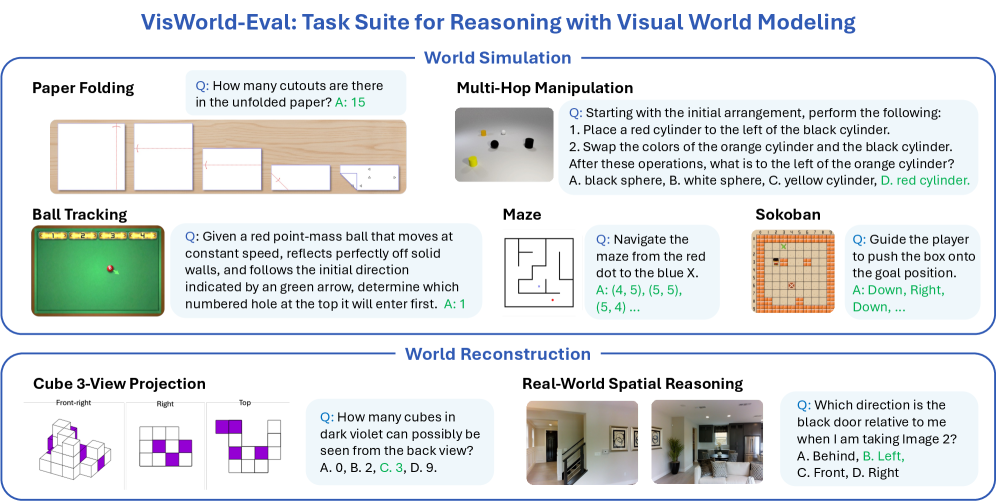
The image presents a structured task suite divided into two sections: **World Simulation** and **World Reconstruction**. Each section contains multiple tasks with visual diagrams, questions, and answers. The tasks evaluate reasoning skills such as spatial manipulation, problem-solving, and perspective analysis.
---
### Components/Axes
#### World Simulation
1. **Paper Folding**
- **Question**: "How many cutouts are there in the unfolded paper?"
- **Answer**: A: 15
- **Visual**: Diagram of folded paper with creases and cutouts.
2. **Multi-Hop Manipulation**
- **Question**: "Starting with the initial arrangement, perform the following: 1. Place a red cylinder to the left of the black cylinder. 2. Swap the colors of the orange cylinder and the black cylinder. After these operations, what is to the left of the orange cylinder?"
- **Answer**: A: black sphere, B: white sphere, C: yellow cylinder, D: red cylinder.
- **Visual**: Diagram of colored cylinders with positional instructions.
3. **Ball Tracking**
- **Question**: "Given a red-point-mass ball that moves at constant speed, reflects perfectly off solid walls, and follows the initial direction indicated by a green arrow, determine which numbered hole at the top it will enter first."
- **Answer**: A: 1
- **Visual**: Pool table with a red ball and green directional arrow.
4. **Maze**
- **Question**: "Navigate the maze from the red dot to the blue X."
- **Answer**: A: (4, 5), (5, 5), (5, 4), ...
- **Visual**: Grid-based maze with red start and blue goal.
5. **Sokoban**
- **Question**: "Guide the player to push the box onto the goal position."
- **Answer**: A: Down, Right, Down, ...
- **Visual**: Sokoban grid with boxes, goals, and player.
#### World Reconstruction
1. **Cube 3-View Projection**
- **Question**: "How many cubes in dark violet can possibly be seen from the back view?"
- **Answer**: A: 0, B: 2, C: 3, D: 9
- **Visual**: Front-right, right, and top views of a cube structure.
2. **Real-World Spatial Reasoning**
- **Question**: "Which direction is the black door relative to me when I am taking Image 2?"
- **Answer**: A: Behind, B: Left, C: Front, D: Right
- **Visual**: Two interior room images showing door positions.
---
### Detailed Analysis
- **World Simulation Tasks**:
- **Paper Folding**: Focuses on spatial reasoning and geometric transformations.
- **Multi-Hop Manipulation**: Tests sequential action planning and color/symbol tracking.
- **Ball Tracking**: Evaluates physics-based trajectory prediction.
- **Maze**: Requires pathfinding and coordinate-based navigation.
- **Sokoban**: Combines spatial reasoning with sequential movement constraints.
- **World Reconstruction Tasks**:
- **Cube 3-View Projection**: Assesses 3D visualization from 2D projections.
- **Real-World Spatial Reasoning**: Tests egocentric perspective and environmental navigation.
---
### Key Observations
1. **Structured Format**: Each task includes a question, answer options, and a visual diagram.
2. **Task Diversity**: Tasks span abstract (e.g., paper folding) and real-world scenarios (e.g., maze navigation).
3. **Answer Specificity**: Answers are labeled with letters (A-D) and include numerical or directional responses.
4. **Visual Consistency**: Diagrams align with task descriptions (e.g., maze grid matches coordinate answers).
---
### Interpretation
This task suite evaluates **visual world modeling** by requiring subjects to:
- Manipulate objects in simulated environments (e.g., cylinder swaps).
- Predict outcomes based on physical constraints (e.g., ball trajectories).
- Translate 2D representations into 3D understanding (e.g., cube projections).
- Navigate real-world spaces using egocentric perspectives (e.g., door direction).
The inclusion of both abstract and concrete tasks suggests a focus on **generalizable reasoning skills** applicable to robotics, AI, and human cognition studies. The structured format implies a benchmarking framework for comparing performance across tasks.