## Diagram: LLM-Powered Node Communication and Data Handling
### Overview
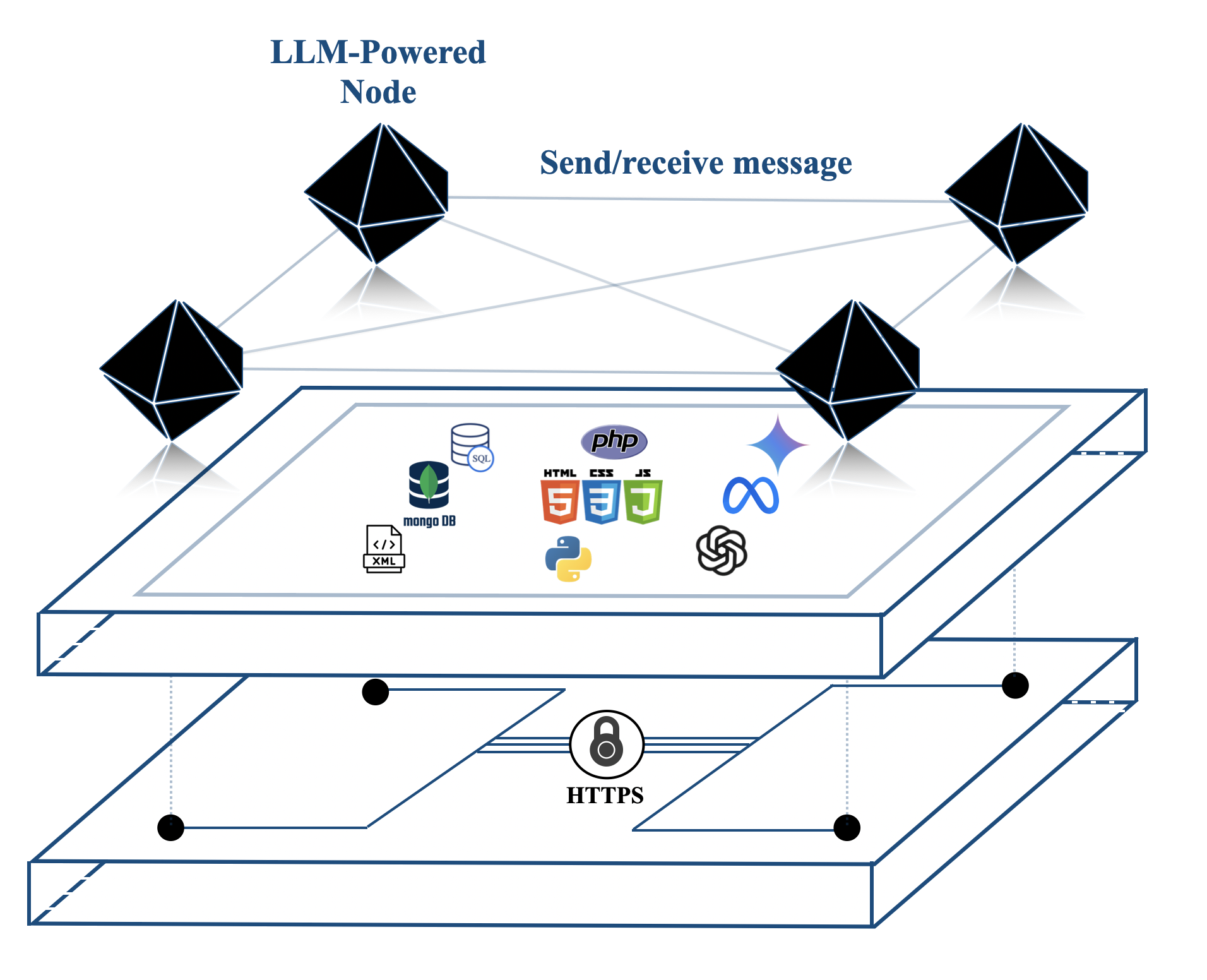
This diagram illustrates a conceptual architecture involving multiple "LLM-Powered Nodes" that communicate with each other by sending and receiving messages. These nodes interact with a layered system that appears to represent a backend infrastructure. The upper layer of this infrastructure hosts various data storage and programming language icons, suggesting data management and application development capabilities. The lower layer is secured by HTTPS, indicating secure communication protocols.
### Components/Axes
The diagram does not feature traditional axes or scales as it is a conceptual representation. The key components are:
* **LLM-Powered Nodes**: Represented by black, faceted, geometric shapes (likely octahedrons). There are four such nodes depicted.
* **Communication Lines**: Thin grey lines connect the LLM-Powered Nodes, indicating a network or communication pathway.
* **"Send/receive message" Text**: A label positioned above the communication lines, clarifying the nature of the interaction between the nodes.
* **Layered Infrastructure**: A two-tiered structure, depicted with blue outlines and a lighter blue interior.
* **Upper Layer**: Contains several icons representing technologies:
* **SQL Icon**: A database cylinder with a SQL label.
* **MongoDB Icon**: A green leaf within a database cylinder, labeled "mongo DB".
* **XML Icon**: A document icon with "</>" symbols, labeled "XML".
* **PHP Icon**: A purple oval with "php" text.
* **HTML, CSS, JS Icons**: Three distinct icons representing web technologies.
* **Python Icon**: The Python programming language logo.
* **Meta (Facebook) Icon**: The infinity-like symbol.
* **OpenAI (ChatGPT) Icon**: A circular, stylized symbol.
* **Lower Layer**: Features a prominent HTTPS icon (a padlock with "HTTPS" text below it) situated within a central horizontal band. This layer also has black circular nodes connected by dashed lines, suggesting internal connections or points of interest.
* **Connection Points**: Black dots are present on the lower layer, connected by dashed lines to the upper layer, indicating a structural or data flow connection between the layers.
### Detailed Analysis or Content Details
The diagram depicts a distributed system where multiple LLM-Powered Nodes are interconnected. The phrase "Send/receive message" suggests that these nodes exchange information. These nodes appear to interact with a backend system represented by the layered structure.
The upper layer of the backend infrastructure showcases a diverse set of technologies:
* **Databases**: SQL and MongoDB are explicitly shown, implying relational and NoSQL data storage capabilities.
* **Data Format**: XML is represented, indicating support for this structured data format.
* **Programming Languages/Frameworks**: PHP, HTML, CSS, JavaScript, and Python are visible, suggesting a broad range of development and scripting capabilities.
* **Services/Platforms**: Icons for Meta and OpenAI are present, hinting at potential integrations or dependencies on these platforms or their services.
The lower layer is secured by HTTPS, signifying that all communication passing through this layer is encrypted and protected. The black dots and dashed lines within this layer might represent secure communication channels, network interfaces, or specific security modules.
### Key Observations
* The architecture emphasizes the role of LLM-Powered Nodes in a networked environment.
* The backend infrastructure is designed to support a variety of data storage solutions and programming paradigms.
* The inclusion of specific platform icons (Meta, OpenAI) suggests potential integration points or the use of their APIs/services.
* HTTPS in the lower layer highlights a focus on secure data transmission within the backend.
* The diagram is abstract and does not provide specific details on data volume, latency, or processing power.
### Interpretation
This diagram illustrates a modern, distributed system architecture where Large Language Models (LLMs) act as intelligent nodes. These nodes are capable of communicating with each other, likely to share insights, process information collaboratively, or distribute tasks. The system's backend is robust, supporting diverse data management (SQL, MongoDB, XML) and development stacks (PHP, Python, web technologies). The presence of Meta and OpenAI icons suggests that these LLM nodes might leverage external AI services or platforms for enhanced capabilities, or that the system itself is designed to interact with these ecosystems. The HTTPS layer underscores the critical importance of security in handling data and communications within this architecture.
The overall design suggests a flexible and scalable system that can handle complex data processing and communication tasks, potentially for applications in areas like natural language processing, data analysis, or intelligent automation. The diagram implies a layered approach to system design, with distinct responsibilities for communication, data handling, and security. The LLM nodes are presented as the primary agents of intelligence and interaction within this framework.