## Diagram: Synthetic Geometry Problem Set with Difficulty Levels
### Overview
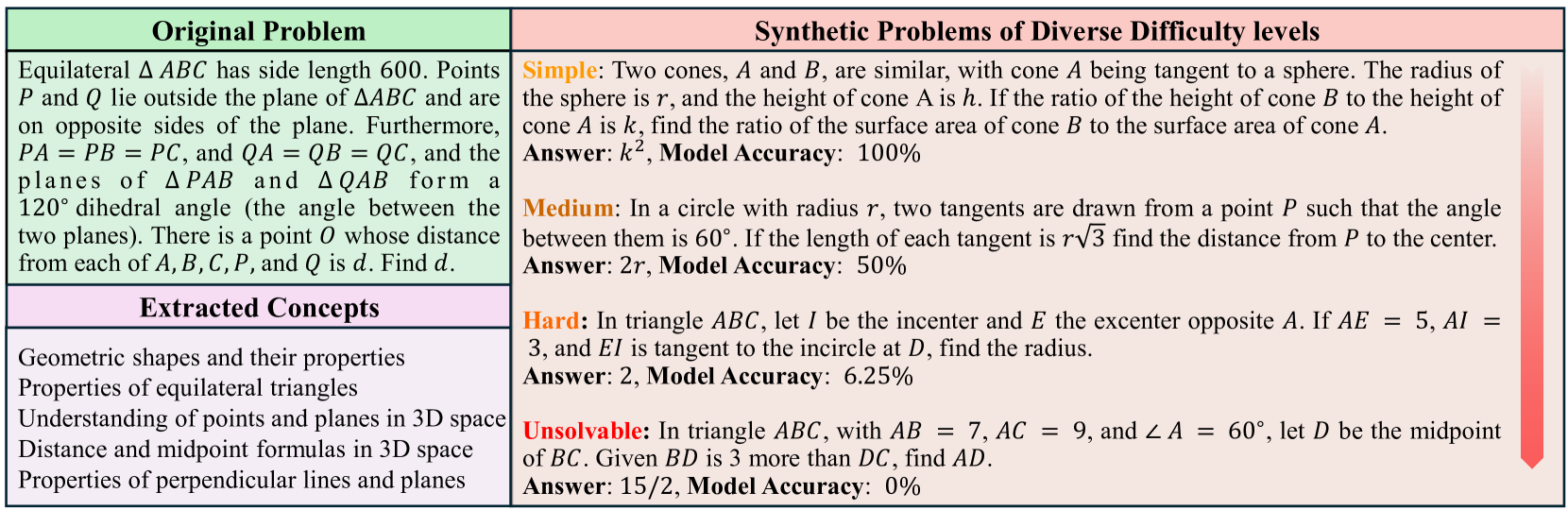
The image presents a structured comparison of a complex 3D geometry problem (Original Problem) and four synthetic problems of varying difficulty levels (Simple, Medium, Hard, Unsolvable). Each synthetic problem includes a geometric scenario, a numerical answer, and a "Model Accuracy" percentage. The Original Problem involves an equilateral triangle in 3D space with constraints on points and planes, while the synthetic problems test concepts like similarity, tangents, incenters, and midpoints.
### Components/Axes
- **Left Panel**:
- **Original Problem**: Describes an equilateral triangle ΔABC (side length 600) with points P and Q outside the plane, forming a 120° dihedral angle between planes ΔPAB and ΔQAB. A point O equidistant to A, B, C, P, Q is introduced.
- **Extracted Concepts**: Lists geometric principles (equilateral triangles, 3D distance formulas, perpendicular planes).
- **Right Panel**:
- **Synthetic Problems**: Four problems categorized by difficulty (Simple to Unsolvable), each with:
- **Problem Statement**: Geometric scenario (e.g., similar cones, circle tangents, triangle incenters).
- **Answer**: Numerical solution (e.g., \(k^2\), \(2r\), 2, \(15/2\)).
- **Model Accuracy**: Percentage (100%, 50%, 6.25%, 0%).
- **Color Gradient**: A vertical red gradient bar on the right, likely indicating difficulty progression (green to red).
### Detailed Analysis
#### Original Problem
- **Key Details**:
- ΔABC is equilateral (side 600).
- Points P and Q lie on opposite sides of the plane, equidistant from A, B, C (PA=PB=PC, QA=QB=QC).
- Planes ΔPAB and ΔQAB form a 120° dihedral angle.
- Point O is equidistant (\(d\)) from A, B, C, P, Q.
#### Synthetic Problems
1. **Simple**:
- **Problem**: Similar cones A and B (radius \(r\), height \(h\) for A). Ratio of heights \(h_B/h_A = k\). Find surface area ratio of B to A.
- **Answer**: \(k^2\), Model Accuracy: 100%.
2. **Medium**:
- **Problem**: Circle radius \(r\), tangents from point P form 60° angle. Tangent length \(r\sqrt{3}\). Find distance from P to center.
- **Answer**: \(2r\), Model Accuracy: 50%.
3. **Hard**:
- **Problem**: Triangle ABC with incenter I and excenter E opposite A. Given AE=5, AI=3, EI tangent to incircle. Find radius.
- **Answer**: 2, Model Accuracy: 6.25%.
4. **Unsolvable**:
- **Problem**: Triangle ABC (AB=7, AC=9, ∠A=60°). D is midpoint of BC. BD = DC + 3. Find AD.
- **Answer**: \(15/2\), Model Accuracy: 0%.
### Key Observations
- **Difficulty Correlation**: Model accuracy decreases as problem complexity increases (100% → 0%).
- **Unsolvable Anomaly**: The "Unsolvable" problem has a non-zero answer (\(15/2\)) but 0% accuracy, suggesting a contradiction or unsolvable nature.
- **Color Gradient**: The red gradient on the right visually reinforces the difficulty progression.
### Interpretation
The diagram illustrates a pedagogical framework for testing geometric reasoning across difficulty tiers. The Original Problem emphasizes 3D spatial reasoning, while synthetic problems isolate specific concepts (similarity, tangents, triangle centers). The drastic drop in model accuracy for harder problems highlights challenges in automated problem-solving for complex scenarios. The "Unsolvable" problem’s 0% accuracy despite a numerical answer suggests either a mislabeled problem or a test of edge-case handling. The extracted concepts align with the synthetic problems, indicating a curated focus on foundational geometry principles.