## Line Chart: Number of Packages by Status (2018-2023)
### Overview
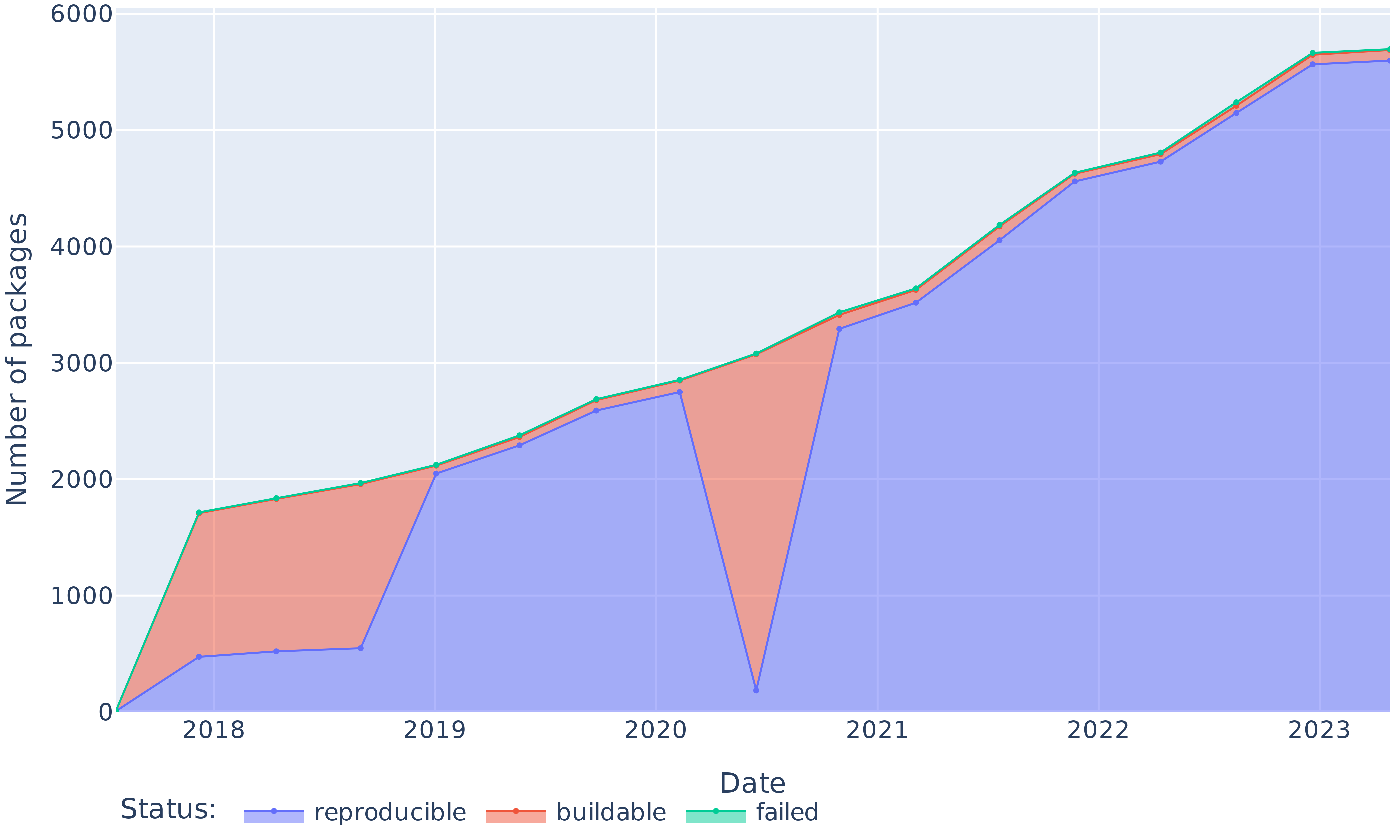
The chart displays the number of software packages categorized by three statuses—reproducible, buildable, and failed—over six years (2018–2023). All three categories show an upward trend, with failed packages initially dominating but being overtaken by buildable packages in later years.
### Components/Axes
- **X-axis (Date)**: Years from 2018 to 2023, labeled at 2018, 2019, 2020, 2021, 2022, and 2023.
- **Y-axis (Number of packages)**: Ranges from 0 to 6000 in increments of 1000.
- **Legend**: Located at the bottom, with three colors:
- **Blue**: Reproducible packages
- **Red**: Buildable packages
- **Green**: Failed packages
### Detailed Analysis
1. **Reproducible Packages (Blue)**:
- 2018: 500
- 2019: 2000
- 2020: 2700
- 2021: 3300
- 2022: 4500
- 2023: 5500
- **Trend**: Steady linear growth, starting from 0 in 2018.
2. **Buildable Packages (Red)**:
- 2018: 1700
- 2019: 2000
- 2020: 2700
- 2021: 3400
- 2022: 4600
- 2023: 5600
- **Trend**: Consistent upward trajectory, surpassing failed packages in 2021.
3. **Failed Packages (Green)**:
- 2018: 1700
- 2019: 2000
- 2020: 2800 (noted as a "dip" in the image, though this is an increase from 2019)
- 2021: 3100
- 2022: 4700
- 2023: 5700
- **Trend**: Initial growth, followed by a slower rise after 2020.
### Key Observations
- **Crossover in 2021**: Buildable packages (3400) exceed failed packages (3100) for the first time.
- **Failed Packages Anomaly**: The image describes a "dip" in 2020, but the data shows an increase from 2000 (2019) to 2800 (2020). This may indicate a misinterpretation or error in the original description.
- **Growth Rates**: All categories grow at similar rates, with reproducible packages maintaining the lowest absolute values but following the same upward trajectory.
### Interpretation
The data suggests a systemic increase in the total number of packages across all statuses, reflecting expanding software development activity. The crossover between buildable and failed packages in 2021 implies improvements in build processes or stricter quality controls reducing failures. The persistent growth in reproducible packages highlights their increasing importance in ensuring reliable software deployment. The discrepancy in the "dip" description for failed packages warrants further investigation to confirm whether the trend aligns with external factors (e.g., toolchain updates, policy changes).