## Chart: Validation Loss vs. FLOPs for Different Model Configurations
### Overview
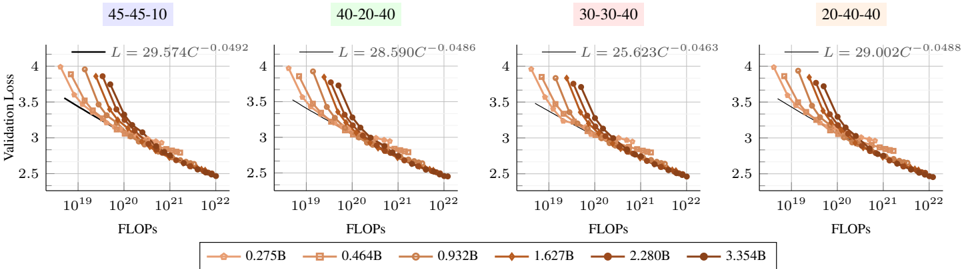
The image presents four line charts comparing validation loss against FLOPs (Floating Point Operations Per Second) for different model configurations. Each chart represents a different configuration, labeled as "45-45-10", "40-20-40", "30-30-40", and "20-40-40". Each chart contains multiple lines, each representing a different model size, ranging from 0.275B to 3.354B parameters. The x-axis (FLOPs) is on a logarithmic scale.
### Components/Axes
* **X-axis:** FLOPs (Floating Point Operations Per Second). Logarithmic scale from approximately 10^19 to 10^22.
* **Y-axis:** Validation Loss. Linear scale from 2.5 to 4.0.
* **Chart Titles (Top):**
* Top-left: "45-45-10" (Blue text)
* Top-middle-left: "40-20-40" (Green text)
* Top-middle-right: "30-30-40" (Pink text)
* Top-right: "20-40-40" (Yellow-Orange text)
* **Legend (Bottom):**
* 0.275B (Light Brown, circle markers)
* 0.464B (Light Brown, square markers)
* 0.932B (Light Brown, diamond markers)
* 1.627B (Brown, triangle markers)
* 2.280B (Dark Brown, circle markers)
* 3.354B (Dark Brown, no marker)
* **Trendline:** Each chart has a black trendline represented by the equation L = aC^-b, where 'L' is the validation loss, 'C' is the FLOPs, and 'a' and 'b' are constants specific to each configuration.
### Detailed Analysis
**Chart 1: 45-45-10**
* Equation: L = 29.574C^-0.0492
* 0.275B: Starts at approximately (10^19, 3.6), decreases to (10^22, 2.6)
* 0.464B: Starts at approximately (10^19, 3.7), decreases to (10^22, 2.7)
* 0.932B: Starts at approximately (10^19, 3.8), decreases to (10^22, 2.7)
* 1.627B: Starts at approximately (10^19, 3.9), decreases to (10^22, 2.8)
* 2.280B: Starts at approximately (10^19, 4.0), decreases to (10^22, 2.8)
* 3.354B: Starts at approximately (10^19, 4.1), decreases to (10^22, 2.9)
**Chart 2: 40-20-40**
* Equation: L = 28.590C^-0.0486
* 0.275B: Starts at approximately (10^19, 3.8), decreases to (10^22, 2.5)
* 0.464B: Starts at approximately (10^19, 3.9), decreases to (10^22, 2.6)
* 0.932B: Starts at approximately (10^19, 4.0), decreases to (10^22, 2.7)
* 1.627B: Starts at approximately (10^19, 4.1), decreases to (10^22, 2.8)
* 2.280B: Starts at approximately (10^19, 4.2), decreases to (10^22, 2.9)
* 3.354B: Starts at approximately (10^19, 4.3), decreases to (10^22, 3.0)
**Chart 3: 30-30-40**
* Equation: L = 25.623C^-0.0463
* 0.275B: Starts at approximately (10^19, 3.7), decreases to (10^22, 2.6)
* 0.464B: Starts at approximately (10^19, 3.8), decreases to (10^22, 2.7)
* 0.932B: Starts at approximately (10^19, 3.9), decreases to (10^22, 2.8)
* 1.627B: Starts at approximately (10^19, 4.0), decreases to (10^22, 2.9)
* 2.280B: Starts at approximately (10^19, 4.1), decreases to (10^22, 3.0)
* 3.354B: Starts at approximately (10^19, 4.2), decreases to (10^22, 3.1)
**Chart 4: 20-40-40**
* Equation: L = 29.002C^-0.0488
* 0.275B: Starts at approximately (10^19, 3.8), decreases to (10^22, 2.6)
* 0.464B: Starts at approximately (10^19, 3.9), decreases to (10^22, 2.7)
* 0.932B: Starts at approximately (10^19, 4.0), decreases to (10^22, 2.8)
* 1.627B: Starts at approximately (10^19, 4.1), decreases to (10^22, 2.9)
* 2.280B: Starts at approximately (10^19, 4.2), decreases to (10^22, 3.0)
* 3.354B: Starts at approximately (10^19, 4.3), decreases to (10^22, 3.1)
### Key Observations
* **General Trend:** For all configurations and model sizes, the validation loss decreases as FLOPs increase. The rate of decrease diminishes as FLOPs increase, indicating diminishing returns.
* **Model Size Impact:** Larger models (higher parameter counts) generally exhibit higher validation loss for a given FLOP count, but also tend to achieve lower final validation loss as FLOPs increase significantly.
* **Configuration Impact:** The "45-45-10" configuration appears to have a slightly lower validation loss compared to the other configurations for similar FLOPs and model sizes.
* **Trendline Fit:** The trendlines provide a reasonable approximation of the overall trend, but they do not perfectly capture the behavior of individual model sizes.
### Interpretation
The charts illustrate the relationship between computational effort (FLOPs) and model performance (validation loss) for different model configurations and sizes. The data suggests that increasing FLOPs generally leads to improved model performance, but the benefit diminishes as FLOPs increase. Larger models tend to have higher initial validation loss but can achieve lower final validation loss with sufficient computational resources. The specific configuration "45-45-10" may be more efficient in terms of validation loss compared to the others. The equations provided above each chart, L = aC^-b, are power law models that describe the relationship between validation loss (L) and FLOPs (C). The exponent 'b' indicates the rate at which validation loss decreases with increasing FLOPs. A smaller absolute value of 'b' indicates a slower rate of decrease.