\n
## Diagram: Acoustic Source Localization
### Overview
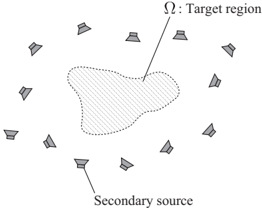
The image is a schematic diagram illustrating a scenario involving acoustic source localization. It depicts a target region surrounded by multiple secondary sources, likely representing microphones or sensors. The diagram appears to be conceptual, focusing on the spatial arrangement of these elements rather than specific numerical data.
### Components/Axes
* **Target Region (Ω):** An irregularly shaped area in the center of the diagram, filled with diagonal lines. Labeled "Ω: Target region" with a line pointing towards the center of the shape.
* **Secondary Sources:** Small, grey, speaker-like icons arranged in a roughly circular pattern around the target region. There are approximately 16 secondary sources visible.
* **Label:** "Secondary source" with a line pointing to one of the speaker-like icons at the bottom of the diagram.
* **Background:** White.
### Detailed Analysis or Content Details
The diagram does not contain any numerical data or axes. It is purely a visual representation of a spatial configuration. The secondary sources are positioned at varying distances and angles around the target region. The target region is not a regular shape, suggesting a complex acoustic environment. The arrangement of the secondary sources suggests they are intended to capture acoustic signals emanating from within the target region.
### Key Observations
The diagram highlights the concept of using multiple sensors (secondary sources) to localize a sound source within a defined area (target region). The irregular shape of the target region suggests the localization process might be more challenging in complex environments.
### Interpretation
This diagram likely represents a simplified model for acoustic source localization, a common problem in fields like robotics, surveillance, and audio engineering. The secondary sources act as sensors, and their collective data is used to determine the location of a sound source within the target region. The diagram suggests a scenario where the sound source is *within* the target region, and the goal is to pinpoint its location. The arrangement of the sensors implies that triangulation or other spatial analysis techniques might be employed to achieve this localization. The lack of specific data suggests this is a conceptual illustration rather than a presentation of experimental results.