## Line Chart: Math Problem Accuracy by Model
### Overview
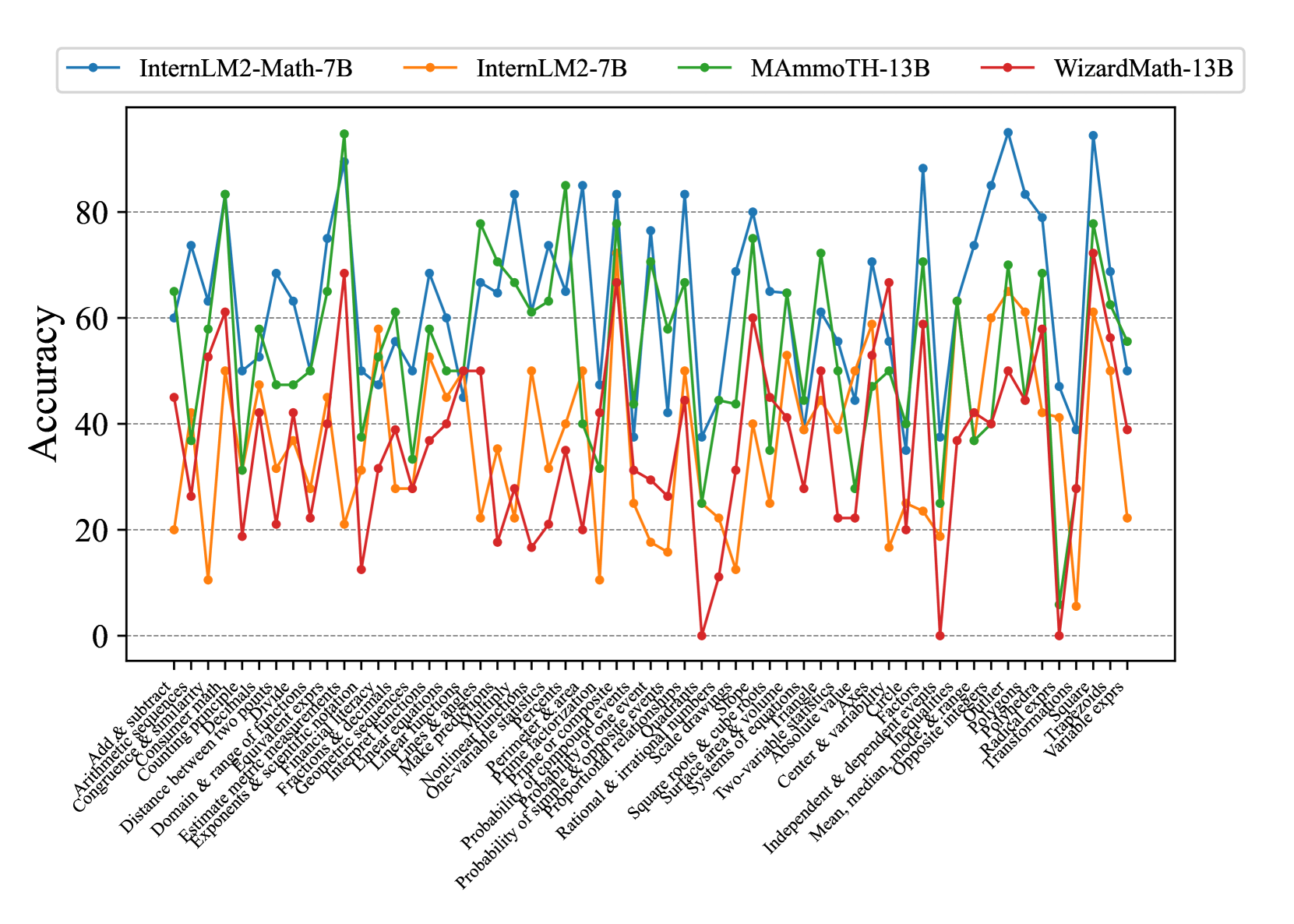
This line chart compares the accuracy of four different language models – InternLM2-Math-7B, InternLM2-7B, MAmmoTH-13B, and WizardMath-13B – across a range of math problem categories. The x-axis represents the math problem category, and the y-axis represents the accuracy score (ranging from 0 to 100).
### Components/Axes
* **X-axis Title:** Math Problem Category
* **Y-axis Title:** Accuracy
* **Legend:** Located at the top-left corner of the chart.
* InternLM2-Math-7B (Blue Line)
* InternLM2-7B (Green Line)
* MAmmoTH-13B (Orange Line)
* WizardMath-13B (Red Line)
* **Math Problem Categories (X-axis labels):** Arithmetic, Addition & subtraction, Complex continued fraction, Complete the equation, Combining paths, Domain & range of functions, Distance between two points, Distance & segment lengths, Exponents & scientific notation, Fractions & mixed numbers, Geometry, Linear equations, Linear inequalities, Logarithms, Make fractions, More fractions, One-variable absolute value, One-variable equations, One-variable inequalities, Permutation & combinations, Probability of compound events, Probability of simple events, Proportional relationships, Quadratic equations, Rational & irrational numbers, Square roots & cube roots, Systems & inequalities, Two-variable absolute value, Two-variable equations, Two-variable inequalities, Center & dependent variables, Mean, median, opposite, Pie charts, Ratio & proportions, Transformations, Variable expressions.
### Detailed Analysis
The chart displays accuracy scores for each model across each math problem category. The following details are extracted, noting approximate values due to the chart's resolution:
* **InternLM2-Math-7B (Blue):**
* Starts around 60% accuracy for "Arithmetic".
* Fluctuates between approximately 50% and 85% across the categories.
* Peaks around 85% for "One-variable equations".
* Dips to around 50% for "Systems & inequalities".
* Ends around 70% for "Variable expressions".
* **InternLM2-7B (Green):**
* Starts around 20% accuracy for "Arithmetic".
* Generally remains below 40% accuracy throughout most categories.
* Shows a slight increase to around 40% for "One-variable equations".
* Remains consistently low, ending around 30% for "Variable expressions".
* **MAmmoTH-13B (Orange):**
* Starts around 60% accuracy for "Arithmetic".
* Shows a relatively stable performance between 50% and 70% for most categories.
* Peaks around 75% for "One-variable equations".
* Dips to around 50% for "Systems & inequalities".
* Ends around 65% for "Variable expressions".
* **WizardMath-13B (Red):**
* Starts around 70% accuracy for "Arithmetic".
* Demonstrates the highest overall accuracy, frequently exceeding 80%.
* Peaks around 90% for "One-variable equations".
* Experiences a dip to around 60% for "Systems & inequalities".
* Ends around 80% for "Variable expressions".
### Key Observations
* WizardMath-13B consistently outperforms the other models across all categories.
* InternLM2-7B exhibits the lowest accuracy scores, significantly underperforming the other models.
* InternLM2-Math-7B and MAmmoTH-13B show comparable performance, with moderate accuracy scores.
* All models show a dip in accuracy for "Systems & inequalities".
* "One-variable equations" appears to be the category where all models achieve their highest accuracy.
### Interpretation
The data suggests that model size and specialized training (as seen in WizardMath-13B and InternLM2-Math-7B) significantly impact performance on math problems. WizardMath-13B's consistently high accuracy indicates a strong capability in mathematical reasoning. The lower performance of InternLM2-7B suggests that a larger model size alone is not sufficient for achieving high accuracy; specialized training on mathematical datasets is crucial. The dip in accuracy for "Systems & inequalities" across all models may indicate that this category presents a particularly challenging type of problem, requiring more advanced reasoning skills. The peak accuracy for "One-variable equations" suggests that this type of problem is relatively easier for these models to solve. The chart provides a comparative analysis of the models' strengths and weaknesses, highlighting the importance of both model size and specialized training in achieving high accuracy on math problems.