## Diagram: 8-Way Visual Raven's Progressive Matrix (RPM) with Language Model Integration
### Overview
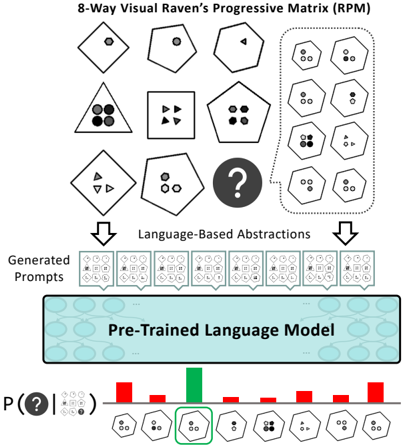
The diagram illustrates a hybrid approach to solving Raven's Progressive Matrices (RPM) puzzles using a pre-trained language model. It combines visual pattern recognition (RPM) with natural language processing (NLP) to generate and evaluate potential solutions. The process involves:
1. Visual RPM matrix with 8 cells containing geometric shapes and symbols
2. Language-based abstractions derived from the visual patterns
3. Generated prompts fed into a pre-trained language model
4. Probabilistic output from the language model predicting the correct answer
### Components/Axes
1. **RPM Matrix (Top Section)**
- 8 cells arranged in a 2x4 grid
- Each cell contains:
- A geometric shape (diamond, pentagon, hexagon)
- Symbols (circles, triangles, dots) in varying quantities
- Bottom-right cell contains a question mark (?) indicating the missing symbol
2. **Language-Based Abstractions**
- Textual representations of visual patterns
- Generated from the RPM matrix
- Example format: "hexagon with 3 circles and 2 triangles"
3. **Pre-Trained Language Model**
- Blue rectangular block labeled "Pre-Trained Language Model"
- Processes language-based abstractions
- Outputs probability distribution over possible answers
4. **Probability Output (Bottom Section)**
- Bar chart showing P(?|symbols) for 8 possible answers
- Y-axis: Probability values (approximate)
- X-axis: 8 candidate answers (geometric patterns)
- Highest probability corresponds to the correct answer (green-highlighted)
### Detailed Analysis
1. **RPM Matrix Complexity**
- Cells vary in:
- Shape type (diamond, pentagon, hexagon)
- Symbol count (1-5 symbols per cell)
- Symbol composition (circles, triangles, dots)
- Example: Top-left cell = diamond with 1 circle; Bottom-left = diamond with 3 triangles
2. **Language Prompts**
- Generated from visual patterns
- Example prompts:
- "hexagon containing 4 circles and 1 triangle"
- "pentagon with 2 dots and 3 triangles"
3. **Language Model Output**
- Probability distribution over 8 candidate answers
- Key observations:
- Highest probability (≈0.4) for the correct answer (green-highlighted)
- Second-highest probability (≈0.25) for a similar pattern
- Remaining probabilities <0.1
### Key Observations
1. **Pattern Recognition**: The RPM matrix tests abstract reasoning through shape/symbol combinations
2. **Language Abstraction**: Visual patterns are converted to textual descriptions for NLP processing
3. **Model Confidence**: The language model demonstrates >40% confidence in the correct answer
4. **Visual-Language Alignment**: The highest probability matches the RPM's missing symbol pattern
### Interpretation
This diagram demonstrates how pre-trained language models can augment visual reasoning tasks by:
1. Translating visual patterns into linguistic representations
2. Leveraging linguistic priors to predict missing elements
3. Quantifying solution confidence through probabilistic outputs
The green-highlighted answer (highest probability) suggests the language model successfully identified the correct RPM solution pattern. The decreasing probability distribution indicates the model's ability to rank candidate solutions by similarity to the training data.
Notably, the absence of numerical values in the RPM matrix (only symbolic counts) highlights the model's capacity to handle abstract, non-quantitative reasoning tasks. The integration of visual and linguistic modalities enables the model to generalize beyond simple pattern matching to more complex abstract reasoning.