## Screenshot: Dress Selection Task Interface
### Overview
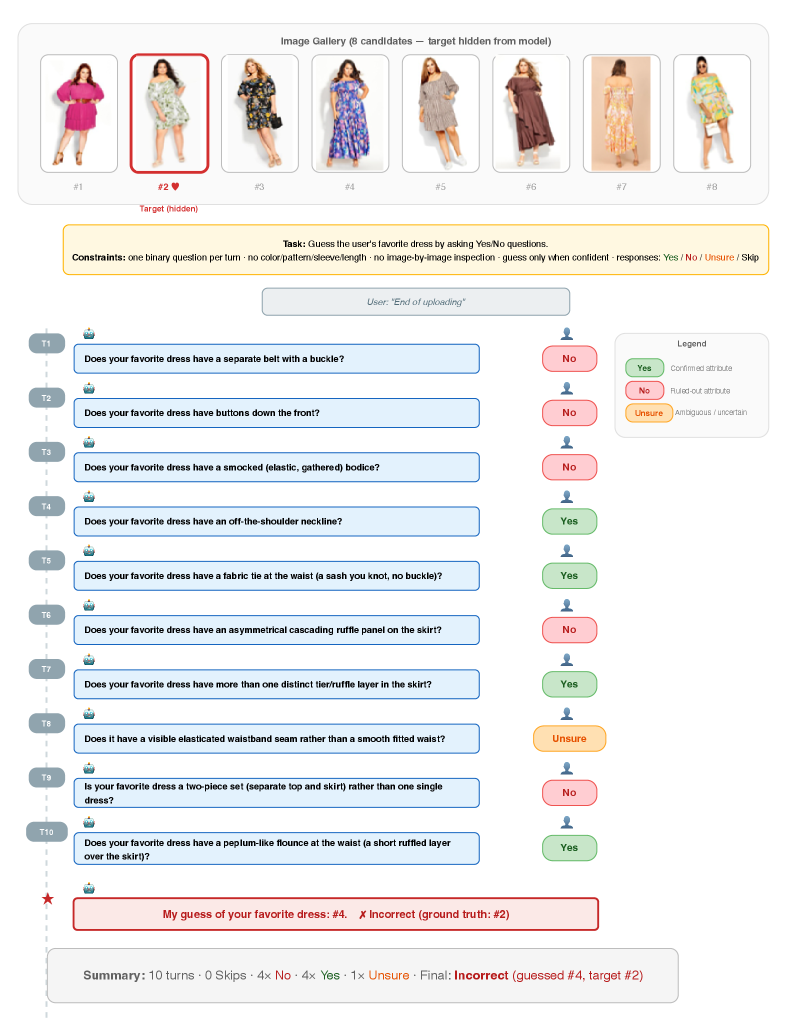
The image depicts a web-based interactive task where a user attempts to identify a target dress from a gallery of eight options by asking yes/no questions. The interface includes a visual gallery, task instructions, a conversation log, and a summary of the interaction. The target dress is hidden (marked with a red border and heart in the gallery), and the AI's guess is evaluated for accuracy.
---
### Components/Axes
1. **Image Gallery**
- **Position**: Top section of the interface.
- **Content**: Eight dresses labeled #1 to #8, each displayed on a model.
- **Target Indicator**: Dress #2 is highlighted with a red border and heart.
- **Legend**: No explicit legend, but the target is visually marked.
2. **Task Instructions**
- **Position**: Below the gallery.
- **Content**:
- **Task**: "Guess the user's favorite dress by asking Yes/No questions."
- **Constraints**:
- One binary question per turn.
- No image-by-image inspection.
- Guess only when confident.
- Responses: Yes / No / Unsure / Skip.
3. **Conversation Log**
- **Position**: Central section.
- **Structure**:
- **T1-T10**: Ten questions asked by the AI, each with a user response.
- **Response Legend**:
- **Green**: Yes (confirmed attribute).
- **Red**: No (ruled-out attribute).
- **Yellow**: Unsure (ambiguous/uncertain).
- **Example**:
- **T1**: "Does your favorite dress have a separate belt with a buckle?" → **No** (red).
- **T8**: "Does it have a visible elasticated waistband seam rather than a smooth fitted waist?" → **Unsure** (yellow).
4. **Summary**
- **Position**: Bottom section.
- **Content**:
- **Turns**: 10.
- **Skips**: 0.
- **Responses**: 4× Yes, 4× No, 1× Unsure.
- **Final Result**: Incorrect guess (guessed #4, target #2).
---
### Detailed Analysis
#### Conversation Log Breakdown
- **T1-T3**: Focus on structural features (belt, buttons, bodice). All answered **No**.
- **T4**: "Off-the-shoulder neckline?" → **Yes** (green).
- **T5**: "Fabric tie at the waist?" → **Yes** (green).
- **T6**: "Asymmetrical cascading ruffle panel?" → **No** (red).
- **T7**: "More than one distinct tier/ruffle layer?" → **Yes** (green).
- **T8**: Waistband seam ambiguity → **Unsure** (yellow).
- **T9**: "Two-piece set?" → **No** (red).
- **T10**: "Peplum-like flounce at the waist?" → **Yes** (green).
#### Final Guess Evaluation
- **Guessed Dress**: #4 (incorrect).
- **Target Dress**: #2 (correct).
- **Key Discrepancy**: The AI prioritized features like off-the-shoulder necklines and ruffles (common in #4), while the target dress (#2) likely had unique attributes not probed effectively (e.g., color, pattern, or fit).
---
### Key Observations
1. **Question Strategy**: The AI focused on structural details (necklines, waist ties, ruffles) but overlooked attributes like color, fabric type, or silhouette, which may have differentiated the target dress.
2. **Ambiguity**: The single "Unsure" response (T8) introduced uncertainty, potentially derailing the narrowing process.
3. **Incorrect Guess**: The AI's final guess (#4) shared some features with the target (#2) but lacked critical distinguishing traits.
---
### Interpretation
The task highlights the challenges of inferring preferences through binary questions without visual inspection. The AI's reliance on structural features (e.g., necklines, ruffles) suggests a bias toward design elements over holistic attributes (e.g., color, fit). The user's "Unsure" response (T8) may have introduced noise, preventing the AI from converging on the correct answer. This underscores the importance of balancing specificity and flexibility in question design for such tasks.
**Final Note**: The interface effectively visualizes the iterative questioning process but reveals limitations in inferring preferences without explicit feature prioritization.