\n
## Scatter Plot: Benchmark Performance vs. Model Size
### Overview
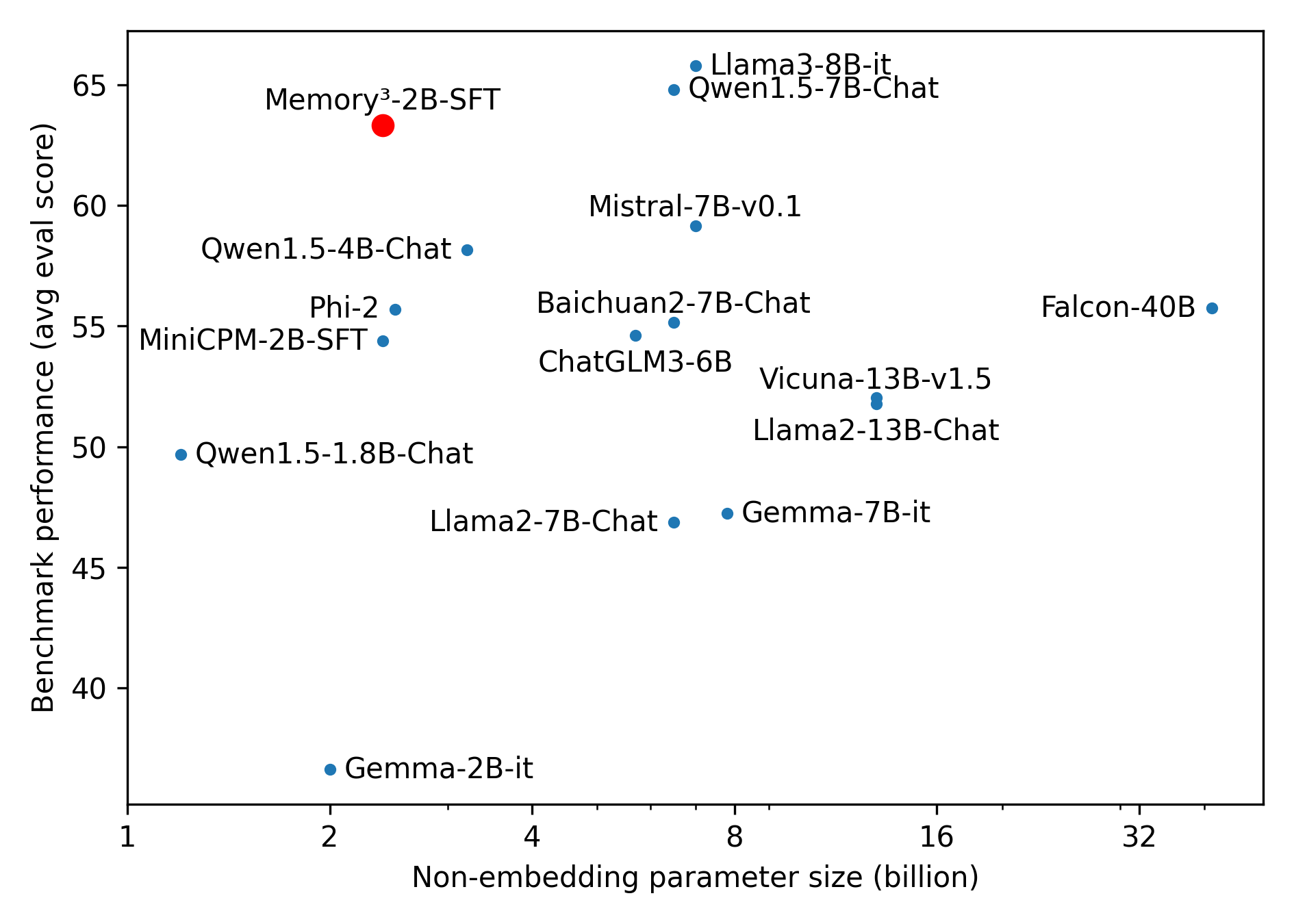
This image presents a scatter plot comparing the benchmark performance (average evaluation score) of various language models against their non-embedding parameter size. The plot visualizes the relationship between model size and performance, allowing for a comparison of different models.
### Components/Axes
* **X-axis:** Non-embedding parameter size (billion). Scale ranges from approximately 1 to 32 billion.
* **Y-axis:** Benchmark performance (avg eval score). Scale ranges from approximately 40 to 65.
* **Data Points:** Each point represents a specific language model. The points are labeled with the model name.
* **Models:** The following models are represented:
* Memory³-2B-SFT
* Qwen1.5-4B-Chat
* Phi-2
* MiniCPM-2B-SFT
* Qwen1.5-1.8B-Chat
* Mistral-7B-v0.1
* Baichuan2-7B-Chat
* ChatGLM3-6B
* Llama2-7B-Chat
* Vicuna-13B-v1.5
* Llama3-8B-it
* Qwen1.5-7B-Chat
* Gemma-7B-it
* Llama2-13B-Chat
* Falcon-40B
* Gemma-2B-it
### Detailed Analysis
The data points are scattered across the plot, indicating varying levels of performance for different model sizes.
* **Memory³-2B-SFT:** Located at approximately (2, 64).
* **Qwen1.5-4B-Chat:** Located at approximately (4, 59).
* **Phi-2:** Located at approximately (2, 55).
* **MiniCPM-2B-SFT:** Located at approximately (2, 54).
* **Qwen1.5-1.8B-Chat:** Located at approximately (2, 51).
* **Mistral-7B-v0.1:** Located at approximately (7, 61).
* **Baichuan2-7B-Chat:** Located at approximately (7, 57).
* **ChatGLM3-6B:** Located at approximately (6, 56).
* **Llama2-7B-Chat:** Located at approximately (7, 47).
* **Vicuna-13B-v1.5:** Located at approximately (13, 55).
* **Llama3-8B-it:** Located at approximately (8, 64).
* **Qwen1.5-7B-Chat:** Located at approximately (7, 63).
* **Gemma-7B-it:** Located at approximately (7, 48).
* **Llama2-13B-Chat:** Located at approximately (13, 52).
* **Falcon-40B:** Located at approximately (32, 55).
* **Gemma-2B-it:** Located at approximately (2, 41).
**Trends:**
* There is a general trend of increasing performance with increasing model size, but it is not strictly linear.
* Models with similar parameter sizes can exhibit significantly different performance scores.
* The largest model, Falcon-40B, does not achieve the highest performance score.
* Several models cluster around the 7 billion parameter mark.
### Key Observations
* **Outlier:** Gemma-2B-it has a relatively low benchmark performance compared to other models of similar size.
* **High Performers:** Llama3-8B-it and Memory³-2B-SFT exhibit the highest benchmark performance scores.
* **Performance Plateau:** The performance increase appears to plateau at higher parameter sizes (e.g., Falcon-40B).
### Interpretation
The scatter plot suggests that model size is a significant, but not the sole, determinant of benchmark performance. While larger models generally perform better, the architecture, training data, and other factors play a crucial role. The presence of outliers like Gemma-2B-it indicates that model design and training methodologies can have a substantial impact on performance, even with a smaller parameter size. The plateau in performance at higher parameter sizes suggests diminishing returns – increasing model size beyond a certain point may not yield significant improvements in benchmark scores. The clustering of models around the 7 billion parameter mark suggests this may be a sweet spot for balancing performance and computational cost. The data highlights the complexity of evaluating language models and the importance of considering multiple factors beyond just model size.