## SHAP Value Plots: Feature Impact with and without Prior Knowledge
### Overview
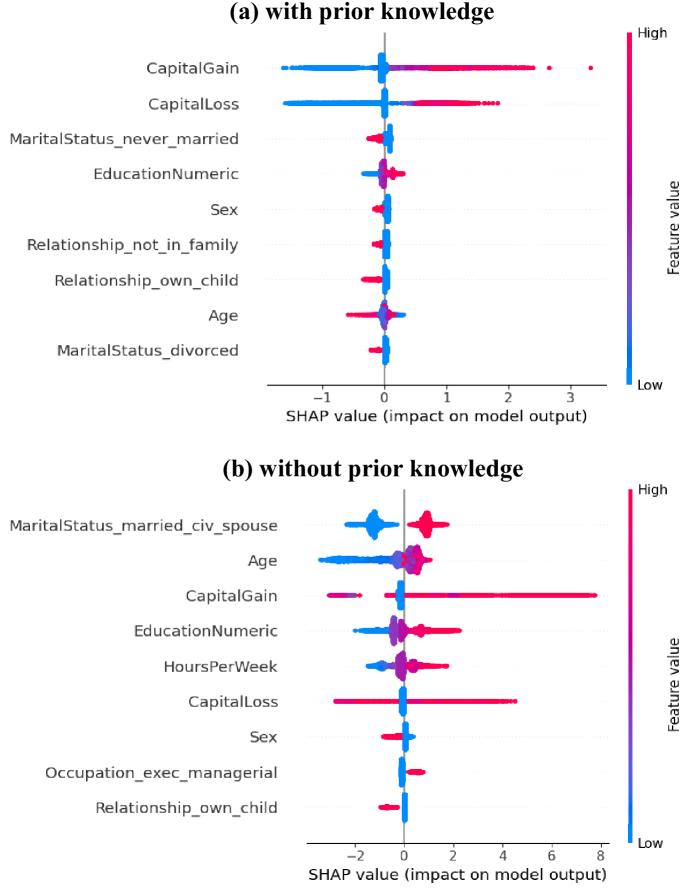
The image presents two SHAP value plots, comparing feature impact on a model output with and without prior knowledge. Each plot displays features on the y-axis and SHAP values (impact on model output) on the x-axis. The color of each point represents the feature value, ranging from low (blue) to high (red). The plots illustrate how different features contribute to the model's predictions and how this contribution changes based on the presence or absence of prior knowledge.
### Components/Axes
**Plot (a): With Prior Knowledge**
* **Title:** (a) with prior knowledge
* **Y-axis:** Features: CapitalGain, CapitalLoss, MaritalStatus\_never\_married, EducationNumeric, Sex, Relationship\_not\_in\_family, Relationship\_own\_child, Age, MaritalStatus\_divorced
* **X-axis:** SHAP value (impact on model output), ranging from -1 to 3. Axis markers at -1, 0, 1, 2, and 3.
* **Color Gradient Legend (right side):** Feature value, ranging from Low (blue) to High (red).
**Plot (b): Without Prior Knowledge**
* **Title:** (b) without prior knowledge
* **Y-axis:** Features: MaritalStatus\_married\_civ\_spouse, Age, CapitalGain, EducationNumeric, HoursPerWeek, CapitalLoss, Sex, Occupation\_exec\_managerial, Relationship\_own\_child
* **X-axis:** SHAP value (impact on model output), ranging from -2 to 8. Axis markers at -2, 0, 2, 4, 6, and 8.
* **Color Gradient Legend (right side):** Feature value, ranging from Low (blue) to High (red).
### Detailed Analysis
**Plot (a): With Prior Knowledge**
* **CapitalGain:** The distribution is centered around 0, with a significant number of high values (red) having a positive impact (up to ~3) and low values (blue) having a negative impact (down to ~-1).
* **CapitalLoss:** The distribution is centered around 0, with a significant number of high values (red) having a positive impact (up to ~1) and low values (blue) having a negative impact (down to ~-1).
* **MaritalStatus\_never\_married:** The distribution is centered around 0, with a slight positive impact for high values (red) and a slight negative impact for low values (blue).
* **EducationNumeric:** The distribution is centered around 0, with a slight positive impact for high values (red) and a slight negative impact for low values (blue).
* **Sex:** The distribution is centered around 0, with a slight positive impact for high values (red) and a slight negative impact for low values (blue).
* **Relationship\_not\_in\_family:** The distribution is centered around 0, with a slight positive impact for high values (red) and a slight negative impact for low values (blue).
* **Relationship\_own\_child:** The distribution is centered around 0, with a slight positive impact for high values (red) and a slight negative impact for low values (blue).
* **Age:** The distribution is centered around 0, with a slight positive impact for high values (red) and a slight negative impact for low values (blue).
* **MaritalStatus\_divorced:** The distribution is centered around 0, with a slight positive impact for high values (red) and a slight negative impact for low values (blue).
**Plot (b): Without Prior Knowledge**
* **MaritalStatus\_married\_civ\_spouse:** The distribution is centered around 0, with a significant number of high values (red) having a positive impact (up to ~2) and low values (blue) having a negative impact (down to ~-2).
* **Age:** The distribution is centered around 0, with a significant number of high values (red) having a positive impact (up to ~2) and low values (blue) having a negative impact (down to ~-2).
* **CapitalGain:** The distribution is centered around 0, with a significant number of high values (red) having a positive impact (up to ~8) and low values (blue) having a negative impact (down to ~-1).
* **EducationNumeric:** The distribution is centered around 0, with a slight positive impact for high values (red) and a slight negative impact for low values (blue).
* **HoursPerWeek:** The distribution is centered around 0, with a slight positive impact for high values (red) and a slight negative impact for low values (blue).
* **CapitalLoss:** The distribution is centered around 0, with a significant number of high values (red) having a positive impact (up to ~2) and low values (blue) having a negative impact (down to ~-1).
* **Sex:** The distribution is centered around 0, with a slight positive impact for high values (red) and a slight negative impact for low values (blue).
* **Occupation\_exec\_managerial:** The distribution is centered around 0, with a slight positive impact for high values (red) and a slight negative impact for low values (blue).
* **Relationship\_own\_child:** The distribution is centered around 0, with a slight positive impact for high values (red) and a slight negative impact for low values (blue).
### Key Observations
* **CapitalGain:** Has a significant positive impact when high, especially in the "without prior knowledge" scenario.
* **CapitalLoss:** Similar to CapitalGain, but with a smaller impact.
* **Age:** Shows a more pronounced impact in the "without prior knowledge" scenario.
* **Feature Importance Shift:** The relative importance of features changes significantly between the two plots, indicating that prior knowledge influences the model's reliance on different features.
* **SHAP Value Range:** The SHAP values have a wider range in the "without prior knowledge" plot, suggesting that the model relies more heavily on certain features when prior knowledge is absent.
### Interpretation
The SHAP value plots demonstrate how the presence or absence of prior knowledge affects the importance of different features in a model. When prior knowledge is available, the model distributes importance across a wider range of features, resulting in smaller SHAP values. Without prior knowledge, the model relies more heavily on certain features like CapitalGain and Age, leading to larger SHAP values. This suggests that prior knowledge helps the model make more informed decisions by considering a broader set of factors, while the absence of prior knowledge forces the model to rely on a few dominant features. The plots highlight the importance of feature engineering and domain expertise in building robust and accurate models.