## Diagram: Cognitive Processing Model
### Overview
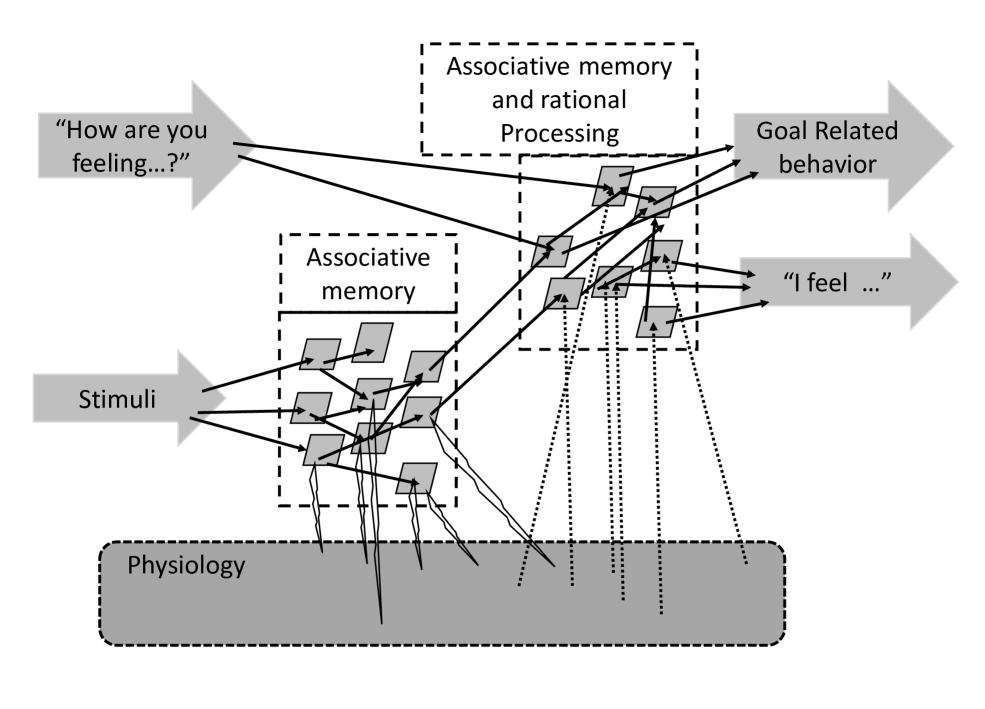
The image is a diagram illustrating a cognitive processing model, showing the flow of information from stimuli and physiology through associative memory and rational processing, ultimately leading to goal-related behavior and expressed feelings.
### Components/Axes
* **Inputs (Left Side):**
* **Stimuli:** Represented by a gray arrow pointing right.
* **Physiology:** Represented by a gray rounded rectangle at the bottom.
* **Processing Blocks (Center):**
* **Associative Memory:** A dashed rectangle containing several small, tilted gray squares connected by lines.
* **Associative Memory and Rational Processing:** A dashed rectangle containing several small, tilted gray squares connected by lines.
* **Outputs (Right Side):**
* **"How are you feeling...?"**: Represented by a gray arrow pointing right.
* **Goal Related behavior:** Represented by a gray arrow pointing right.
* **"I feel ..."**: Represented by a gray arrow pointing right.
* **Connections:**
* Solid black lines indicate direct connections between components.
* Dotted black lines indicate connections from Physiology to the "Associative memory and rational Processing" block.
### Detailed Analysis
* **Stimuli Input:** The "Stimuli" arrow points towards the "Associative Memory" block. Several lines connect the arrow to the individual squares within the block.
* **Physiology Input:** The "Physiology" block has vertical lines extending upwards, connecting to the squares within the "Associative Memory" block. There are also dotted lines connecting the "Physiology" block to the "Associative Memory and Rational Processing" block.
* **Associative Memory Processing:** The squares within the "Associative Memory" block are interconnected with lines, suggesting internal processing and associations.
* **Associative Memory and Rational Processing:** The squares within this block are also interconnected. This block receives input from both the "Associative Memory" block and the "Physiology" block.
* **Outputs:** The "Associative Memory and Rational Processing" block connects to all three output arrows: "How are you feeling...?", "Goal Related behavior", and "I feel ...".
### Key Observations
* The diagram emphasizes the role of both associative memory and rational processing in generating responses to stimuli and physiological states.
* The connections between the components suggest a complex interplay between different cognitive processes.
* The "Physiology" block appears to influence both "Associative Memory" and "Associative Memory and Rational Processing", indicating the impact of bodily states on cognitive functions.
### Interpretation
The diagram presents a simplified model of how cognitive processes might work. It suggests that external stimuli and internal physiological states are processed through associative memory and rational thought, leading to both behavioral responses and subjective feelings. The model highlights the interconnectedness of these processes, suggesting that feelings and behaviors are not simply reactions to stimuli but are the result of complex cognitive processing. The inclusion of "Physiology" as an input emphasizes the embodied nature of cognition, suggesting that our physical state influences our thoughts and feelings.