## Diagram: Cognitive-Affective Processing Model
### Overview
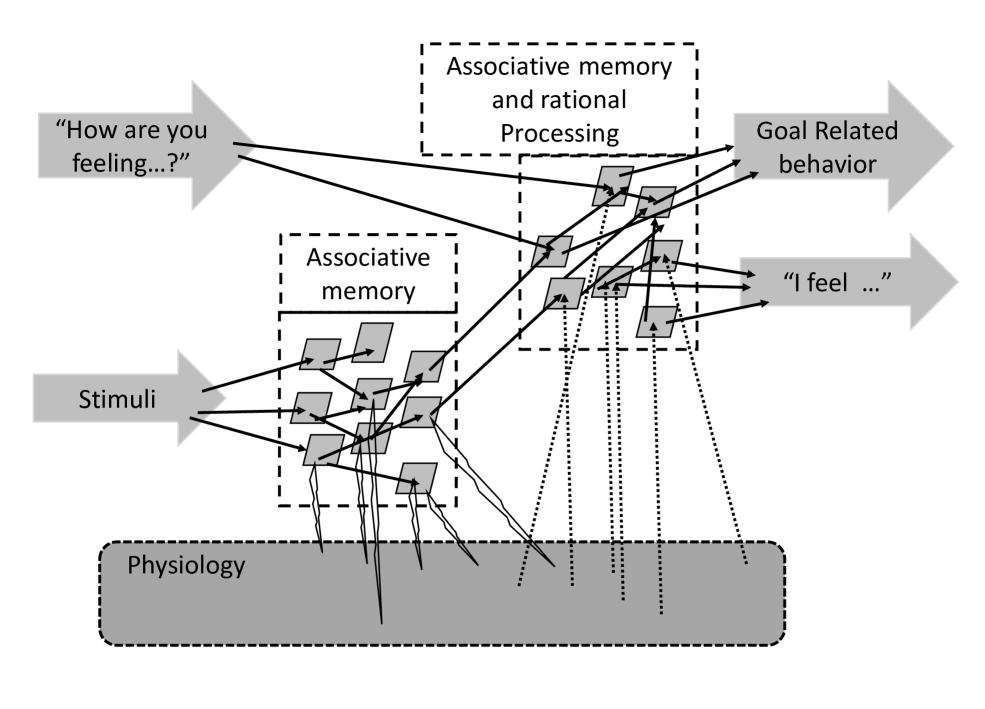
The image is a conceptual diagram illustrating a model of cognitive and affective processing. It depicts how external stimuli and internal physiological states are processed through memory systems to produce emotional responses and goal-directed behavior. The diagram uses labeled boxes, arrows, and dashed boundaries to represent components and information flow.
### Components/Axes
The diagram is organized into several key components, identified by text labels within or adjacent to graphical elements:
1. **Inputs (Left Side):**
* **"Stimuli"**: A large gray arrow pointing right, representing external sensory input.
* **"How are you feeling...?"**: A text label in quotation marks, representing a social or internal query prompting emotional introspection.
2. **Processing Modules (Central Area):**
* **"Associative memory"**: A dashed-line box containing a network of interconnected gray parallelogram nodes. This represents a system for storing and linking sensory and experiential data.
* **"Associative memory and rational Processing"**: A larger dashed-line box positioned above the first, also containing a network of interconnected nodes. This represents a higher-level system combining memory with cognitive reasoning.
* **"Physiology"**: A large, gray, rounded rectangle at the bottom of the diagram. It represents the body's internal state (e.g., heart rate, hormones).
3. **Outputs (Right Side):**
* **"Goal Related behavior"**: A large gray arrow pointing right, representing actions taken to achieve objectives.
* **"I feel ..."**: A text label in quotation marks, representing the conscious experience or verbal report of an emotional state.
4. **Connections (Arrows):**
* **Solid Black Arrows**: Indicate the primary flow of information or influence between components.
* **Dotted Black Lines**: Indicate connections originating from the "Physiology" module, suggesting modulatory or foundational influences on the memory networks.
### Detailed Analysis
**Spatial Layout and Flow:**
* The overall flow is from left (inputs) to right (outputs), with processing occurring in the center.
* The "Physiology" module is positioned as a base layer, with dotted lines projecting upward into both memory networks.
* The "Associative memory" network is positioned lower and to the left of the "Associative memory and rational Processing" network, suggesting a potential hierarchy or sequence.
**Component Relationships & Connections:**
1. **Stimuli Pathway:** The "Stimuli" arrow has multiple solid arrows pointing to various nodes within the "Associative memory" network.
2. **Query Pathway:** The "How are you feeling...?" label has solid arrows pointing to nodes within the "Associative memory and rational Processing" network.
3. **Internal Processing Flow:** Solid arrows connect nodes within the "Associative memory" network to nodes in the "Associative memory and rational Processing" network, indicating information transfer from lower-level to higher-level processing.
4. **Physiological Influence:** Multiple dotted lines originate from the "Physiology" box and connect to nodes in both the "Associative memory" and "Associative memory and rational Processing" networks. This indicates that the body's state influences both associative and rational processing.
5. **Output Generation:**
* Nodes from the "Associative memory and rational Processing" network have solid arrows pointing to the "Goal Related behavior" output.
* Nodes from the same higher-level network also have solid arrows pointing to the "I feel ..." output.
* This suggests that both conscious emotional feeling and goal-directed action are outputs of the combined associative and rational processing system.
### Key Observations
* **Dual Memory Systems:** The model explicitly separates a basic "Associative memory" from a more complex "Associative memory and rational Processing" system.
* **Physiology as a Foundation:** The "Physiology" component is not an input in the traditional sense but a foundational layer that modulates all cognitive processing via dotted connections.
* **Social/Internal Query as a Direct Input:** The question "How are you feeling...?" bypasses the basic "Stimuli" pathway and feeds directly into the rational processing network, acting as a trigger for introspection.
* **Unified Emotional Output:** The label "I feel ..." is generated solely from the higher-level "Associative memory and rational Processing" network, implying that conscious emotional experience requires rational processing, not just associative memory.
### Interpretation
This diagram presents a theoretical model of how emotion and behavior are generated. It argues against a simple stimulus-response mechanism, proposing instead a multi-stage process:
1. **Bottom-Up & Top-Down Processing:** Raw stimuli are first processed by associative memory (bottom-up). Concurrently, internal questions ("How are you feeling?") and physiological states provide top-down and modulatory inputs.
2. **Integration for Consciousness:** The critical integration happens in the "Associative memory and rational Processing" module. Here, associative links are combined with rational thought, influenced by physiology, to produce two key outputs: a conscious feeling ("I feel...") and a decision to act ("Goal Related behavior").
3. **The Role of Physiology:** The model emphasizes that our bodily state is not just an output of emotion but a constant, underlying influence on how we process information and feel. The dotted lines suggest this influence is pervasive and perhaps less direct than the solid-line information pathways.
4. **Implications:** This model suggests that to understand or influence emotional states (the "I feel..." output), one must consider not just external events (Stimuli) but also internal questioning, the state of the body (Physiology), and the interplay between associative memories and rational thought. It provides a framework for discussing conditions where this integration might be disrupted.