## Code Snippet: Python Function Definitions
### Overview
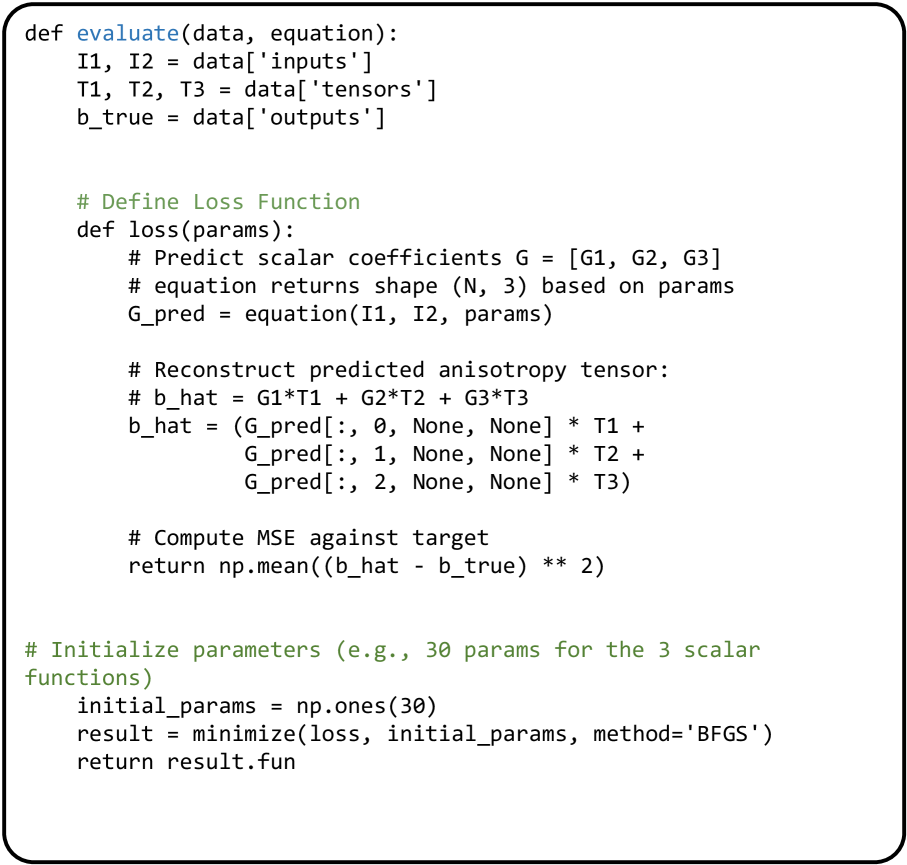
The image contains a Python code snippet defining two functions, `evaluate` and `loss`, along with initialization steps. The code appears to be related to machine learning or numerical optimization, possibly in the context of tensor analysis or anisotropy prediction.
### Components/Axes
* **Function `evaluate(data, equation)`:**
* Input arguments: `data`, `equation`
* Extracts `I1`, `I2` from `data['inputs']`
* Extracts `T1`, `T2`, `T3` from `data['tensors']`
* Extracts `b_true` from `data['outputs']`
* **Function `loss(params)`:**
* Input argument: `params`
* Predicts scalar coefficients `G = [G1, G2, G3]`
* `equation` returns shape `(N, 3)` based on `params`
* `G_pred = equation(I1, I2, params)`
* Reconstructs predicted anisotropy tensor `b_hat`
* Computes Mean Squared Error (MSE) against target `b_true`
* **Initialization:**
* `initial_params = np.ones(30)`: Initializes parameters as an array of 30 ones.
* `result = minimize(loss, initial_params, method='BFGS')`: Minimizes the `loss` function using the BFGS optimization method.
* `return result.fun`: Returns the optimized function value.
### Detailed Analysis or ### Content Details
**Function `evaluate(data, equation)`:**
* The function takes `data` and `equation` as input.
* It extracts input data (`I1`, `I2`), tensor data (`T1`, `T2`, `T3`), and target output (`b_true`) from the `data` dictionary.
**Function `loss(params)`:**
* The function takes `params` as input.
* It predicts scalar coefficients `G = [G1, G2, G3]`.
* It calls the `equation` function with inputs `I1`, `I2`, and `params` to get `G_pred`.
* It reconstructs the predicted anisotropy tensor `b_hat` using `G_pred` and the tensor data `T1`, `T2`, `T3`. The reconstruction involves element-wise multiplication and broadcasting using `None` to expand dimensions.
* It computes the MSE between the predicted tensor `b_hat` and the target tensor `b_true` using `np.mean((b_hat - b_true) ** 2)`.
**Initialization:**
* `initial_params = np.ones(30)`: Creates an array of 30 ones, which serves as the initial guess for the parameters to be optimized.
* `result = minimize(loss, initial_params, method='BFGS')`: Uses the `minimize` function (likely from `scipy.optimize`) to find the parameters that minimize the `loss` function. The BFGS (Broyden–Fletcher–Goldfarb–Shanno) algorithm is used for optimization.
* `return result.fun`: Returns the optimized value of the loss function.
### Key Observations
* The code defines a loss function that calculates the MSE between a predicted anisotropy tensor and a target tensor.
* The `evaluate` function prepares the data for the loss calculation.
* The code initializes parameters and uses an optimization algorithm (BFGS) to minimize the loss function.
* The use of `None` in the tensor reconstruction suggests broadcasting operations for element-wise multiplication.
### Interpretation
The code snippet implements a process for predicting anisotropy tensors and optimizing the prediction using a loss function and an optimization algorithm. The `evaluate` function prepares the input data, the `loss` function quantifies the error between the prediction and the target, and the initialization and optimization steps find the parameters that minimize this error. This is a common pattern in machine learning and numerical optimization, where the goal is to find the best parameters for a model by minimizing a loss function. The specific application appears to be related to tensor analysis, possibly in the context of material science or image processing.