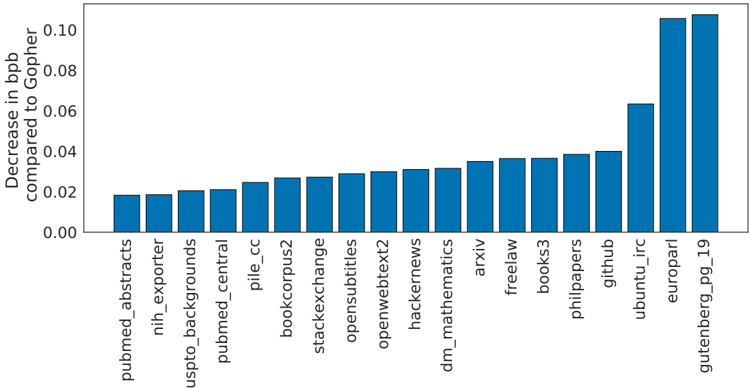
## Bar Chart: Decrease in Bits Per Byte (bpb) Compared to Gopher Across Various Datasets
### Overview
The image displays a vertical bar chart comparing 19 different datasets based on a metric labeled "Decrease in bpb compared to Gopher." The chart shows a generally increasing trend from left to right, with the final two datasets exhibiting a significantly larger decrease than the others.
### Components/Axes
* **Chart Type:** Vertical Bar Chart.
* **Y-Axis (Vertical):**
* **Label:** "Decrease in bpb compared to Gopher"
* **Scale:** Linear scale ranging from 0.00 to 0.10, with major tick marks at intervals of 0.02 (0.00, 0.02, 0.04, 0.06, 0.08, 0.10).
* **X-Axis (Horizontal):**
* **Label:** None explicit. The axis contains categorical labels for each dataset.
* **Categories (from left to right):** `pubmed_abstracts`, `nih_exporter`, `uspto_backgrounds`, `pubmed_central`, `pile_cc`, `bookcorpus2`, `stackexchange`, `opensubtitles`, `openwebtext2`, `hackernews`, `dn_mathematics`, `arxiv`, `freelaw`, `books3`, `philpapers`, `github`, `ubuntu_irc`, `europarl`, `gutenberg_pg_19`.
* **Legend:** Not present. All bars are the same solid blue color.
* **Spatial Layout:** The chart occupies the entire frame. The y-axis label is positioned vertically along the left edge. The x-axis category labels are rotated approximately 90 degrees clockwise for readability and are placed below the baseline of the bars.
### Detailed Analysis
The chart presents the "decrease in bpb" for each dataset. The values are approximate, derived from visual estimation against the y-axis scale.
**Trend Verification:** The visual trend is a gradual, step-wise increase from the first dataset (`pubmed_abstracts`) to the seventeenth (`ubuntu_irc`), followed by a sharp, substantial increase for the final two datasets (`europarl` and `gutenberg_pg_19`).
**Estimated Data Points (in order from left to right):**
1. `pubmed_abstracts`: ~0.019
2. `nih_exporter`: ~0.020
3. `uspto_backgrounds`: ~0.021
4. `pubmed_central`: ~0.022
5. `pile_cc`: ~0.025
6. `bookcorpus2`: ~0.027
7. `stackexchange`: ~0.028
8. `opensubtitles`: ~0.030
9. `openwebtext2`: ~0.031
10. `hackernews`: ~0.032
11. `dn_mathematics`: ~0.033
12. `arxiv`: ~0.036
13. `freelaw`: ~0.037
14. `books3`: ~0.038
15. `philpapers`: ~0.039
16. `github`: ~0.040
17. `ubuntu_irc`: ~0.064 (Notable jump)
18. `europarl`: ~0.106 (Significant increase, exceeds top axis tick)
19. `gutenberg_pg_19`: ~0.108 (Highest value, exceeds top axis tick)
### Key Observations
1. **Dominant Trend:** There is a clear, monotonic increase in the "decrease in bpb" metric across the ordered list of datasets.
2. **Significant Outliers:** The last two datasets, `europarl` and `gutenberg_pg_19`, are major outliers. Their values (~0.106 and ~0.108) are more than 2.5 times higher than the next highest dataset (`ubuntu_irc` at ~0.064) and over 5 times higher than the lowest dataset (`pubmed_abstracts` at ~0.019).
3. **Clustering:** The first 16 datasets form a relatively tight cluster with values between approximately 0.019 and 0.040. A distinct second tier is formed by `ubuntu_irc` (~0.064). The final two form a third, high-value tier.
4. **Data Source Context:** The dataset names suggest they are corpora used for training or evaluating language models, spanning scientific abstracts (`pubmed`), code (`github`), books (`bookcorpus2`, `gutenberg_pg_19`), conversations (`ubuntu_irc`), and multilingual text (`europarl`).
### Interpretation
This chart likely visualizes a comparative analysis of **information density or compressibility** across different text corpora, relative to a baseline model or dataset named "Gopher."
* **What "Decrease in bpb" Means:** "bpb" likely stands for "bits per byte," a common metric in data compression and language modeling (often related to cross-entropy loss). A *decrease* in bpb compared to Gopher suggests that the given dataset is **more predictable, more compressible, or has lower perplexity** when modeled by the same system that processed Gopher. A higher bar indicates a greater relative improvement over the Gopher baseline.
* **Relationship Between Elements:** The ordering of the datasets on the x-axis is not alphabetical but appears to be sorted by the value of the metric itself, from lowest to highest decrease. This ordering reveals the performance hierarchy.
* **Notable Implications:**
* The very high values for `europarl` (European Parliament proceedings) and `gutenberg_pg_19` (Project Gutenberg books) suggest these datasets are **highly structured, repetitive, or formulaic** compared to the others. Their language is likely more predictable, leading to a much larger decrease in bits per byte.
* The low values for datasets like `pubmed_abstracts` and `nih_exporter` indicate they are **less predictable or more information-dense** relative to Gopher, offering less compression gain.
* The chart effectively ranks these corpora by their "ease of modeling" relative to a specific benchmark, which is crucial for understanding model performance, data selection for training, and the inherent properties of different text sources.