## Flow Diagram: Generative LLM Process with Mistake Detection
### Overview
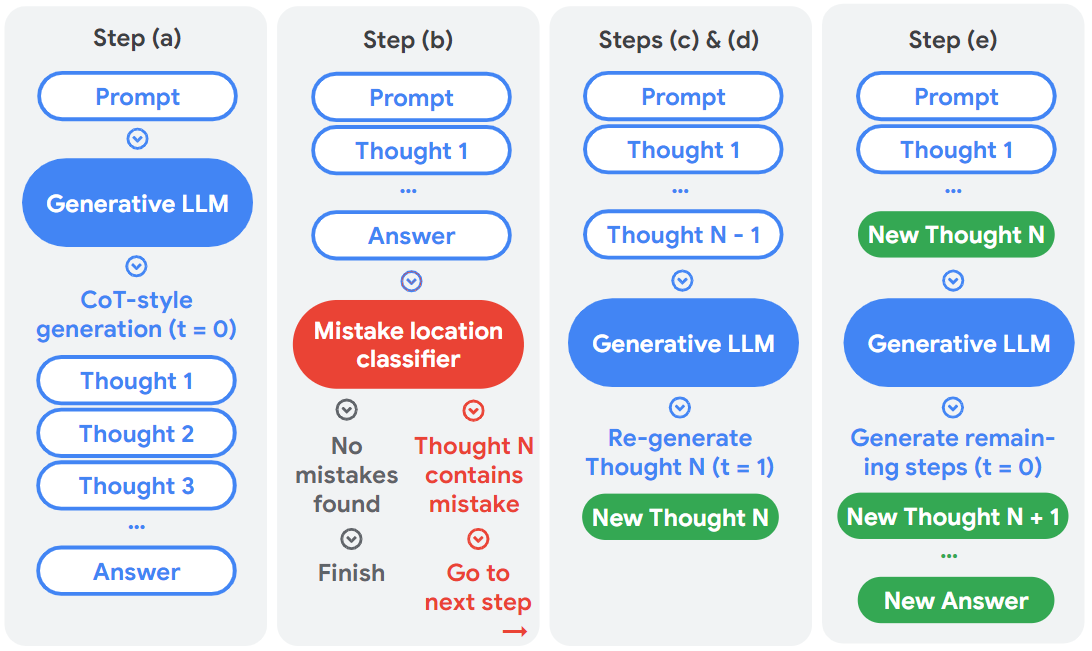
The image presents a flow diagram illustrating the steps involved in a Generative Large Language Model (LLM) process, incorporating a mechanism for mistake detection and correction. The process is divided into five steps, labeled (a) through (e), each depicting different stages of thought generation, mistake classification, and regeneration.
### Components/Axes
The diagram uses rounded rectangles to represent processes or states. Arrows indicate the flow of information. Colors are used to distinguish between different types of operations:
* **Blue:** Represents standard LLM operations (prompting, thought generation).
* **Red:** Represents the mistake location classifier and error states.
* **Green:** Represents new or corrected thoughts/answers.
The steps are labeled as follows:
* **Step (a):** Initial prompt and CoT-style (Chain-of-Thought) generation.
* **Step (b):** Mistake location classification.
* **Steps (c) & (d):** Regeneration of thought upon mistake detection.
* **Step (e):** Generation of remaining steps after correction.
Each step contains the following elements:
* **Prompt:** The initial input to the LLM.
* **Thought:** Intermediate steps in the reasoning process.
* **Answer:** The final output of the LLM.
* **Generative LLM:** The core language model.
* **Mistake location classifier:** A component that identifies errors in the generated thoughts.
### Detailed Analysis or ### Content Details
**Step (a):**
* Starts with a "Prompt" (blue).
* Flows into "Generative LLM" (blue).
* "CoT-style generation (t = 0)" is indicated below the LLM.
* Generates a series of "Thought 1", "Thought 2", "Thought 3", and so on (blue).
* Ends with an "Answer" (blue).
**Step (b):**
* Starts with a "Prompt" (blue).
* Generates "Thought 1", followed by "...", and then "Answer" (blue).
* Flows into "Mistake location classifier" (red).
* Two possible outcomes:
* "No mistakes found" (gray text) leading to "Finish" (gray text).
* "Thought N contains mistake" (gray text) leading to "Go to next step" (gray text) with an arrow pointing to the right.
**Steps (c) & (d):**
* Starts with a "Prompt" (blue).
* Generates "Thought 1", followed by "...", and then "Thought N - 1" (blue).
* Flows into "Generative LLM" (blue).
* "Re-generate Thought N (t = 1)" is indicated below the LLM.
* Generates "New Thought N" (green).
**Step (e):**
* Starts with a "Prompt" (blue).
* Generates "Thought 1", followed by "...", and then "New Thought N" (green).
* Flows into "Generative LLM" (blue).
* "Generate remaining steps (t = 0)" is indicated below the LLM.
* Generates "New Thought N + 1", followed by "...", and then "New Answer" (green).
### Key Observations
* The diagram illustrates an iterative process where the LLM generates thoughts, a classifier checks for mistakes, and the LLM regenerates thoughts if mistakes are found.
* The use of color highlights the different stages of the process, with red indicating error detection and green indicating corrected outputs.
* The time parameter 't' is used to indicate the number of regeneration attempts.
* Step (b) is the only step that has a decision point, based on whether a mistake is found.
### Interpretation
The diagram demonstrates a system for improving the accuracy of LLM outputs by incorporating a mistake detection and correction mechanism. The process leverages Chain-of-Thought prompting to generate intermediate reasoning steps, which are then evaluated for errors. If an error is detected, the LLM regenerates the erroneous thought, potentially leading to a more accurate final answer. This iterative process aims to enhance the reliability and trustworthiness of LLM-generated content. The diagram highlights the importance of error detection and correction in complex AI systems.