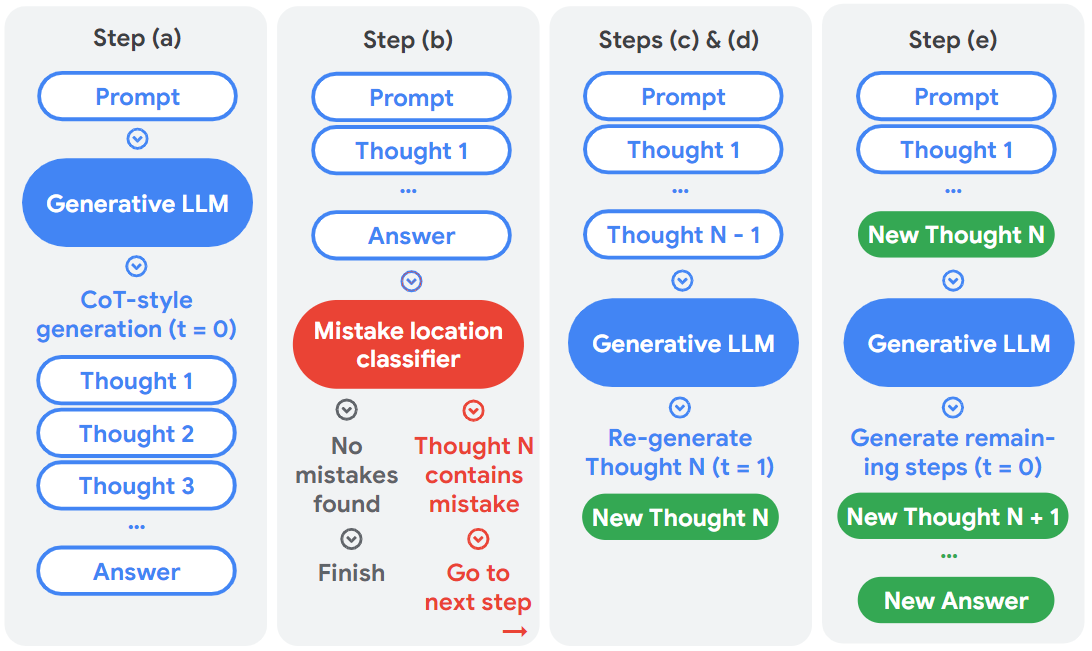
## Flowchart: Multi-Step Generative Language Model Workflow with Error Correction
### Overview
The image depicts a five-step flowchart illustrating a generative language model (LLM) workflow with iterative thought generation, error detection, and regeneration. The process involves prompt processing, thought generation, mistake classification, and iterative refinement until a final answer is produced.
### Components/Axes
1. **Step (a): Initial Generation**
- **Prompt** (white oval, top)
- **Generative LLM** (blue oval, labeled "CoT-style generation (t = 0)")
- **Thought 1-3** (white ovals, sequential)
- **Answer** (white oval, bottom)
2. **Step (b): Mistake Detection**
- **Prompt** (white oval, top)
- **Thought 1** (white oval)
- **Answer** (white oval)
- **Mistake Location Classifier** (red oval, labeled "No mistakes found" or "Thought N contains mistake")
- **Flow Arrows**:
- Green checkmark → "Finish"
- Red checkmark → "Go to next step"
3. **Steps (c) & (d): Regeneration**
- **Prompt** (white oval, top)
- **Thought 1** (white oval)
- **Thought N-1** (white oval)
- **Generative LLM** (blue oval, labeled "Re-generate Thought N (t = 1)")
- **New Thought N** (green oval)
- **New Answer** (green oval)
4. **Step (e): Final Generation**
- **Prompt** (white oval, top)
- **Thought 1** (white oval)
- **Generative LLM** (blue oval, labeled "Generate remaining steps (t = 0)")
- **New Thought N+1** (green oval)
- **New Answer** (green oval)
### Detailed Analysis
- **Color Coding**:
- **Blue**: Core Generative LLM components (steps a, c, d, e)
- **Red**: Error detection/classification (step b)
- **Green**: Regenerated thoughts/answers (steps c, d, e)
- **White**: Standard thought/answer components
- **Flow Logic**:
1. Initial prompt → Generative LLM produces CoT thoughts (t=0)
2. Mistake classifier evaluates thoughts:
- If errors found → Regenerate specific thought (t=1)
- If no errors → Proceed to final answer
3. Regenerated thoughts (green) replace original thoughts in subsequent steps
4. Final answer aggregates all validated thoughts
### Key Observations
1. **Iterative Refinement**: The process allows up to N thought generations with error correction.
2. **Temporal Parameter (t)**:
- t=0: Initial generation
- t=1: Regeneration after error detection
3. **Color-Coded Workflow**: Visual distinction between core generation (blue), error handling (red), and refinement (green).
4. **Dynamic Thought Count**: Thought N+1 suggests variable-length thought chains.
### Interpretation
This flowchart represents a robust LLM workflow designed for complex reasoning tasks requiring:
1. **Self-Correction**: The red classifier acts as a quality control mechanism.
2. **Efficiency**: Regeneration (green) only occurs when necessary, preserving computational resources.
3. **Adaptability**: The variable thought count (N) allows handling of varying problem complexities.
4. **Temporal Control**: The t parameter differentiates between initial and refined generations.
The system prioritizes accuracy over speed by allowing targeted regeneration of flawed thoughts while maintaining a linear flow for error-free outputs. The use of distinct colors creates an intuitive visual hierarchy for debugging and process tracking.