## Line Chart: Training Performance Comparison (% Negative Objects)
### Overview
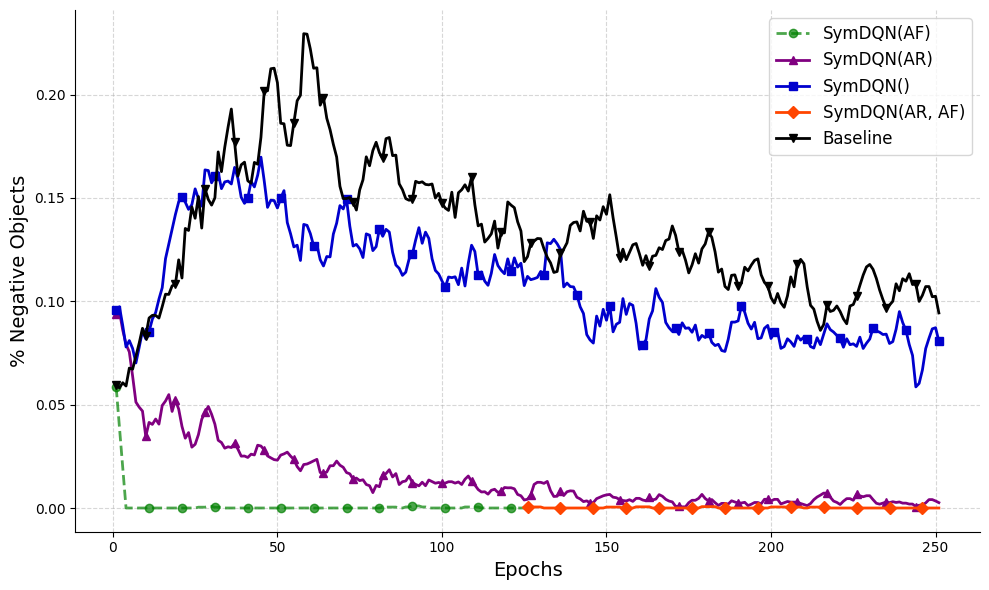
This chart illustrates the training performance of five different configurations of a "SymDQN" model compared to a "Baseline" model. The metric being tracked is the percentage of "Negative Objects" generated over 250 training epochs. The chart demonstrates how different architectural or algorithmic modifications (AF, AR) affect the model's tendency to produce negative objects during the learning process.
### Components/Axes
* **X-Axis:** Labeled "Epochs," ranging from 0 to 250, with major grid lines every 50 epochs.
* **Y-Axis:** Labeled "% Negative Objects," ranging from 0.00 to 0.20+, with major grid lines every 0.05.
* **Legend:** Located in the top-right corner.
* **SymDQN(AF):** Green dashed line with circle markers.
* **SymDQN(AR):** Purple solid line with triangle markers.
* **SymDQN():** Blue solid line with square markers.
* **SymDQN(AR, AF):** Orange solid line with diamond markers.
* **Baseline:** Black solid line with inverted triangle markers.
### Detailed Analysis
The following trends are observed for each data series:
* **Baseline (Black, Inverted Triangles):**
* **Trend:** Starts at ~0.06, rises sharply to a peak of ~0.23 at approximately epoch 60. Following this peak, it exhibits a gradual downward trend, ending at ~0.10 by epoch 250.
* **Performance:** This configuration consistently produces the highest percentage of negative objects throughout the training duration.
* **SymDQN() (Blue, Squares):**
* **Trend:** Starts at ~0.09, rises to a peak of ~0.17 at epoch 40. It then fluctuates with a downward trend, ending at ~0.08 by epoch 250.
* **Performance:** Performs better than the Baseline but still maintains a significant percentage of negative objects.
* **SymDQN(AR) (Purple, Triangles):**
* **Trend:** Starts at ~0.09, drops sharply to ~0.05 by epoch 10. It then exhibits a slow, steady decay, approaching 0.00 by the end of the training (epoch 250).
* **Performance:** Shows significant improvement over the Baseline and the standard SymDQN() configuration.
* **SymDQN(AF) (Green, Circles):**
* **Trend:** Starts at ~0.06, drops immediately to 0.00 by epoch 5, and remains at 0.00 for the duration of the training.
* **Performance:** Highly effective at eliminating negative objects almost immediately.
* **SymDQN(AR, AF) (Orange, Diamonds):**
* **Trend:** Remains at 0.00 throughout the entire training process.
* **Performance:** Identical to SymDQN(AF) in terms of eliminating negative objects, maintaining a 0.00 rate from the start.
### Key Observations
* **Dominance of AF:** The inclusion of "AF" (likely Action Filtering or a similar constraint) appears to be the primary factor in eliminating negative objects. Both configurations containing "AF" (`SymDQN(AF)` and `SymDQN(AR, AF)`) achieve near-zero negative objects.
* **Baseline Instability:** The Baseline model is highly unstable, peaking early (epoch 60) and failing to converge to a low error rate, suggesting it lacks the constraints necessary to avoid negative object generation.
* **AR Impact:** The "AR" configuration (`SymDQN(AR)`) provides a gradual improvement over the standard `SymDQN()` but is not as immediately effective as the "AF" configurations.
### Interpretation
The data suggests that the "SymDQN" architecture is significantly more robust than the "Baseline" when it comes to avoiding the generation of "Negative Objects."
The most critical finding is the efficacy of the "AF" component. Whether used alone or in combination with "AR," the "AF" component effectively forces the model to avoid negative objects almost instantly (within 5 epochs). The "AR" component alone (`SymDQN(AR)`) provides a learning-based reduction, where the model gradually learns to avoid negative objects over time, whereas "AF" appears to act as a hard constraint or a highly effective filter. The "Baseline" and standard "SymDQN()" models struggle significantly, indicating that without these specific modifications, the model is prone to generating undesirable outputs.