## Diagram: Synapse Model
### Overview
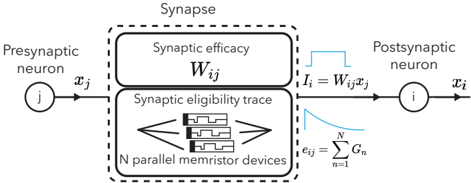
The image presents a diagram of a synapse model, illustrating the connection between a presynaptic neuron and a postsynaptic neuron. The synapse is represented as a central processing unit with two key components: synaptic efficacy and synaptic eligibility trace. The diagram includes mathematical notations to describe the signal transmission and processing within the synapse.
### Components/Axes
* **Presynaptic neuron:** Labeled "Presynaptic neuron" on the left side of the diagram. It is represented by a circle labeled "j".
* **Postsynaptic neuron:** Labeled "Postsynaptic neuron" on the right side of the diagram. It is represented by a circle labeled "i".
* **Synapse:** The central part of the diagram, enclosed in a dashed-line rectangle and labeled "Synapse" at the top.
* **Synaptic efficacy:** The upper part of the synapse, labeled "Synaptic efficacy". It contains the term "W<sub>ij</sub>".
* **Synaptic eligibility trace:** The lower part of the synapse, labeled "Synaptic eligibility trace". It contains a representation of "N parallel memristor devices".
* **Input signal:** Represented by an arrow labeled "x<sub>j</sub>" pointing from the presynaptic neuron to the synapse.
* **Output signal:** Represented by an arrow labeled "x<sub>i</sub>" pointing from the synapse to the postsynaptic neuron.
* **Synaptic current:** Represented by an arrow labeled "I<sub>i</sub> = W<sub>ij</sub>x<sub>j</sub>" pointing from the synapse to the postsynaptic neuron. A blue rectangular pulse is shown above this arrow.
* **Eligibility trace signal:** Represented by an arrow labeled "e<sub>ij</sub> = Σ<sub>n=1</sub><sup>N</sup> G<sub>n</sub>" pointing from the synapse to the postsynaptic neuron. A decaying blue curve is shown above this arrow.
### Detailed Analysis or Content Details
* **Presynaptic neuron:** The presynaptic neuron sends a signal "x<sub>j</sub>" to the synapse.
* **Synapse:** The synapse processes the incoming signal. It consists of two main components:
* **Synaptic efficacy (W<sub>ij</sub>):** Represents the strength of the connection between the two neurons.
* **Synaptic eligibility trace:** Implemented using "N parallel memristor devices". This component tracks the history of synaptic activity.
* **Postsynaptic neuron:** The postsynaptic neuron receives the processed signal from the synapse.
* **Synaptic current (I<sub>i</sub>):** The current generated in the postsynaptic neuron is calculated as the product of the synaptic efficacy (W<sub>ij</sub>) and the presynaptic signal (x<sub>j</sub>), i.e., I<sub>i</sub> = W<sub>ij</sub>x<sub>j</sub>.
* **Eligibility trace signal (e<sub>ij</sub>):** The eligibility trace signal is calculated as the sum of the contributions from N parallel memristor devices, represented as e<sub>ij</sub> = Σ<sub>n=1</sub><sup>N</sup> G<sub>n</sub>.
### Key Observations
* The diagram illustrates a simplified model of a synapse, highlighting the key components involved in signal transmission and processing.
* The synaptic efficacy (W<sub>ij</sub>) represents the strength of the connection, while the synaptic eligibility trace captures the history of synaptic activity.
* The synaptic current (I<sub>i</sub>) is directly proportional to the synaptic efficacy and the presynaptic signal.
* The eligibility trace signal (e<sub>ij</sub>) is a function of the activity of N parallel memristor devices.
### Interpretation
The diagram provides a functional representation of a synapse, emphasizing the role of synaptic efficacy and eligibility traces in neural communication. The use of memristor devices to implement the eligibility trace suggests a potential mechanism for learning and adaptation in neural networks. The equations presented describe how the signals are processed and transmitted between neurons. The diagram highlights the complex interplay of factors that determine the strength and plasticity of synaptic connections.