## Hybrid Reasoning Approaches: Symbolic vs. Neural
### Overview
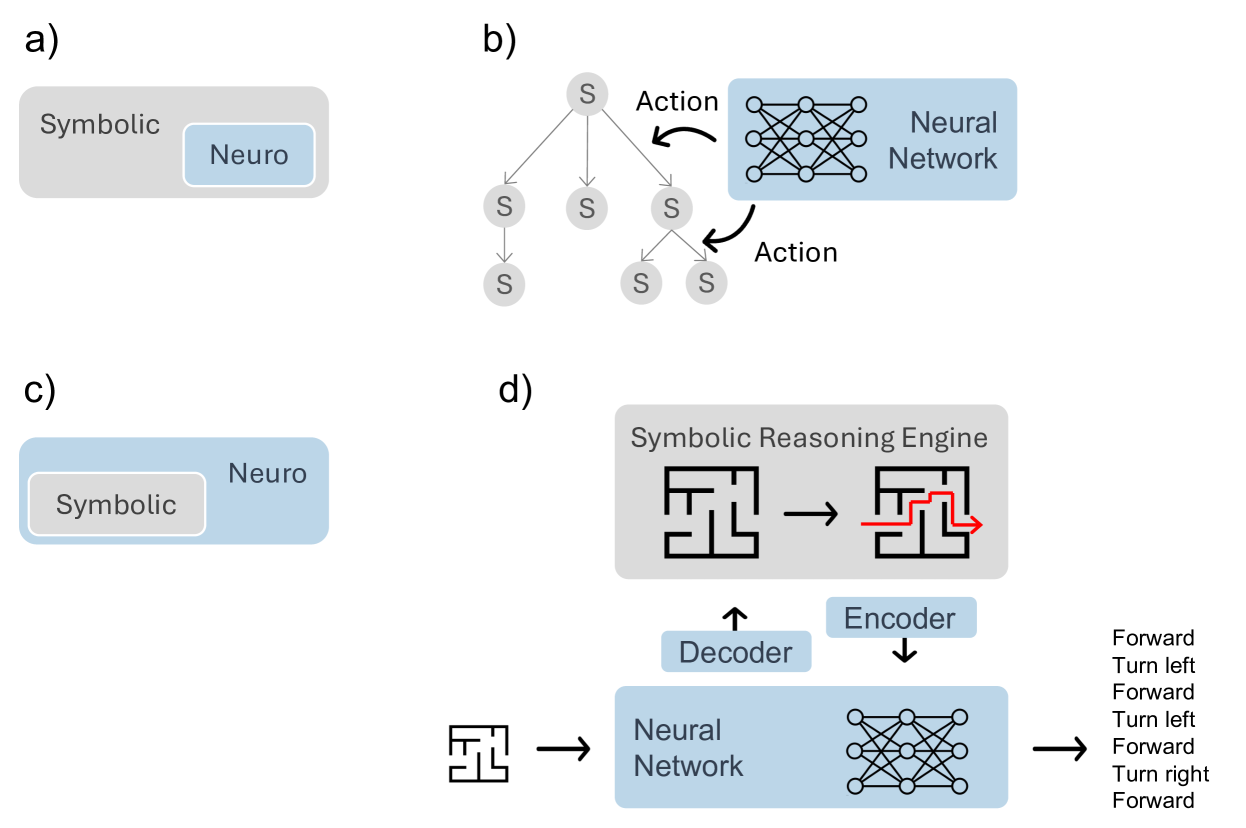
The image presents four diagrams (a, b, c, d) illustrating different approaches to reasoning, contrasting symbolic and neural methods, and showcasing a hybrid approach.
### Components/Axes
**Diagram a)**
* Two overlapping rounded rectangles. The left rectangle is labeled "Symbolic" and is filled with light gray. The right rectangle is labeled "Neuro" and is filled with light blue. The "Neuro" rectangle is visually on top of the "Symbolic" rectangle.
**Diagram b)**
* A tree-like structure with nodes labeled "S".
* The root node "S" branches into three "S" nodes.
* Two of these "S" nodes further branch into two "S" nodes each.
* Arrows labeled "Action" connect the rightmost "S" node at the top level to a "Neural Network" block, and from the "Neural Network" block back to the "S" node.
* A rounded rectangle labeled "Neural Network" filled with light blue. Inside the rectangle is a schematic representation of a neural network.
**Diagram c)**
* Two overlapping rounded rectangles. The left rectangle is labeled "Symbolic" and is filled with light gray. The right rectangle is labeled "Neuro" and is filled with light blue. The "Symbolic" rectangle is visually on top of the "Neuro" rectangle.
**Diagram d)**
* A rounded rectangle at the top labeled "Symbolic Reasoning Engine" filled with light gray. Inside the rectangle is a maze. An arrow points from the initial maze to a solved maze, where the solution path is highlighted in red.
* Below the "Symbolic Reasoning Engine" are two rounded rectangles labeled "Encoder" and "Decoder" filled with light blue. An arrow points downwards from "Encoder" and upwards from "Decoder".
* Below the "Encoder" and "Decoder" is a rounded rectangle labeled "Neural Network" filled with light blue. Inside the rectangle is a schematic representation of a neural network.
* An arrow points from a maze icon to the "Neural Network" block.
* An arrow points from the "Neural Network" block to a list of actions: "Forward", "Turn left", "Forward", "Turn left", "Forward", "Turn right", "Forward".
### Detailed Analysis or ### Content Details
**Diagram a)**
* Illustrates a scenario where the "Neuro" approach dominates the "Symbolic" approach.
**Diagram b)**
* Depicts a decision-making process using a tree search, where a "Neural Network" is used to determine the "Action" at each node.
**Diagram c)**
* Illustrates a scenario where the "Symbolic" approach dominates the "Neuro" approach.
**Diagram d)**
* Shows a hybrid approach where a "Neural Network" interacts with a "Symbolic Reasoning Engine" to solve a maze.
* The "Neural Network" encodes the maze and the "Symbolic Reasoning Engine" decodes the solution.
* The output of the "Neural Network" is a sequence of actions to solve the maze.
### Key Observations
* The diagrams highlight the contrast and potential integration of symbolic and neural reasoning approaches.
* Diagram b shows a neural network being used to guide a symbolic search.
* Diagram d shows a neural network and symbolic reasoning engine working together.
### Interpretation
The image illustrates different ways to combine symbolic and neural reasoning. Diagrams a and c show the dominance of one approach over the other. Diagram b shows a neural network guiding a symbolic search. Diagram d shows a hybrid system where a neural network encodes information for a symbolic reasoning engine, which then decodes the information to produce a solution. This suggests that combining these approaches can leverage the strengths of both, potentially leading to more robust and efficient AI systems. The maze example in diagram d demonstrates a practical application of this hybrid approach.