## Comparison Diagram: Computing Paradigms
### Overview
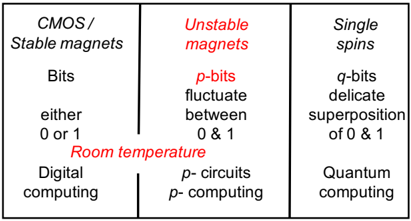
The image is a diagram comparing three computing paradigms: CMOS/Stable magnets, Unstable magnets, and Single spins. It contrasts their fundamental units (bits, p-bits, q-bits), behavior, and application areas.
### Components/Axes
The diagram is divided into three vertical sections, each representing a different computing paradigm.
* **Left Section:** CMOS/Stable magnets
* **Middle Section:** Unstable magnets
* **Right Section:** Single spins
Each section contains descriptive text about the paradigm.
### Detailed Analysis
**Left Section: CMOS/Stable magnets**
* **Title:** CMOS/Stable magnets
* **Fundamental Unit:** Bits
* **Behavior:** either 0 or 1
* **Operating Condition:** Room temperature
* **Application:** Digital computing
**Middle Section: Unstable magnets**
* **Title:** Unstable magnets (in red)
* **Fundamental Unit:** p-bits (in red)
* **Behavior:** fluctuate between 0 & 1
* **Operating Condition:** Room temperature (in red)
* **Application:** p- circuits, p- computing
**Right Section: Single spins**
* **Title:** Single spins
* **Fundamental Unit:** q-bits
* **Behavior:** delicate superposition of 0 & 1
* **Application:** Quantum computing
### Key Observations
* The diagram highlights the transition from deterministic bits (0 or 1) in CMOS to probabilistic p-bits (fluctuating between 0 and 1) and quantum q-bits (superposition of 0 and 1).
* The "Unstable magnets" section and the "Room temperature" text are colored red, possibly indicating a challenge or area of focus.
### Interpretation
The diagram illustrates the evolution of computing from classical digital computing (CMOS) to probabilistic computing (p-bits) and quantum computing (q-bits). It emphasizes the fundamental differences in the units of information and their behavior in each paradigm. The use of red color for "Unstable magnets" and "Room temperature" might suggest that these aspects are critical or present challenges in the development of p-bit based computing. The diagram suggests a progression towards more complex and potentially more powerful computing methods.