\n
## Comparative Table: Computing Paradigms Based on Physical Systems
### Overview
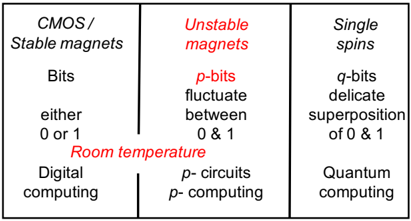
The image is a three-column comparative table that categorizes different physical systems used for computing. It contrasts classical digital computing (CMOS/stable magnets) with two emerging paradigms: probabilistic computing (unstable magnets) and quantum computing (single spins). The table highlights the fundamental unit of information, its behavior, operating conditions, and the resulting computing architecture for each system.
### Comparative Table
| Attribute | CMOS / Stable magnets | Unstable magnets | Single spins |
|-----------|-----------------------|------------------|--------------|
| **Information Unit** | Bits | p-bits | q-bits |
| **State Behavior** | either 0 or 1 | fluctuate between 0 & 1 | delicate superposition of 0 & 1 |
| **Operating Condition** | Not specified | Room temperature | Not specified |
| **Resulting Architecture** | Digital computing | p-circuits and p-computing | Quantum computing |
*Note: In the original image, text for "Unstable magnets," "p-bits," and "Room temperature" is emphasized in red; here, bold is used for emphasis in Markdown.*
### Detailed Analysis
The table presents a direct, row-by-row comparison of three computing substrates:
1. **Information Unit:**
* **Stable Magnets/CMOS:** Uses classical **Bits**.
* **Unstable Magnets:** Uses **p-bits** (probabilistic bits).
* **Single Spins:** Uses **q-bits** (quantum bits).
2. **State Behavior:**
* **Bits:** Have a definite state of **either 0 or 1**.
* **p-bits:** **Fluctuate between 0 & 1**, implying a probabilistic or random binary state.
* **q-bits:** Exist in a **delicate superposition of 0 & 1**, a quantum mechanical state where both values coexist.
3. **Operating Condition:**
* The table explicitly notes **Room temperature** for the "Unstable magnets" column. This implies that the other two systems (CMOS and Single spins) may have different, potentially more restrictive, operating conditions (e.g., cryogenic temperatures for many q-bit implementations), though this is not stated.
4. **Resulting Architecture:**
* **Stable Magnets:** Lead to **Digital computing**.
* **Unstable Magnets:** Lead to **p-circuits** and **p-computing**.
* **Single Spins:** Lead to **Quantum computing**.
### Key Observations
* **Visual Emphasis:** The text for "Unstable magnets," "p-bits," and "Room temperature" is colored red in the original, drawing immediate attention to this column and its key differentiating feature: room-temperature operation.
* **Progressive Complexity:** The table shows a progression from deterministic (Bits) to probabilistic (p-bits) to quantum mechanical (q-bits) information processing.
* **Linguistic Pattern:** The naming convention follows a pattern: "p-" for probabilistic and "q-" for quantum, derived from the core information unit (p-bit, q-bit).
* **Structural Symmetry:** Each column follows a similar logical flow: Physical System -> Information Unit -> State Description -> (Operating Condition) -> Computing Paradigm.
### Interpretation
This table serves as a conceptual map for understanding different approaches to computation beyond traditional CMOS technology. It positions **probabilistic computing (p-computing)** as a distinct, intermediate paradigm between classical digital and full quantum computing.
The key insight is that **unstable magnets can harness natural thermal fluctuations at room temperature to create probabilistic bits (p-bits)**. This contrasts with:
* **Classical bits**, which require stable, non-fluctuating states.
* **Q-bits**, which require extreme isolation and often cryogenic temperatures to maintain their delicate quantum superposition.
The table suggests that p-computing could offer a practical, room-temperature alternative for certain types of problems that benefit from randomness or probabilistic logic, potentially bridging the gap between the robustness of classical systems and the power (but fragility) of quantum systems. The red highlighting underscores room-temperature operation as a significant practical advantage for the unstable magnet/p-bit approach.