## Chart: Type I Error and Power vs. Pre-defined Alpha and Number of Maximum Tests
### Overview
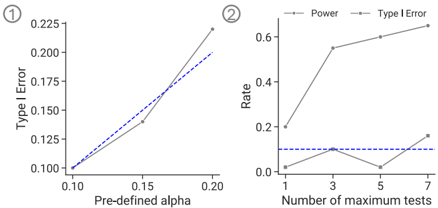
The image presents two line charts side-by-side. The left chart (labeled ①) shows the relationship between "Pre-defined alpha" and "Type I Error". The right chart (labeled ②) illustrates the relationship between "Number of maximum tests" and "Rate", displaying both "Power" and "Type I Error".
### Components/Axes
**Chart ①: Type I Error vs. Pre-defined Alpha**
* **X-axis:** "Pre-defined alpha" with values 0.10, 0.15, and 0.20.
* **Y-axis:** "Type I Error" with values ranging from 0.100 to 0.225.
* **Data Series:**
* Solid gray line: Represents the observed Type I Error.
* Dashed blue line: Represents the expected Type I Error.
**Chart ②: Power and Type I Error vs. Number of Maximum Tests**
* **X-axis:** "Number of maximum tests" with values 1, 3, 5, and 7.
* **Y-axis:** "Rate" with values ranging from 0.0 to 0.6.
* **Data Series:**
* Solid gray line: Represents "Power".
* Solid gray line: Represents "Type I Error".
* Dashed blue line: Represents the expected Type I Error.
* **Legend:** Located at the top-right of the chart.
* Solid gray line: "Power"
* Dashed gray line: "Type I Error"
### Detailed Analysis
**Chart ①: Type I Error vs. Pre-defined Alpha**
* **Solid Gray Line (Observed Type I Error):**
* At Pre-defined alpha = 0.10, Type I Error ≈ 0.10
* At Pre-defined alpha = 0.15, Type I Error ≈ 0.14
* At Pre-defined alpha = 0.20, Type I Error ≈ 0.22
* Trend: The observed Type I Error increases approximately linearly with the pre-defined alpha.
* **Dashed Blue Line (Expected Type I Error):**
* At Pre-defined alpha = 0.10, Type I Error ≈ 0.10
* At Pre-defined alpha = 0.20, Type I Error ≈ 0.20
* Trend: The expected Type I Error increases linearly with the pre-defined alpha.
**Chart ②: Power and Type I Error vs. Number of Maximum Tests**
* **Solid Gray Line (Power):**
* At Number of maximum tests = 1, Rate (Power) ≈ 0.20
* At Number of maximum tests = 3, Rate (Power) ≈ 0.55
* At Number of maximum tests = 5, Rate (Power) ≈ 0.60
* At Number of maximum tests = 7, Rate (Power) ≈ 0.65
* Trend: Power increases with the number of maximum tests, with diminishing returns as the number of tests increases.
* **Solid Gray Line (Type I Error):**
* At Number of maximum tests = 1, Rate (Type I Error) ≈ 0.01
* At Number of maximum tests = 3, Rate (Type I Error) ≈ 0.09
* At Number of maximum tests = 5, Rate (Type I Error) ≈ 0.01
* At Number of maximum tests = 7, Rate (Type I Error) ≈ 0.16
* Trend: Type I Error fluctuates with the number of maximum tests, showing no clear monotonic trend.
* **Dashed Blue Line (Expected Type I Error):**
* The dashed blue line is approximately constant at Rate ≈ 0.10.
### Key Observations
* In Chart ①, the observed Type I Error closely follows the expected Type I Error.
* In Chart ②, Power increases with the number of maximum tests.
* In Chart ②, Type I Error fluctuates around a relatively low value.
* In Chart ②, the dashed blue line represents the expected Type I Error, which is constant.
### Interpretation
The charts illustrate the relationship between pre-defined alpha and Type I Error, as well as the relationship between the number of maximum tests and both Power and Type I Error.
Chart ① demonstrates that the observed Type I Error aligns well with the pre-defined alpha level, suggesting that the experimental setup is behaving as expected in terms of controlling the false positive rate.
Chart ② shows that increasing the number of maximum tests increases the Power of the experiment, but also affects the Type I Error rate. The Type I Error fluctuates, suggesting that simply increasing the number of tests does not guarantee a consistent false positive rate. The constant dashed blue line likely represents a target or acceptable Type I Error rate. The Power increases rapidly from 1 to 3 tests, then plateaus, suggesting that there is a point of diminishing returns.