## Diagram: Conceptual Framework of Physical Experiments and Laws
### Overview
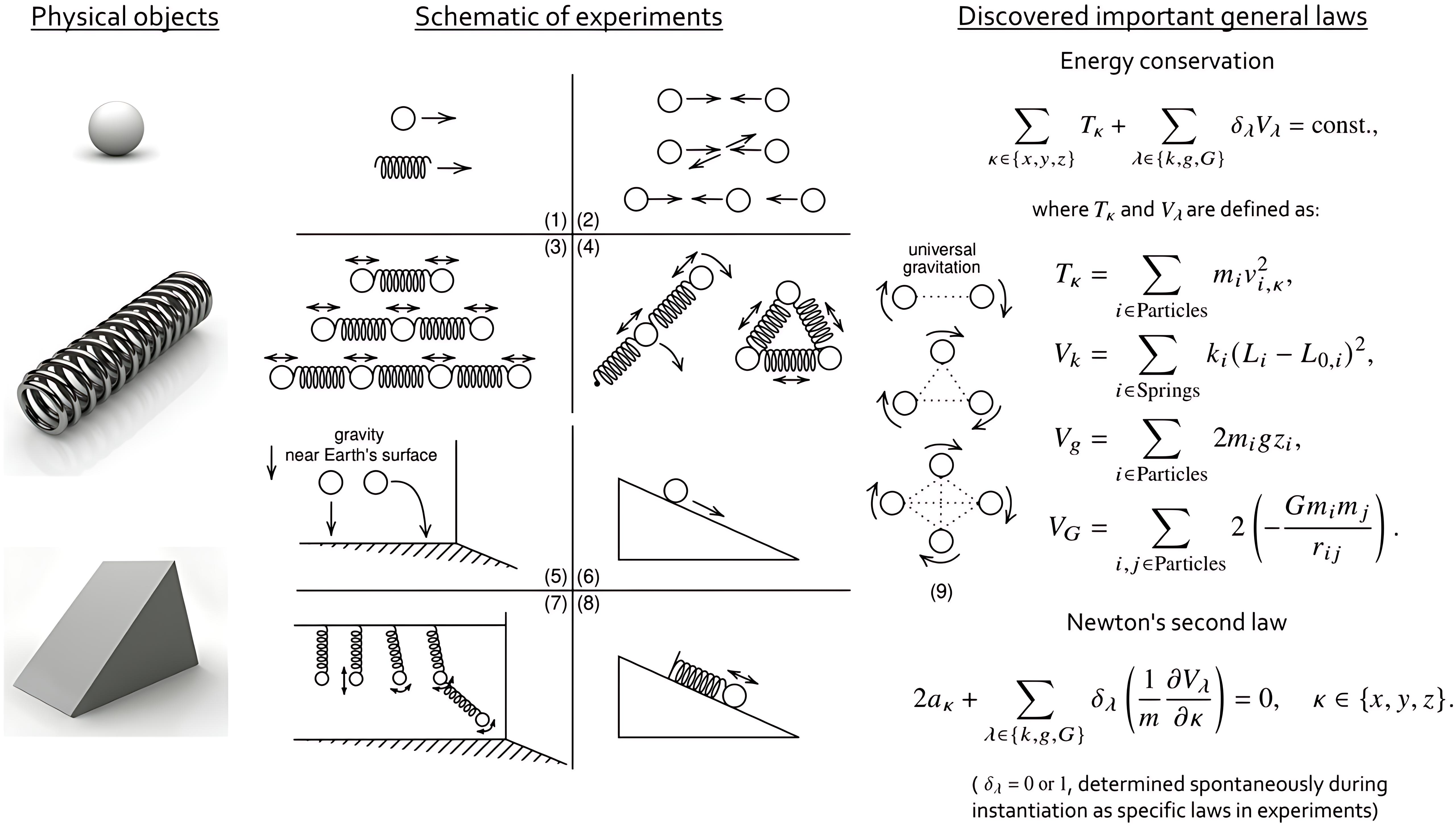
The image presents a conceptual framework mapping physical objects to experimental schematics and their corresponding mathematical laws. It is organized into three vertical columns: "Physical objects" (left), "Schematic of experiments" (center), and "Discovered important general laws" (right). The diagram illustrates how simple physical components (spheres, springs, wedges) are combined into experimental setups (numbered 1-8) and how these setups are governed by specific energy conservation and motion equations.
### Components/Axes
**Column 1: Physical objects**
* **Top:** A single white sphere.
* **Middle:** A metallic helical spring.
* **Bottom:** A grey triangular wedge (inclined plane).
**Column 2: Schematic of experiments**
* **Region 1 (Top):**
* (1) A sphere moving right; a spring moving right.
* (2) Two spheres moving towards each other, then interacting, then moving away.
* **Region 2 (Middle):**
* (3) Three sub-diagrams showing chains of spheres connected by springs (1 spring/2 spheres, 2 springs/3 spheres, 3 springs/4 spheres).
* (4) Two sub-diagrams: a spring-sphere system oscillating, and a triangular configuration of three spheres connected by springs.
* **Region 3 (Bottom):**
* (5) "gravity near Earth's surface": Two spheres, one falling vertically, one bouncing.
* (6) A sphere rolling down an inclined plane.
* (7) A pendulum-like system of spheres and springs hanging from a horizontal surface.
* (8) A spring-sphere system resting on an inclined plane.
**Column 3: Discovered important general laws**
* **Header:** "Energy conservation"
* **Equation:** $\sum_{\kappa \in \{x,y,z\}} T_\kappa + \sum_{\lambda \in \{k,g,G\}} \delta_\lambda V_\lambda = \text{const.}$
* **Definitions:**
* $T_\kappa = \sum_{i \in \text{Particles}} m_i v_{i,\kappa}^2$
* $V_k = \sum_{i \in \text{Springs}} k_i (L_i - L_{0,i})^2$
* $V_g = \sum_{i \in \text{Particles}} 2 m_i g z_i$
* $V_G = \sum_{i,j \in \text{Particles}} 2 \left( -\frac{G m_i m_j}{r_{ij}} \right)$
* **Diagram (9):** "universal gravitation" showing interaction pairs (2 spheres), triplets (3 spheres), and quadruplets (4 spheres) connected by dotted lines with circular arrows indicating gravitational influence.
* **Header:** "Newton's second law"
* **Equation:** $2a_\kappa + \sum_{\lambda \in \{k,g,G\}} \delta_\lambda \left( \frac{1}{m} \frac{\partial V_\lambda}{\partial \kappa} \right) = 0, \quad \kappa \in \{x, y, z\}.$
* **Footer:** "($\delta_\lambda = 0$ or $1$, determined spontaneously during instantiation as specific laws in experiments)"
### Detailed Analysis
* **Energy Conservation Formulation:** The equation defines the total energy as the sum of kinetic energy ($T_\kappa$) and potential energies ($V_\lambda$). The index $\kappa$ represents spatial dimensions $\{x, y, z\}$, and $\lambda$ represents force types $\{k, g, G\}$ (spring, gravity, universal gravitation).
* **Mathematical Notation:**
* The kinetic energy term $T_\kappa$ uses $m_i v_{i,\kappa}^2$.
* The spring potential $V_k$ uses the standard Hooke's law form $k(L-L_0)^2$.
* The gravitational potential $V_g$ (near surface) uses $2 m_i g z_i$.
* The universal gravitation potential $V_G$ uses $2 (- \frac{G m_i m_j}{r_{ij}})$.
* **Newton's Second Law:** The equation is presented in a force-balance form: $2a_\kappa + \sum \dots = 0$. This implies that the acceleration $a_\kappa$ is directly related to the gradient of the potential energy terms.
* **The $\delta_\lambda$ Variable:** This is a binary switch (0 or 1). It acts as a selector. If a specific force (e.g., gravity) is not present in an experiment, $\delta_g$ becomes 0, effectively removing that term from the equation for that specific instance.
### Key Observations
* **Spontaneous Instantiation:** The note at the bottom is critical. It suggests that the system does not use a "one-size-fits-all" equation but rather "instantiates" the relevant laws based on the experimental setup.
* **Consistency:** The diagram (9) visually maps to the summation terms in $V_G$. The 2-sphere, 3-sphere, and 4-sphere configurations in diagram (9) correspond to the $i,j$ summation indices in the $V_G$ equation.
* **Notation Anomalies:** The equations include coefficients (like the '2' in $V_g$ and $V_G$, and the '2' in $2a_\kappa$) that are not standard in classical textbook physics (which usually use $1/2$ for kinetic/potential energy). This suggests this is a specific, perhaps custom, mathematical model or a representation of a machine-learning-derived physics framework.
### Interpretation
This image appears to be a conceptual diagram from a research paper or technical presentation regarding **Symbolic Regression** or **Automated Physics Discovery**.
The core argument is that complex physical systems can be decomposed into a set of primitive objects (spheres, springs, wedges) and primitive forces (spring force, surface gravity, universal gravitation). The system "discovers" the governing laws by toggling the $\delta_\lambda$ parameters. When the system observes an experiment (like a ball on a wedge), it automatically determines which potential energy terms are active (e.g., $\delta_g=1$ for gravity, $\delta_k=0$ for springs) and constructs the appropriate Lagrangian or force-balance equation. The "spontaneous instantiation" note implies an algorithmic process where the model identifies the relevant physics "on the fly" based on the visual or structural input of the experiment.