## Physical Laws and Experiments
### Overview
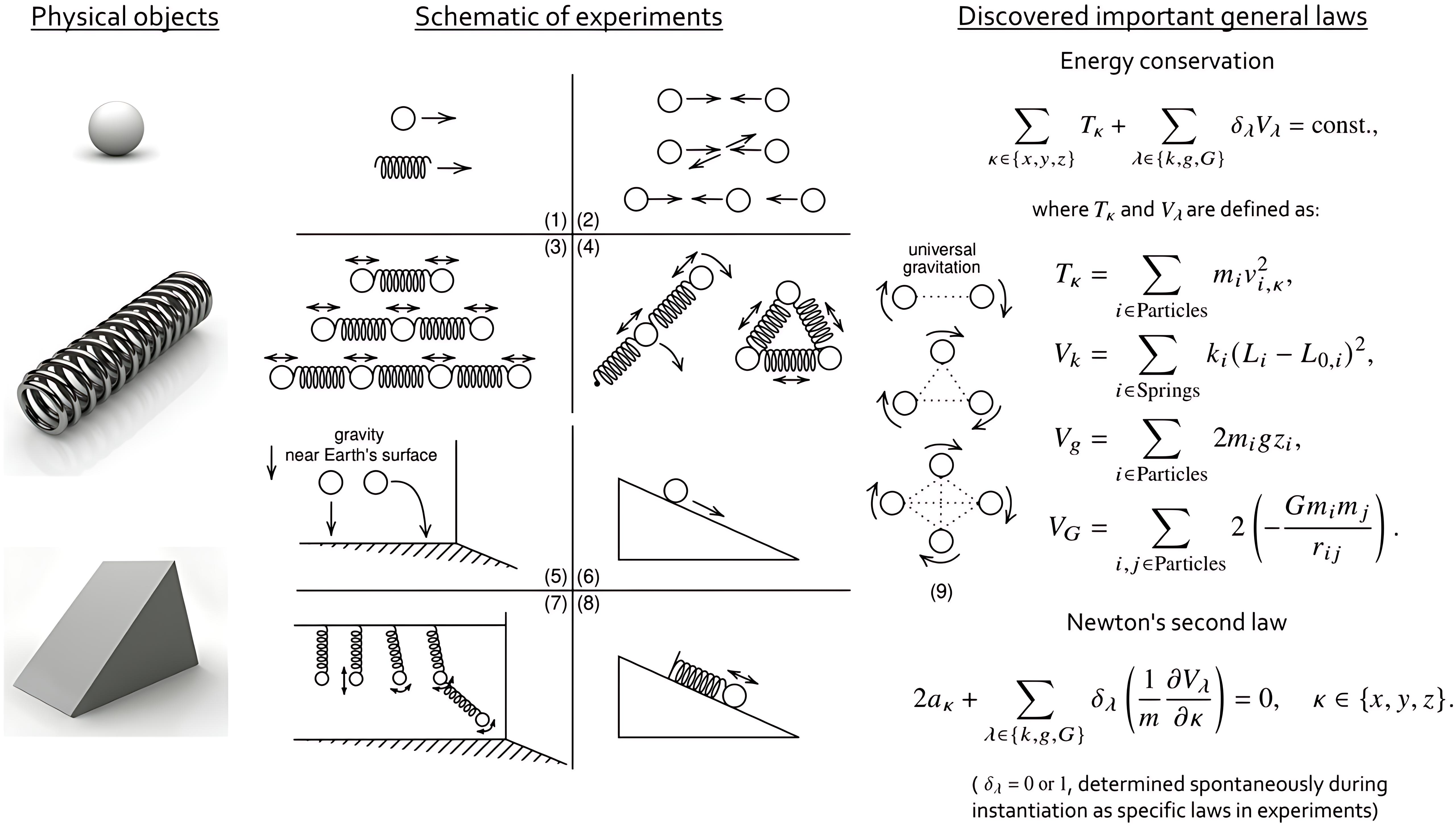
The image presents a visual and mathematical overview of physical laws, linking physical objects to schematic experiments and the corresponding mathematical formulations. It is divided into three main sections: "Physical objects," "Schematic of experiments," and "Discovered important general laws."
### Components/Axes
* **Title:** Physical objects, Schematic of experiments, Discovered important general laws
* **Physical Objects:** Shows a sphere, a spring, and a triangular prism.
* **Schematic of Experiments:** Contains 8 diagrams illustrating different physical setups. These are numbered (1) through (8), with (9) being separate.
* **Discovered Important General Laws:** Presents mathematical equations related to energy conservation, universal gravitation, and Newton's second law.
### Detailed Analysis or ### Content Details
**Physical Objects:**
* A white sphere.
* A metallic spring.
* A gray triangular prism.
**Schematic of Experiments:**
The "Schematic of experiments" section is divided into a 3x3 grid, with each cell containing a diagram.
* **(1):** A sphere moving towards a spring.
* **(2):** Three spheres moving towards each other, connected by springs.
* **(3):** Two rows of spheres connected by springs, with arrows indicating oscillation.
* **(4):** Three spheres connected in a triangle by springs, with arrows indicating oscillation and rotation.
* **(5):** A sphere falling under gravity near Earth's surface.
* **(6):** A sphere rolling down an inclined plane.
* **(7):** A series of spheres connected by springs, oscillating near a surface.
* **(8):** A sphere attached to a spring, rolling down an inclined plane.
* **(9):** Four spheres connected by dotted lines, with arrows indicating rotation, representing universal gravitation.
**Discovered Important General Laws:**
* **Energy Conservation:**
* Equation: ∑(T\_k) + ∑(δ\_λ V\_λ) = const., where k ∈ {x, y, z} and λ ∈ {k, g, G}
* "where T\_k and V\_λ are defined as:"
* **Kinetic Energy (T\_k):**
* Equation: T\_k = ∑(m\_i v\_{i,k}^2), where i ∈ Particles
* **Potential Energy (Springs) (V\_k):**
* Equation: V\_k = ∑(k\_i (L\_i - L\_{0,i})^2), where i ∈ Springs
* **Potential Energy (Gravity) (V\_g):**
* Equation: V\_g = ∑(2 m\_i g z\_i), where i ∈ Particles
* **Potential Energy (Universal Gravitation) (V\_G):**
* Equation: V\_G = ∑(2 (-G m\_i m\_j / r\_{ij})), where i, j ∈ Particles
* **Newton's Second Law:**
* Equation: 2a\_k + ∑(δ\_λ (1/m ∂V\_λ / ∂κ)) = 0, where λ ∈ {k, g, G} and κ ∈ {x, y, z}
* "(δ\_λ = 0 or 1, determined spontaneously during instantiation as specific laws in experiments)"
### Key Observations
* The image connects physical objects to simplified experimental setups and their corresponding mathematical descriptions.
* The schematic experiments illustrate basic physics concepts such as motion, oscillation, gravity, and inclined planes.
* The mathematical equations represent fundamental laws of physics, including energy conservation, universal gravitation, and Newton's second law.
### Interpretation
The image serves as a visual and mathematical summary of fundamental physics principles. It demonstrates how real-world objects and experimental setups can be modeled mathematically using established physical laws. The progression from physical objects to schematic experiments to mathematical equations highlights the process of abstraction and formalization in physics. The equations provide a quantitative framework for understanding and predicting the behavior of the systems depicted in the schematic experiments. The image is a concise representation of the relationship between physical phenomena, experimental observation, and mathematical theory.