TECHNICAL ASSET FINGERPRINT
6b5d91d0df187edfb9517d8b
Click to view fullscreen
Press ESC or click to close
FOUND IN PAPERS
EXPERT: healer-alpha-free VERSION 1
RUNTIME: free/openrouter/healer-alpha
INTEL_VERIFIED
## Diagram: Physics Experiment Schematics and Derived Laws
### Overview
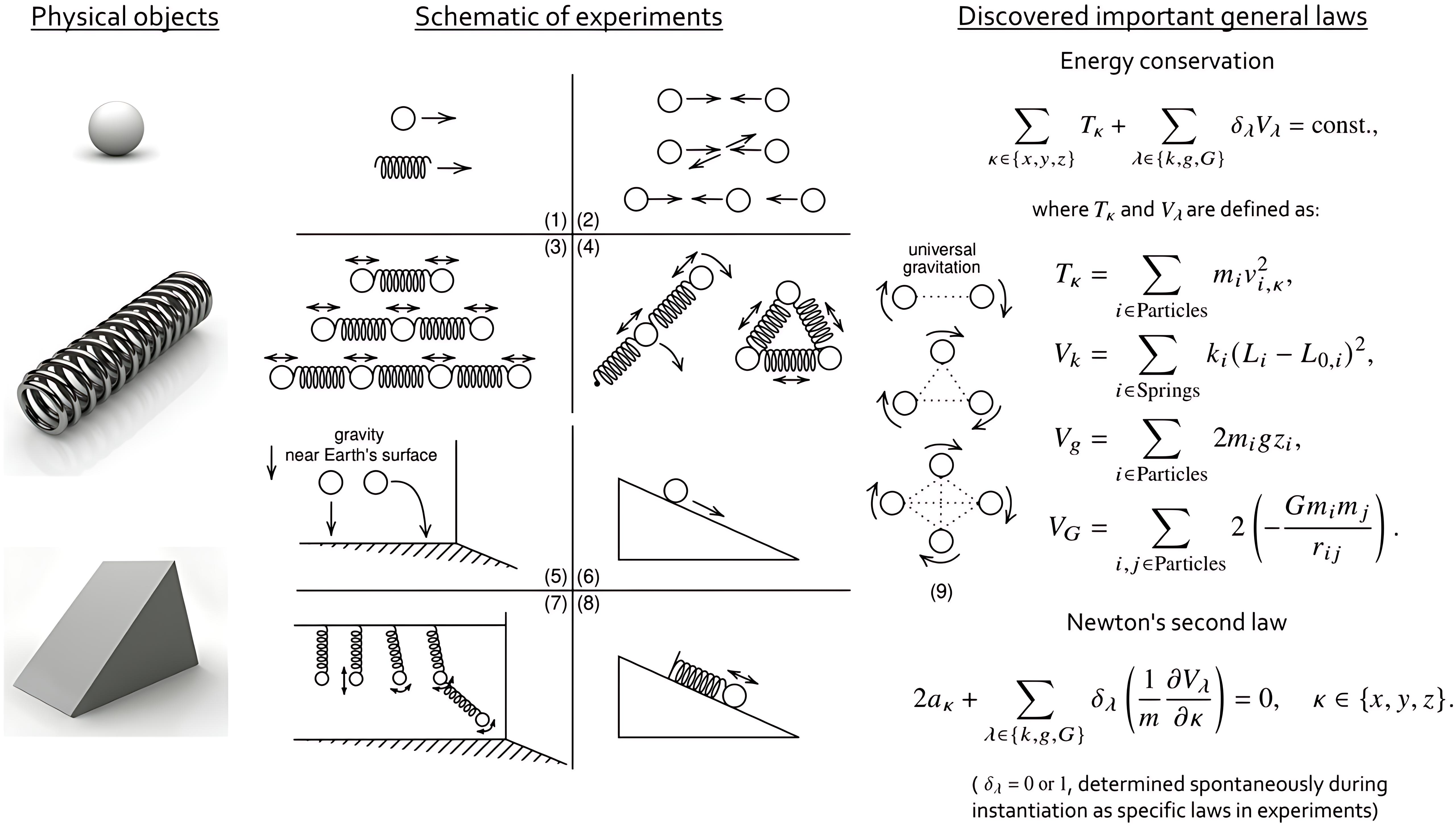
The image is a three-column educational or scientific diagram illustrating the relationship between physical objects, experimental setups, and the fundamental physical laws derived from them. The left column shows 3D renderings of basic physical objects. The middle column presents schematic line drawings of various experiments involving these objects, numbered (1) through (9). The right column lists the "Discovered important general laws" with their corresponding mathematical equations. The entire diagram is in English.
### Components/Axes
The diagram is organized into three distinct vertical sections:
1. **Left Column: "Physical objects"**
* Contains three rendered images:
* Top: A smooth, grey sphere.
* Middle: A metallic coil spring.
* Bottom: A grey wedge or inclined plane.
2. **Middle Column: "Schematic of experiments"**
* This section is a grid of nine schematic drawings, separated by horizontal and vertical lines and numbered (1) to (9).
* **(1)** A single circle (particle) moving right, with a spring below it also moving right.
* **(2)** Three rows of particle interactions: two particles moving toward each other; two particles with arrows indicating a back-and-forth collision; three particles in a line with alternating motion arrows.
* **(3)** Three horizontal setups of particles connected by springs, showing longitudinal oscillations (arrows indicate compression/extension).
* **(4)** Two setups of particles connected by springs in non-linear arrangements (a line and a triangle), with arrows indicating rotational or complex vibrational motion.
* **(5)** A diagram labeled "gravity near Earth's surface". It shows two particles falling vertically downward (straight arrows) and one following a parabolic trajectory (curved arrow) towards a hatched ground line.
* **(6)** A particle rolling down a triangular wedge (inclined plane).
* **(7)** Four pendulums of varying lengths and angles, suspended from a ceiling, with arrows indicating swing motion.
* **(8)** A particle attached to a spring, rolling down an inclined plane.
* **(9)** Located in the right column, but visually part of the experiment schematics. It shows three diagrams of particle systems (two, three, and four particles) with dotted lines connecting them and curved arrows around each particle, labeled "universal gravitation".
3. **Right Column: "Discovered important general laws"**
* **Energy conservation**
* Primary Equation: `∑_{κ ∈ {x,y,z}} T_κ + ∑_{λ ∈ {k,g,G}} δ_λ V_λ = const.,`
* Definition: "where T_κ and V_λ are defined as:"
* **T_κ** (Kinetic Energy): `T_κ = ∑_{i ∈ Particles} m_i v_{i,κ}^2,`
* **V_k** (Spring Potential Energy): `V_k = ∑_{i ∈ Springs} k_i (L_i - L_{0,i})^2,`
* **V_g** (Gravitational Potential Energy near Earth): `V_g = ∑_{i ∈ Particles} 2 m_i g z_i,`
* **V_G** (Universal Gravitational Potential Energy): `V_G = ∑_{i,j ∈ Particles} 2 ( - (G m_i m_j) / r_{ij} ).`
* **Newton's second law**
* Equation: `2 a_κ + ∑_{λ ∈ {k,g,G}} δ_λ ( (1/m) (∂V_λ)/(∂κ) ) = 0, κ ∈ {x, y, z}.`
* Footnote: `( δ_λ = 0 or 1, determined spontaneously during instantiation as specific laws in experiments)`
### Detailed Analysis
The diagram creates a direct mapping between concrete experiments and abstract physical laws.
* **Experiments (1)-(4)** involve particles and springs, leading to the definitions of kinetic energy (`T_κ`) and spring potential energy (`V_k`).
* **Experiments (5) & (6)** involve gravity near Earth's surface (falling, inclined plane), corresponding to the gravitational potential energy term `V_g`.
* **Experiments (7) & (8)** combine elements: pendulums (gravity + rotation) and a mass-spring on an incline (gravity + spring force).
* **Experiment (9)** explicitly illustrates "universal gravitation" between multiple particles, corresponding to the potential energy term `V_G`.
* The **Energy Conservation** law is presented as a universal sum, where the coefficients `δ_λ` (0 or 1) act as switches, activating the relevant potential energy terms (`V_k`, `V_g`, `V_G`) based on the specific experimental setup.
* **Newton's Second Law** is presented in a generalized form, where the acceleration `a_κ` is balanced by the gradient of the active potential energies, scaled by mass.
### Key Observations
1. **Hierarchical Structure:** The diagram flows from concrete (objects) to abstract (schematics) to universal (mathematical laws).
2. **Unification of Forces:** The equations unify spring force, near-Earth gravity, and universal gravitation under a single framework of potential energy (`V_λ`).
3. **The Role of δ_λ:** The footnote is critical. It states that `δ_λ` is not a fixed constant but is "determined spontaneously during instantiation." This means the specific laws (e.g., Hooke's Law, Newton's Law of Gravitation) emerge from the general equations based on the experimental context.
4. **Mathematical Notation:** The equations use summation notation over defined sets (Particles, Springs) and indices (i, j, κ, λ). The kinetic energy `T_κ` is defined per spatial dimension (x, y, z).
### Interpretation
This diagram is a pedagogical tool demonstrating the process of scientific induction in classical mechanics. It argues that by studying simple, idealized experiments with basic objects (spheres, springs, wedges), one can derive general, mathematically precise laws that govern a wide range of physical phenomena.
The core message is the **unifying power of energy conservation and Newtonian dynamics**. The same fundamental equations, with slight modifications (the `δ_λ` switches), can describe a particle colliding, a spring oscillating, an apple falling, or planets orbiting. The "discovery" is not of separate rules for each scenario, but of a single, adaptable framework.
The inclusion of the `δ_λ` parameter is particularly insightful. It moves beyond simply listing laws (Hooke's, Newton's, etc.) and instead presents them as specific cases of a more general principle. This reflects a deeper, more theoretical understanding of physics, where the presence or absence of a type of force (elastic, gravitational) is a condition applied to a universal equation. The diagram effectively visualizes how empirical observation (the experiments) leads to theoretical abstraction (the laws).
DECODING INTELLIGENCE...