## Diagram: Physical Systems and Derived Physical Laws
### Overview
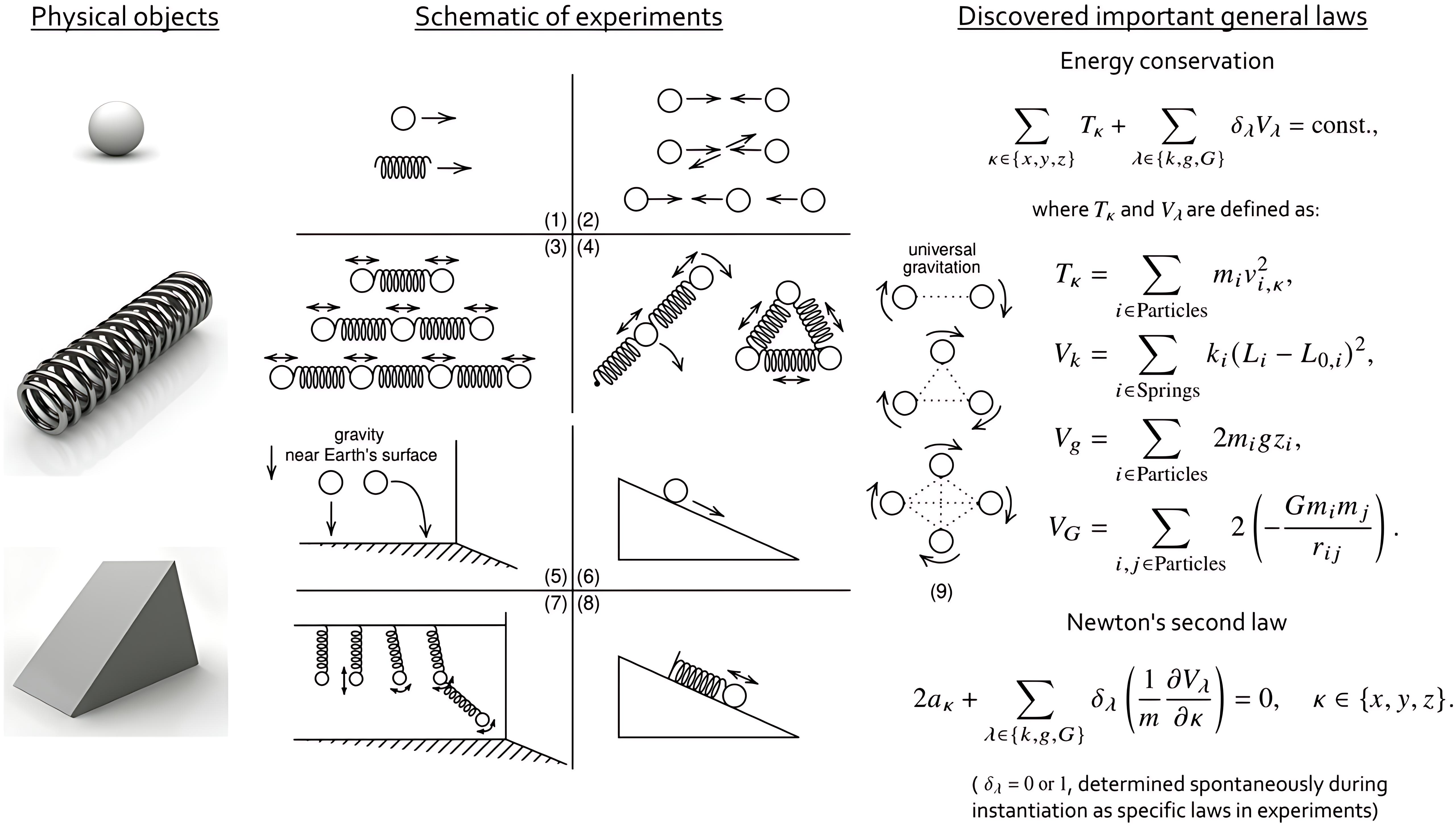
The image presents a technical diagram illustrating physical systems, experimental schematics, and derived physical laws. It is divided into three vertical sections:
1. **Physical objects** (left)
2. **Schematic of experiments** (center)
3. **Discovered important general laws** (right)
The diagram combines visual representations of physical systems with mathematical formulations of physical laws.
---
### Components/Axes
#### Physical Objects (Left Section)
1. **Sphere**: A simple 3D sphere labeled as a physical object.
2. **Spring**: A helical spring depicted in a compressed/extended state.
3. **Wedge**: A triangular prism representing an inclined plane.
#### Schematic of Experiments (Center Section)
Nine labeled diagrams (1–9) illustrate experimental setups:
- **(1)**: Sphere with a rightward arrow (linear motion).
- **(2)**: Spring with bidirectional arrows (compression/expansion).
- **(3)**: Stacked springs and particles with bidirectional arrows (interaction).
- **(4)**: Spring-chain system with bidirectional arrows (coupled motion).
- **(5)**: Sphere near Earth's surface with a downward arrow (gravity).
- **(6)**: Sphere on an inclined plane with a rightward arrow (gravity-induced motion).
- **(7)**: Sphere on an inclined plane with a spring (gravity + spring interaction).
- **(8)**: Sphere on an inclined plane with two springs (coupled forces).
- **(9)**: Four-particle system with bidirectional arrows (universal gravitation).
#### Discovered Laws (Right Section)
- **Energy Conservation**:
Equation:
$$
\sum_{\kappa \in \{x,y,z\}} T_\kappa + \sum_{\lambda \in \{k,g,G\}} \delta_\lambda V_\lambda = \text{const.}
$$
Definitions:
- $ T_\kappa = \sum_{i \in \text{Particles}} m_i v_{i,\kappa}^2 $ (kinetic energy)
- $ V_k = \sum_{i \in \text{Springs}} k_i (L_i - L_{0,i})^2 $ (spring potential energy)
- $ V_g = \sum_{i \in \text{Particles}} 2m_i g z_i $ (gravitational potential energy)
- $ V_G = \sum_{i,j \in \text{Particles}} 2\left(-\frac{G m_i m_j}{r_{ij}}\right) $ (universal gravitation potential energy)
- **Newton's Second Law**:
Equation:
$$
2a_\kappa + \sum_{\lambda \in \{k,g,G\}} \delta_\lambda \left(\frac{1}{m} \frac{\partial V_\lambda}{\partial \kappa}\right) = 0, \quad \kappa \in \{x,y,z\}
$$
Note: $ \delta_\lambda = 0 $ or $ 1 $, determined during experimentation.
---
### Detailed Analysis
#### Physical Objects
- The sphere, spring, and wedge represent fundamental mechanical systems.
- The wedge is explicitly labeled as "near Earth's surface," emphasizing gravitational context.
#### Experimental Schematics
- **Diagrams (1–4)**: Focus on linear motion, spring dynamics, and coupled systems.
- **Diagrams (5–9)**: Introduce gravity, inclined planes, and universal gravitation.
- Arrows indicate force directions (e.g., gravity, spring forces, particle interactions).
#### Derived Laws
- **Energy Conservation**: Combines kinetic energy ($ T_\kappa $), spring potential ($ V_k $), gravitational potential ($ V_g $), and universal gravitation ($ V_G $).
- **Newton's Second Law**: Relates acceleration ($ a_\kappa $) to forces from springs, gravity, and universal gravitation.
---
### Key Observations
1. **System Complexity**: Experiments progress from simple systems (single objects) to complex interactions (multiple particles, springs, and gravitational forces).
2. **Mathematical Abstraction**: Equations generalize experimental observations into universal laws (e.g., energy conservation, Newtonian mechanics).
3. **Notation Consistency**: Variables like $ \kappa $ (spatial coordinates) and $ \lambda $ (force types) are rigorously defined.
4. **Experimental Context**: The note on $ \delta_\lambda $ highlights the role of experimental design in isolating specific forces.
---
### Interpretation
This diagram bridges empirical observations and theoretical physics:
- **Physical Systems**: The left section grounds the analysis in tangible objects (sphere, spring, wedge).
- **Experimental Dynamics**: The center section visualizes forces and interactions, serving as a conceptual bridge to abstract laws.
- **General Laws**: The right section formalizes these interactions into equations, demonstrating how specific experiments (e.g., inclined planes, springs) lead to universal principles like energy conservation and Newtonian mechanics.
The inclusion of $ \delta_\lambda $ in Newton's law emphasizes the importance of experimental control in isolating variables. The diagram underscores the iterative process of physics: from observation to hypothesis to mathematical formalism.