## Heatmap: Accuracy Matrix for Digit Recognition
### Overview
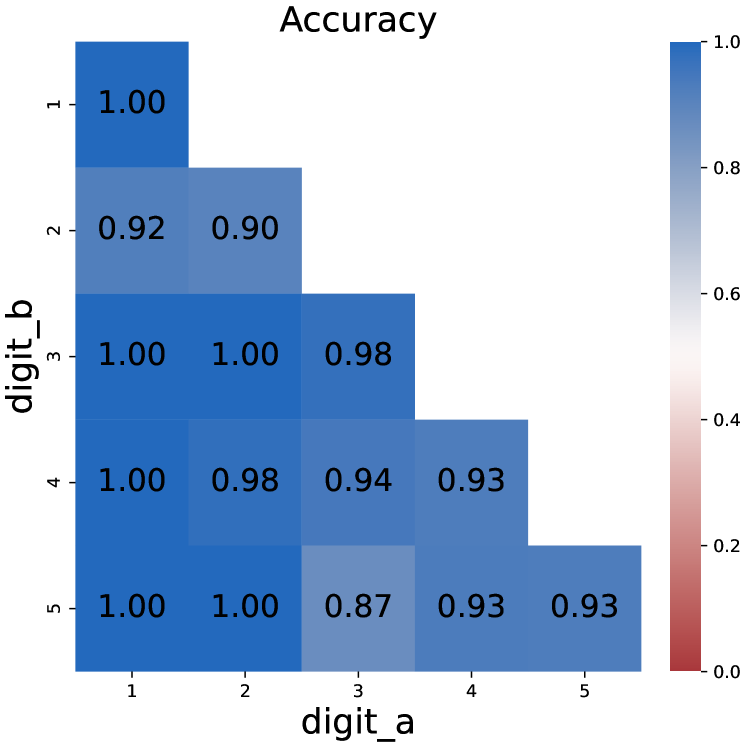
The image displays a 5x5 heatmap titled "Accuracy," visualizing the performance of a digit recognition system. Rows represent predicted digits (`digit_b`), and columns represent true digits (`digit_a`). Values range from 0.0 (red) to 1.0 (blue), indicating classification accuracy. The diagonal from top-left to bottom-right shows perfect accuracy (1.00) for matching digit pairs, while off-diagonal values reflect lower accuracy for mismatched pairs.
### Components/Axes
- **X-axis (digit_a)**: True digit labels (1–5), increasing left to right.
- **Y-axis (digit_b)**: Predicted digit labels (1–5), increasing top to bottom.
- **Legend**: Color gradient from blue (1.0, perfect accuracy) to red (0.0, no accuracy), positioned vertically on the right.
- **Title**: "Accuracy" (centered at the top).
### Detailed Analysis
- **Diagonal Values**: All diagonal cells (e.g., digit_a=1/digit_b=1, digit_a=2/digit_b=2) show 1.00 accuracy, confirming perfect self-classification.
- **Off-Diagonal Trends**:
- **Symmetry**: Values are symmetric across the diagonal (e.g., digit_a=2/digit_b=1 = 0.92; digit_a=1/digit_b=2 = 0.92).
- **Degradation**: Accuracy decreases as digit pairs diverge. For example:
- digit_a=3/digit_b=5 = 0.87 (lowest value).
- digit_a=4/digit_b=5 = 0.93.
- **Consistency**: Values like 0.93 (digit_a=4/digit_b=5 and digit_a=5/digit_b=4) suggest mutual confusion between certain digit pairs.
### Key Observations
1. **Perfect Self-Recognition**: All diagonal entries are 1.00, indicating no errors in identifying the same digit.
2. **Mutual Confusion**: Symmetric off-diagonal values (e.g., 0.92 for 1↔2, 0.93 for 4↔5) suggest bidirectional misclassification.
3. **Lowest Accuracy**: The pair digit_a=3 and digit_b=5 has the lowest accuracy (0.87), highlighting a potential weakness in distinguishing these digits.
4. **Gradual Decline**: Accuracy decreases smoothly from the diagonal outward, with no abrupt drops except for the 3↔5 pair.
### Interpretation
This heatmap represents a **confusion matrix** for a digit recognition model, likely trained on handwritten digits (e.g., MNIST dataset). Key insights:
- **Model Strength**: High diagonal accuracy confirms strong performance in self-classification.
- **Confusion Patterns**: Symmetry implies the model confuses digit pairs bidirectionally (e.g., mistaking 1 for 2 and vice versa).
- **Weaknesses**: The 3↔5 pair’s low accuracy (0.87) suggests specific challenges, possibly due to visual similarities (e.g., stroke patterns or loops).
- **Generalization**: Values above 0.87 indicate the model handles most digit pairs reasonably well, with only minor errors for dissimilar digits.
The data underscores the model’s robustness in digit recognition while highlighting areas for improvement, particularly for digits 3 and 5.