## Flowchart: Fact-Checking Strategies
### Overview
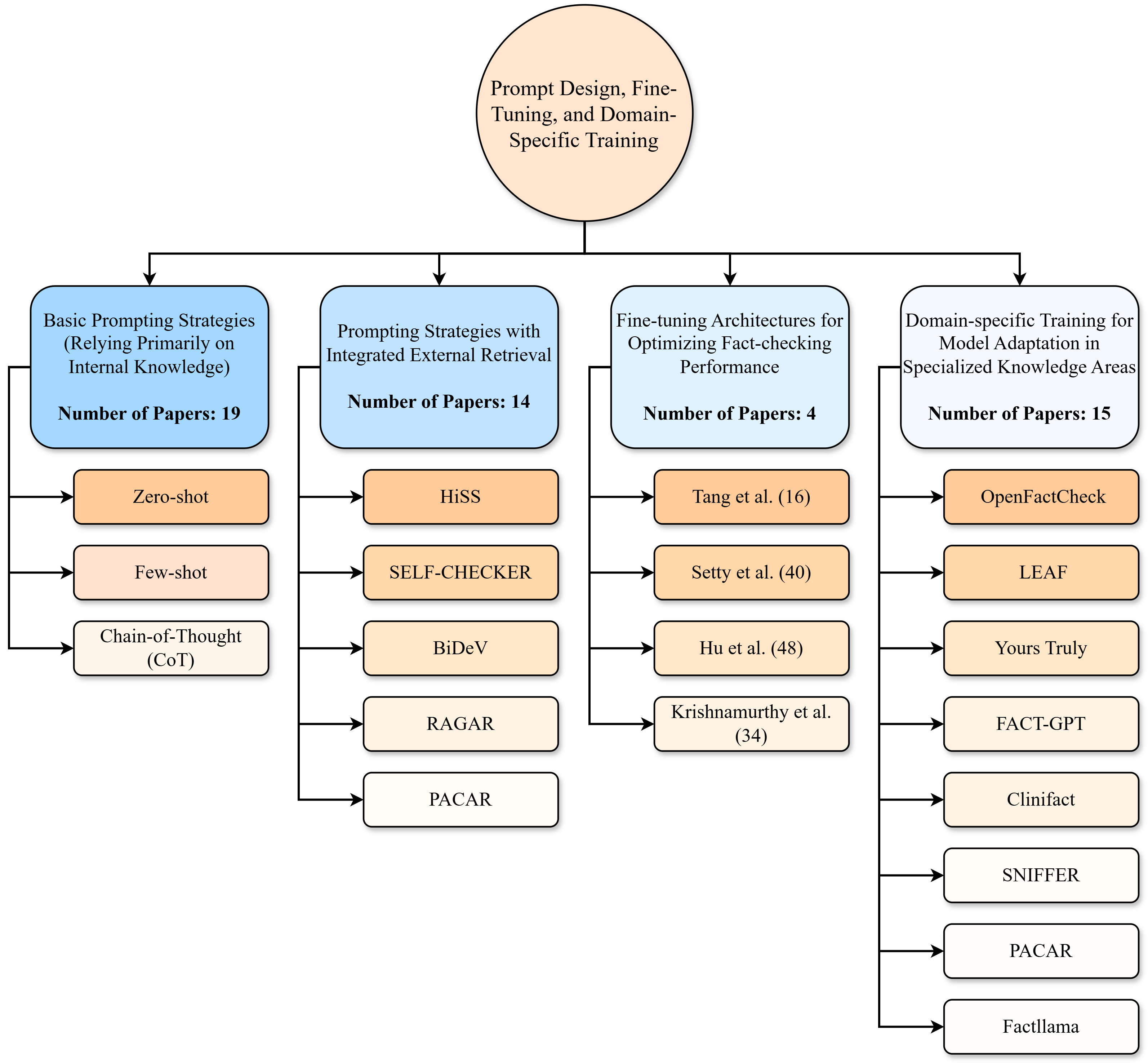
The image is a flowchart illustrating different strategies for fact-checking, categorized into four main approaches: basic prompting strategies, prompting strategies with integrated external retrieval, fine-tuning architectures, and domain-specific training. Each category lists specific techniques or models, along with the number of papers associated with each category.
### Components/Axes
* **Top Node:** "Prompt Design, Fine-Tuning, and Domain-Specific Training" (in a circle)
* **Level 1 Nodes (Blue Rounded Rectangles):**
* "Basic Prompting Strategies (Relying Primarily on Internal Knowledge)" - Number of Papers: 19
* "Prompting Strategies with Integrated External Retrieval" - Number of Papers: 14
* "Fine-tuning Architectures for Optimizing Fact-checking Performance" - Number of Papers: 4
* "Domain-specific Training for Model Adaptation in Specialized Knowledge Areas" - Number of Papers: 15
* **Level 2 Nodes (Orange/White Rounded Rectangles):** Specific techniques/models associated with each Level 1 category.
### Detailed Analysis or ### Content Details
**1. Prompt Design, Fine-Tuning, and Domain-Specific Training**
* This is the root node of the flowchart.
**2. Basic Prompting Strategies (Relying Primarily on Internal Knowledge)**
* Number of Papers: 19
* Sub-categories:
* Zero-shot (Orange)
* Few-shot (Orange)
* Chain-of-Thought (CoT) (White)
**3. Prompting Strategies with Integrated External Retrieval**
* Number of Papers: 14
* Sub-categories:
* HiSS (Orange)
* SELF-CHECKER (Orange)
* BiDeV (Orange)
* RAGAR (White)
* PACAR (White)
**4. Fine-tuning Architectures for Optimizing Fact-checking Performance**
* Number of Papers: 4
* Sub-categories:
* Tang et al. (16) (Orange)
* Setty et al. (40) (Orange)
* Hu et al. (48) (Orange)
* Krishnamurthy et al. (34) (White)
**5. Domain-specific Training for Model Adaptation in Specialized Knowledge Areas**
* Number of Papers: 15
* Sub-categories:
* OpenFactCheck (Orange)
* LEAF (Orange)
* Yours Truly (Orange)
* FACT-GPT (White)
* Clinifact (White)
* SNIFFER (White)
* PACAR (White)
* Factllama (White)
### Key Observations
* The "Basic Prompting Strategies" category has the highest number of associated papers (19).
* The "Fine-tuning Architectures" category has the lowest number of associated papers (4).
* Some techniques/models appear to be more prevalent (Orange), while others are less so (White).
* PACAR appears in two categories: "Prompting Strategies with Integrated External Retrieval" and "Domain-specific Training".
### Interpretation
The flowchart provides a structured overview of different approaches to fact-checking, highlighting the relative prevalence of each strategy based on the number of published papers. The categorization helps to understand the different dimensions of fact-checking research, from basic prompting techniques to more sophisticated methods involving external knowledge retrieval, fine-tuning, and domain-specific adaptation. The presence of "PACAR" in multiple categories suggests its versatility or applicability across different fact-checking paradigms. The number of papers associated with each category could reflect the maturity or popularity of each approach within the research community.