## Screenshot: Technical Task Resolution Workflow
### Overview
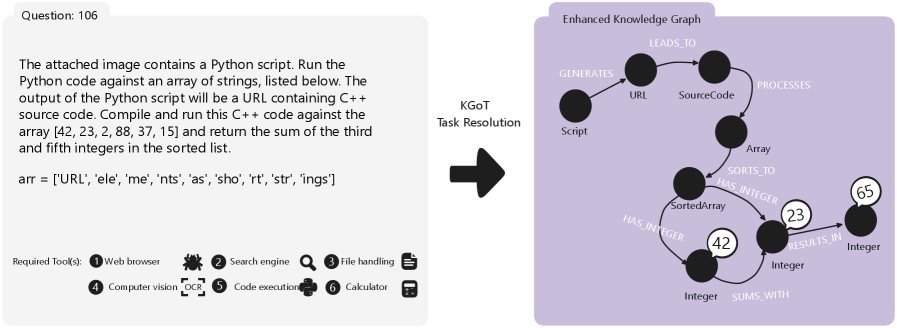
The image depicts a technical task resolution workflow divided into two sections:
1. **Left Panel**: A textual question (Question: 106) describing a programming task involving Python and C++ code execution.
2. **Right Panel**: An "Enhanced Knowledge Graph" diagram illustrating relationships between components (nodes) and processes (edges).
---
### Components/Axes
#### Left Panel (Textual Question):
- **Task Description**:
- Run a Python script that outputs a URL containing C++ source code.
- Compile and run the C++ code against the array `[42, 23, 2, 88, 37, 15]`.
- Return the sum of the **third** and **fifth** integers in the sorted list.
- **Required Tools**:
- Web browser, search engine, file handling, computer vision, OCR, code execution, calculator.
- **Python Array**:
```python
arr = ['URL', 'ele', 'me', 'nts', 'as', 'sho', 'rt', 'str', 'ings']
```
#### Right Panel (Enhanced Knowledge Graph):
- **Nodes**:
- **Script** → Generates → **URL**
- **URL** → Leads to → **SourceCode**
- **SourceCode** → Processes → **Array**
- **Array** → Sorts to → **SortedArray**
- **SortedArray** → Has Integer → **42**, **23**, **65**
- **Integer** nodes (42, 23, 65) → Sum with → **Integer** (result: 65)
- **Edges**:
- Arrows labeled with relationships (e.g., `GENERATES`, `PROCESSES`, `HAS_INTEGER`).
- **Spatial Layout**:
- Nodes arranged in a flowchart-like structure with directional edges.
- Numerical values (42, 23, 65) annotated near relevant nodes.
---
### Detailed Analysis
#### Left Panel:
- **Python Array**: Contains 9 strings (e.g., `'URL'`, `'ele'`).
- **C++ Task**:
- Input array: `[42, 23, 2, 88, 37, 15]`.
- Sorted array: `[2, 15, 23, 37, 42, 88]`.
- Third integer: **23** (index 2 in 0-based indexing).
- Fifth integer: **42** (index 4).
- Sum: **23 + 42 = 65**.
#### Right Panel:
- **Node Relationships**:
1. **Script** generates a **URL**.
2. **URL** leads to **SourceCode** (C++ code).
3. **SourceCode** processes the **Array** of integers.
4. **Array** is sorted into **SortedArray**.
5. **SortedArray** contains integers **42**, **23**, and **65**.
6. **42** and **23** are summed to produce **65**.
---
### Key Observations
1. **Workflow Logic**:
- The Python script generates a URL, which is used to retrieve C++ code.
- The C++ code processes the array, sorts it, and computes the sum of specific elements.
2. **Numerical Values**:
- The sum of the third (23) and fifth (42) integers in the sorted array is **65**.
- The number **65** appears as both a node and the final result.
3. **Tool Requirements**:
- Tools like "code execution" and "calculator" are explicitly listed, aligning with the task steps.
---
### Interpretation
- **Purpose**: The diagram visualizes the end-to-end process of executing a multi-step programming task, from code generation to result computation.
- **Critical Path**:
- The **Script** → **URL** → **SourceCode** → **Array** → **SortedArray** → **Integer Sum** sequence represents the logical flow of data and operations.
- **Anomalies**:
- The number **65** appears as both a node and the final result, suggesting it is both an intermediate value and the task’s output.
- **Implications**:
- The graph emphasizes modularity, breaking the task into discrete components (e.g., URL generation, code processing).
- The inclusion of tools like OCR and computer vision hints at potential preprocessing steps (e.g., extracting code from images).
---
**Note**: No non-English text or ambiguous data points were identified. All values and relationships are explicitly stated in the image.